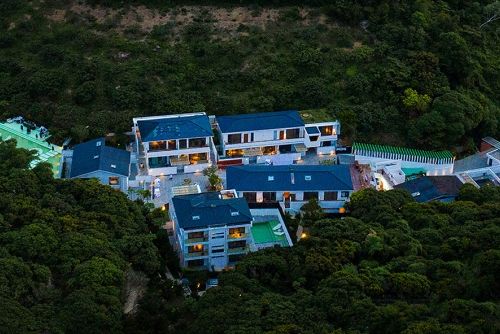
倚石苑和明叶轩,上海 / 致正建筑工作室
项目概况Project Overview
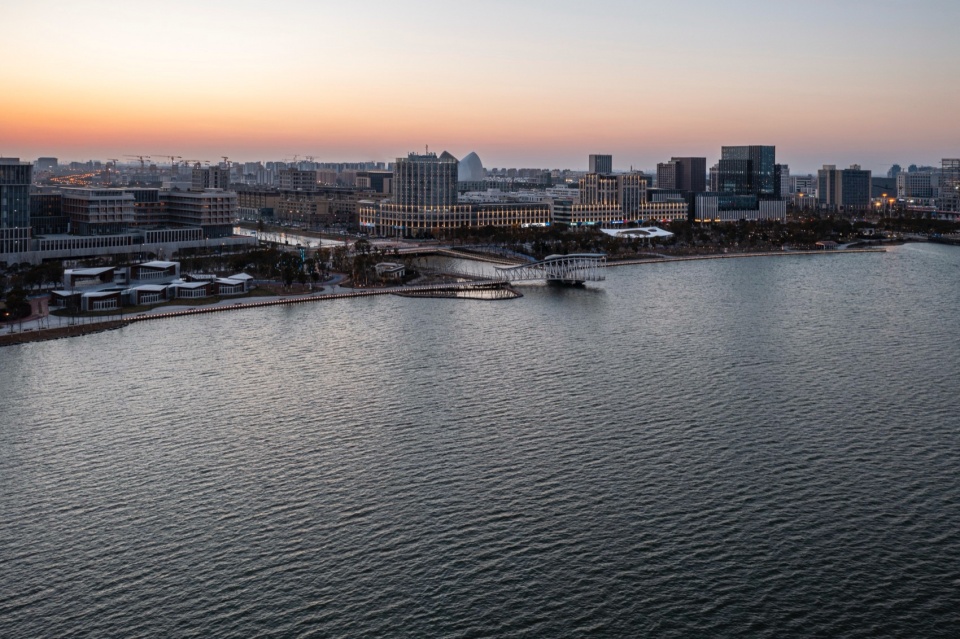
随着临港新片区滴水湖环湖景观带的贯通完工,其规划配套的综合服务用房的建设也进入实施议程。本项目的两栋综合服务建筑是3#和4#,分别位于滴水湖西侧环湖景观带跨黄日港的标志性的“黄篓桥”南北两侧的E2 区和 F 区。环湖景观带共有80米进深,配套建筑的分布都不影响骑行道与漫步道环通。这些配套建筑的主要功能为餐饮设施,以满足环湖日益增长的观光与休闲需求,在与周边环境相融合的同时成为环湖第一线的公共活动支点。同时,它们都需要各结建一处电力用户站,以满足周边景观带的用电需求。
With the completion of the landscape belt around Dishui Lake of Lin-Gang Special Area, the construction of the service buildings, which are part of its planned amenities, has also entered the implementation phase. The two service buildings in this project are Building 3 and Building 4, located in Zone E2 and Zone F, respectively, on the north and south sides of the iconic “Huang Lou Bridge” that spans the Huangrigang River on the west side of Dishui Lake. The landscape belt around the lake has a depth of 80m, and the distribution of these buildings does not interfere with the connectivity of the cycling and walking paths. The primary function of these buildings is to provide food & beverage facilities to meet the growing demand for sightseeing and leisure around the lake. While integrating with the surrounding environment, they will also serve as key public activity hubs along the lake’s perimeter. Additionally, each building will need to combine a subscriber station to meet the power demands of the surrounding scenic area.
▼临湖的两栋配套服务建筑鸟瞰,Aerial view of two lakeside auxiliary service buildings
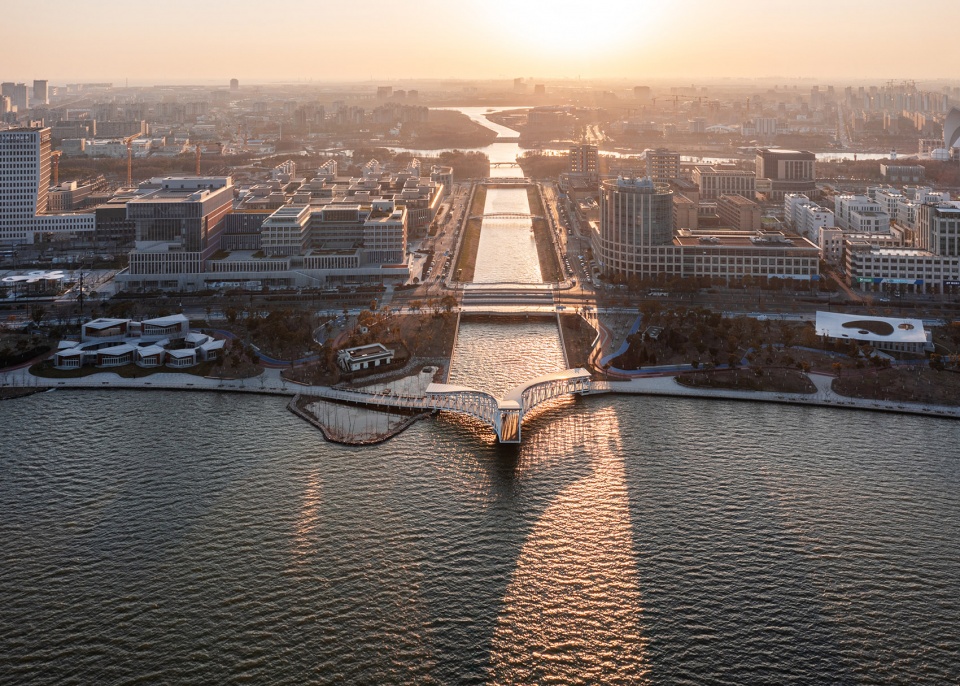
▼整体鸟瞰,Overall aerial view
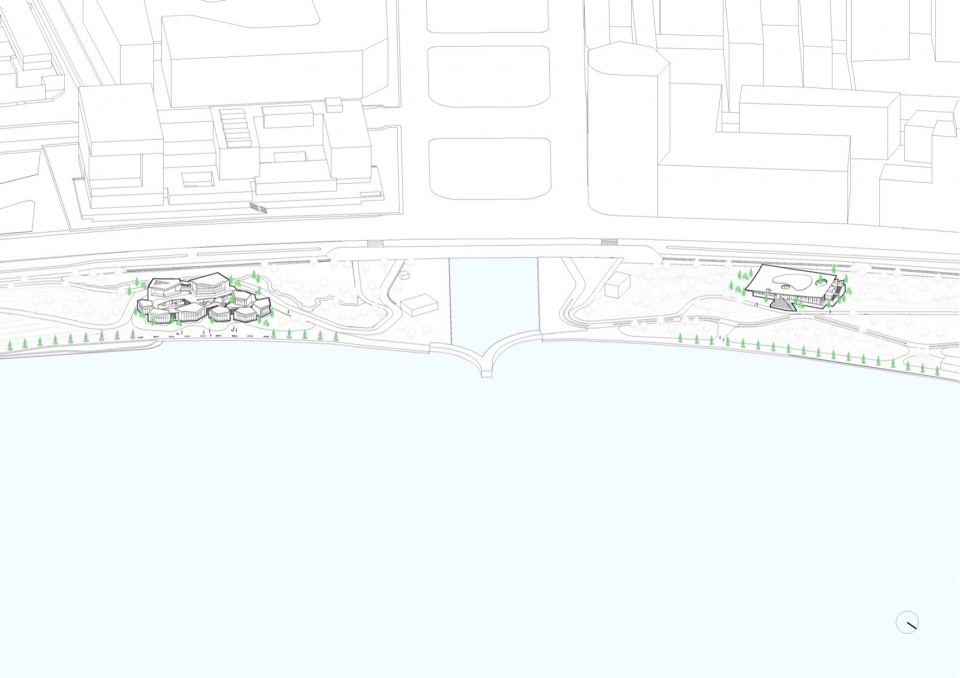
▼倚石苑&明叶轩整体轴测,Overall axonometric of Clustered Rocks Court and Mingyexuan
倚石苑 – 综合服务建筑3#Clustered Rocks Court – Service Building 3
倚石苑位于黄日港南岸一处骑行道和漫步道向外弯折形成的面湖湾形场地内,其西侧隔环湖一路背靠港城广场的朵云书院滴水湖店。建筑整体规模较大,且运营目标是包房式中餐业态,我们希望借此让它呈现为化整为零的体量布局。方案的设计概念取自唐代诗人白居易《莲石》中的诗句:“石倚风前树,莲栽月下池”,建筑形态化为一组“山石”,散落分布在水岸林中,故名“倚石苑”。设计传承中国园林的空间基因,以庭院为组织线索,通过曲廊串联几何山石形态的亭榭楼台,虚实掩映,高低起伏,巧妙地处理内外环境关系。
▼倚石苑形体生成,Massing generation of Clustered Rocks Court
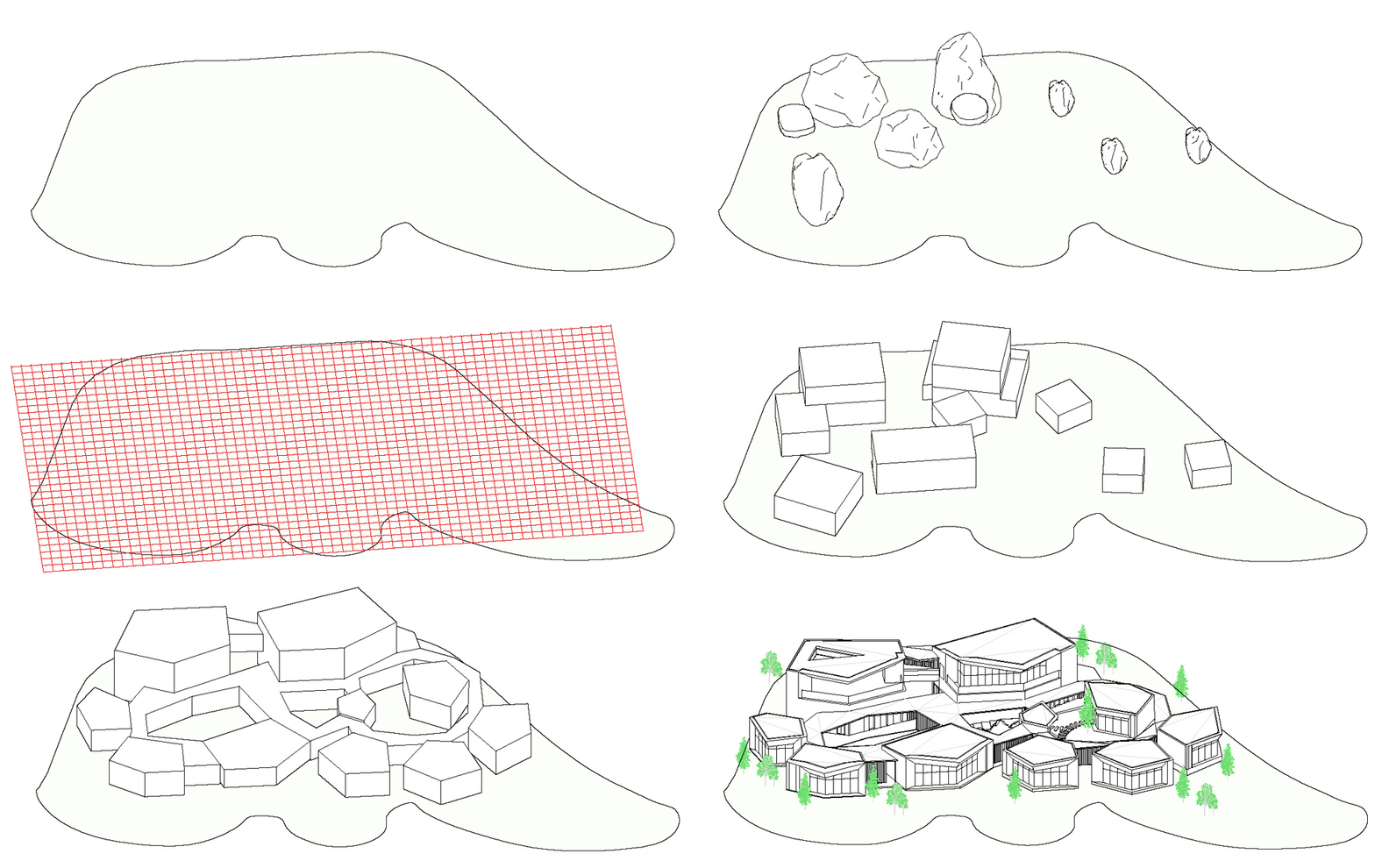
Clustered Rocks Court is situated in a lake-facing bay-shaped site formed by the outward bend of a cycling and walking paths on the southern bank of Huangrigang River. To its west, it is separated by the Ring Lake Road from the Duoyun Books Dishui Lake Store at Harbour City Plaza. The building’s operational goal is to offer private dining rooms for Chinese cuisine,so we aim to present it as a layout that breaks down into smaller units. The design concept is inspired by a line from the Tang Dynasty poet Bai Juyi’s poem “Lotus and Stone”: ” Stone leans by the wind-swept tree, lotus blooms in the moonlit pond”. The building is shaped like a group of “Hill-stones” scattered among the water’s edge and forest, hence the name “Clustered Rocks Court.” The design inherits the spatial genes of traditional Chinese gardens, using courtyards as the organizing principle. It connects different units with geometric stone shapes through winding corridors, creating a play of light and shadow, and a dynamic interplay between different volume heights, skillfully managing the relationship between internal and external environments.
▼倚石苑东侧鸟瞰,East side aerial view of Clustered Rocks Court
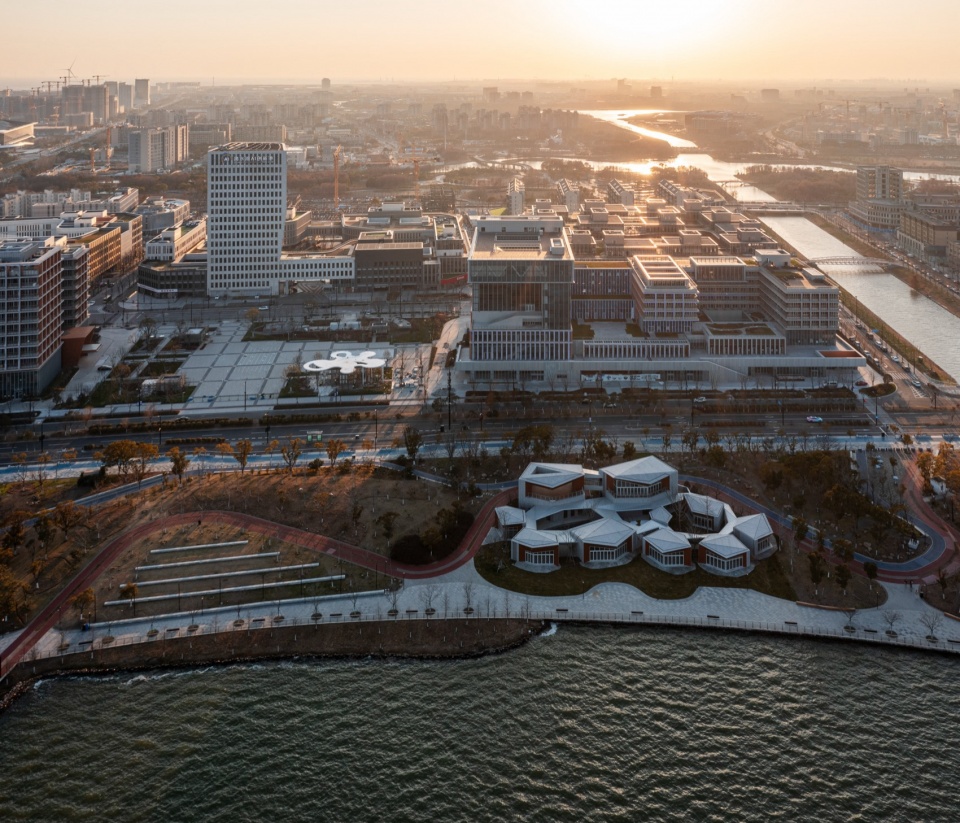
▼倚石苑北侧鸟瞰,North side aerial view of Clustered Rocks Court
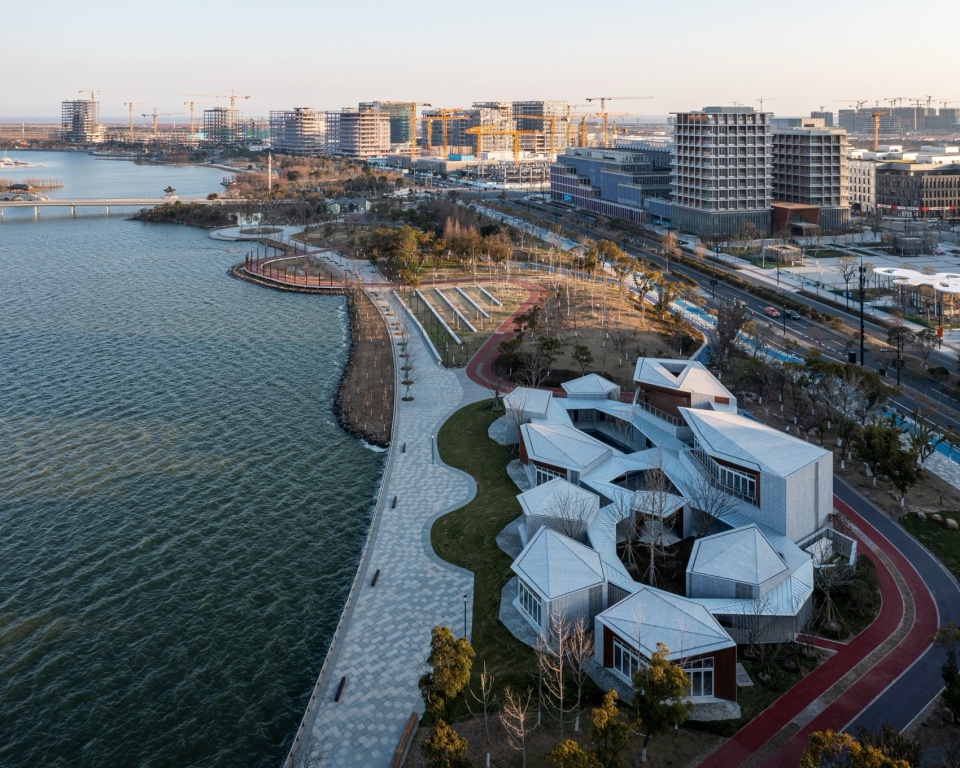
▼倚石苑北侧街景,North side street view of Clustered Rocks Court
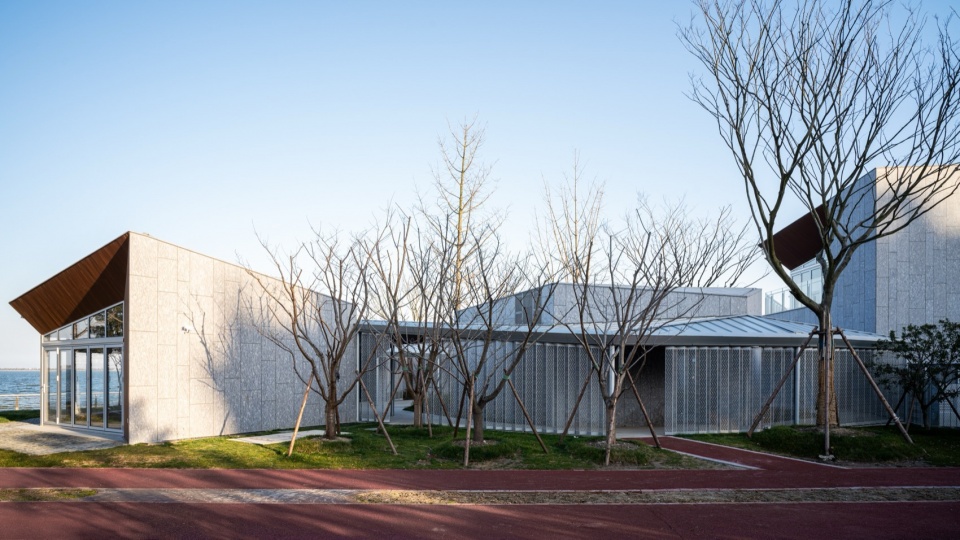
▼倚石苑餐厅室内,Restaurant interior of Clustered Rocks Court
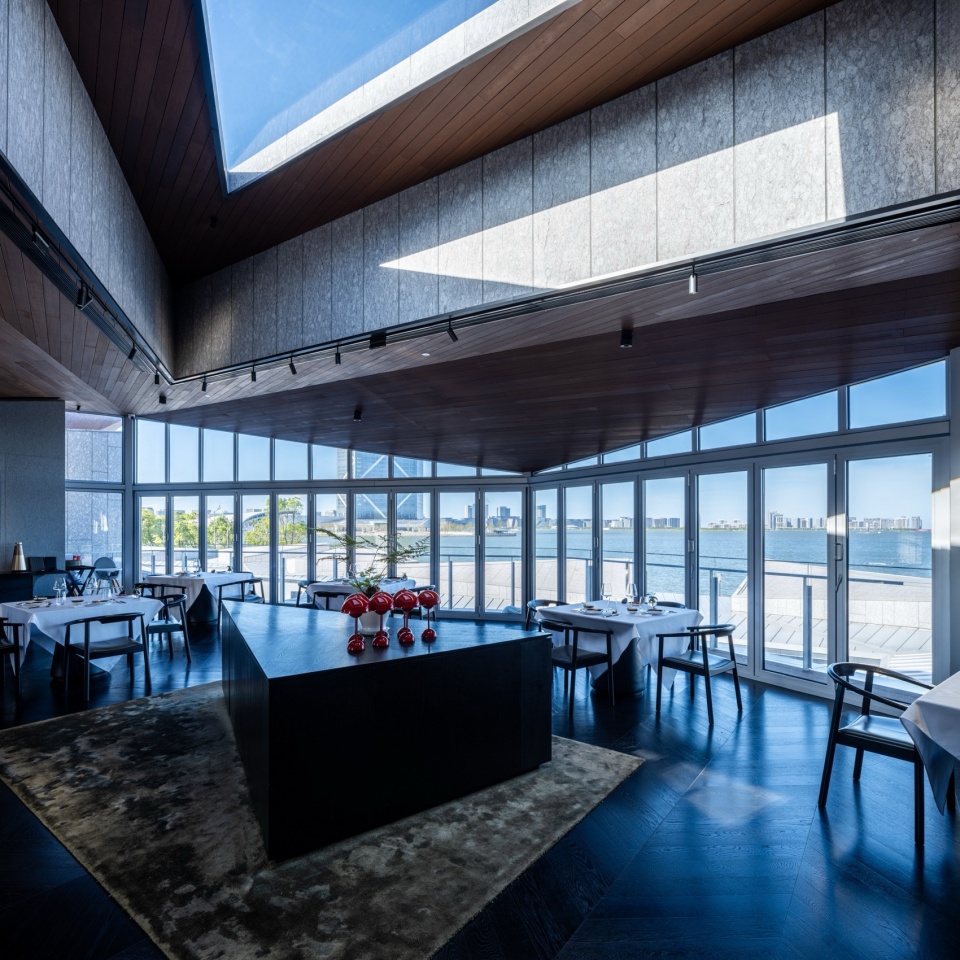
整组建筑由十栋大小不同的五边形平面的多面体建筑单元通过折廊串联成一组聚落,并围合成相互联通的三进庭院。这些单元根据功能需求分为大、中、小三种规格,平面几何关系来自于从十余种密拼五边形中选定的无锐角的四种类型,且相对尺寸可整数度量。多方向的三折坡屋面关系使这些单元体量呈现为自然几何雕塑感的多面体,通过平面的错位、转向,以及一、二层体量的前后错落形成一组几何“山石”景致。
The entire building complex consists of ten varying sizes polyhedral units all with pentagonal plan, connected by zigzag verandas to form a settlement that encloses interconnected three-courtyard spaces. These units are categorized into large, medium, and small specifications based on functional needs. The planar geometry is derived from four non-acute-angled types selected from over ten kinds of closely-packed pentagons, with relative dimensions being integer measurements. The multi-directional three-fold pitched roofs give these units a natural geometric sculpture like appearance, with planar shifts, rotations, and staggered layout of different storey volumes creating a geometric “Hill-stones” scenery.
▼倚石苑西侧鸟瞰,West side aerial view of Clustered Rocks Court
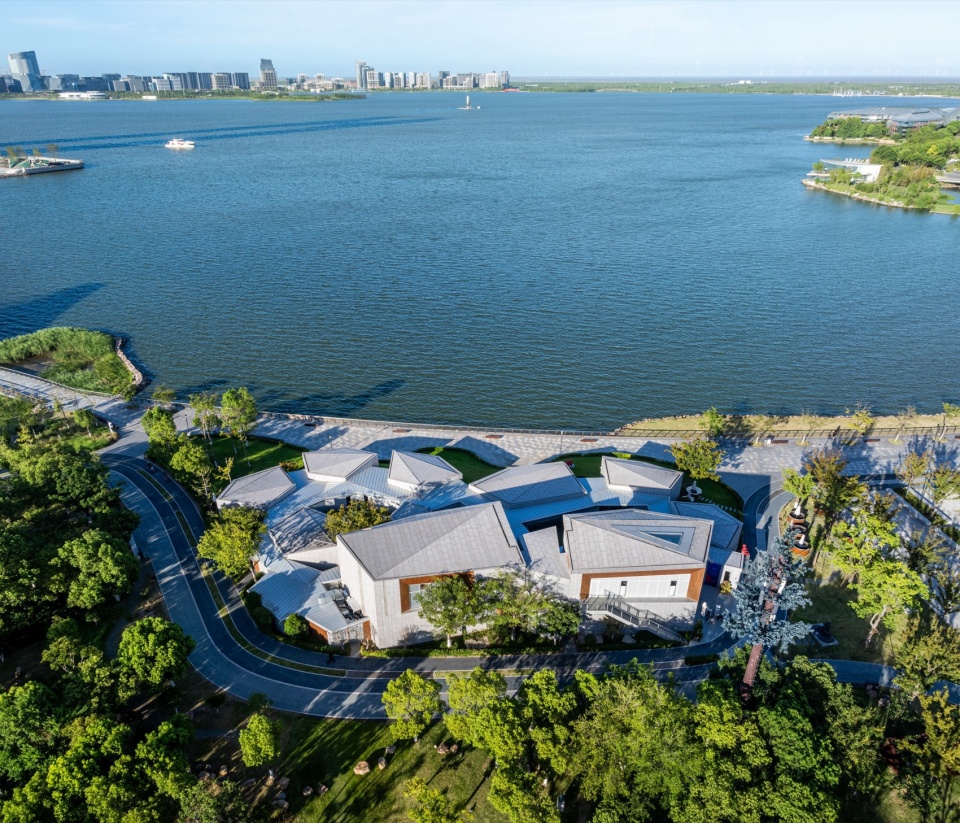
▼倚石苑西侧立面,West elevation of Clustered Rocks Court
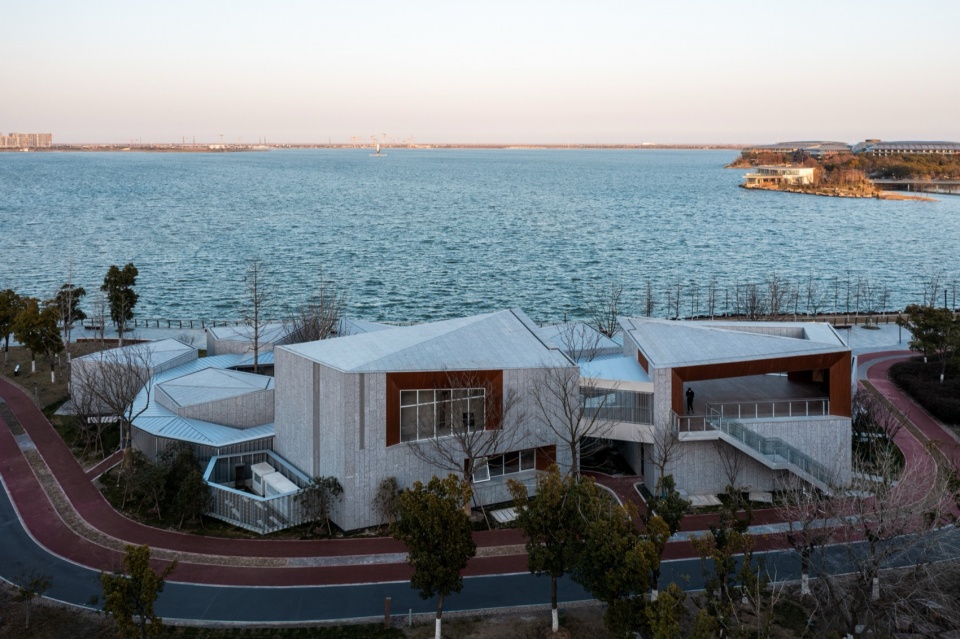
▼倚石苑东侧沿湖街景,East side lakeside street view of Clustered Rocks Court
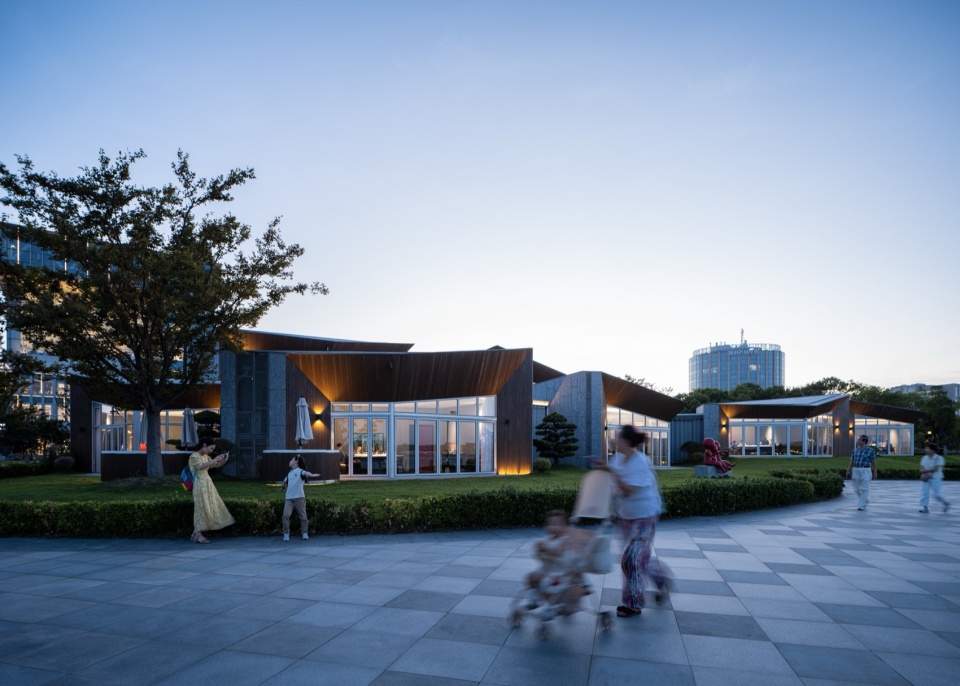
▼倚石苑西侧街景,West side street view of Clustered Rocks Court
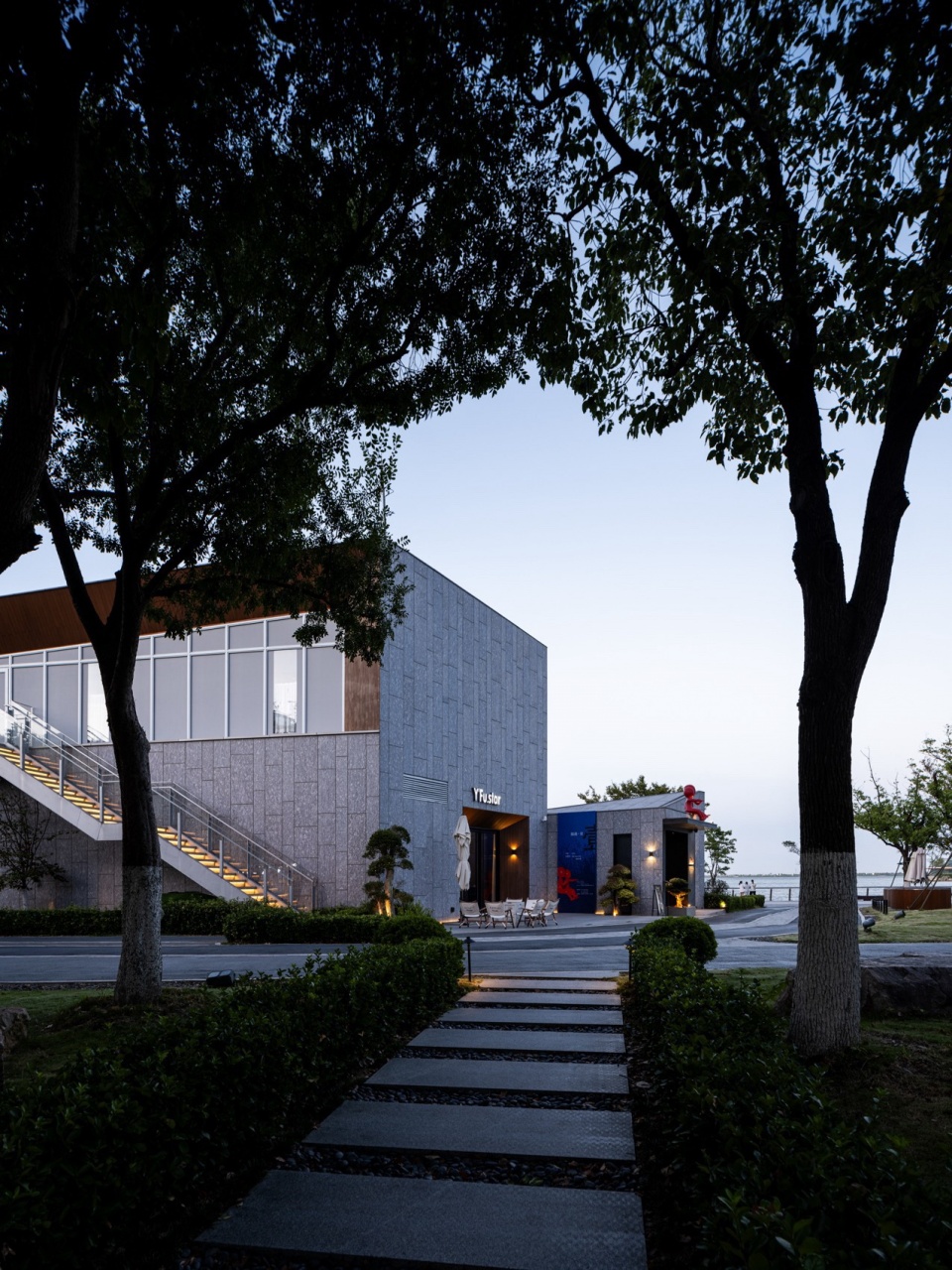
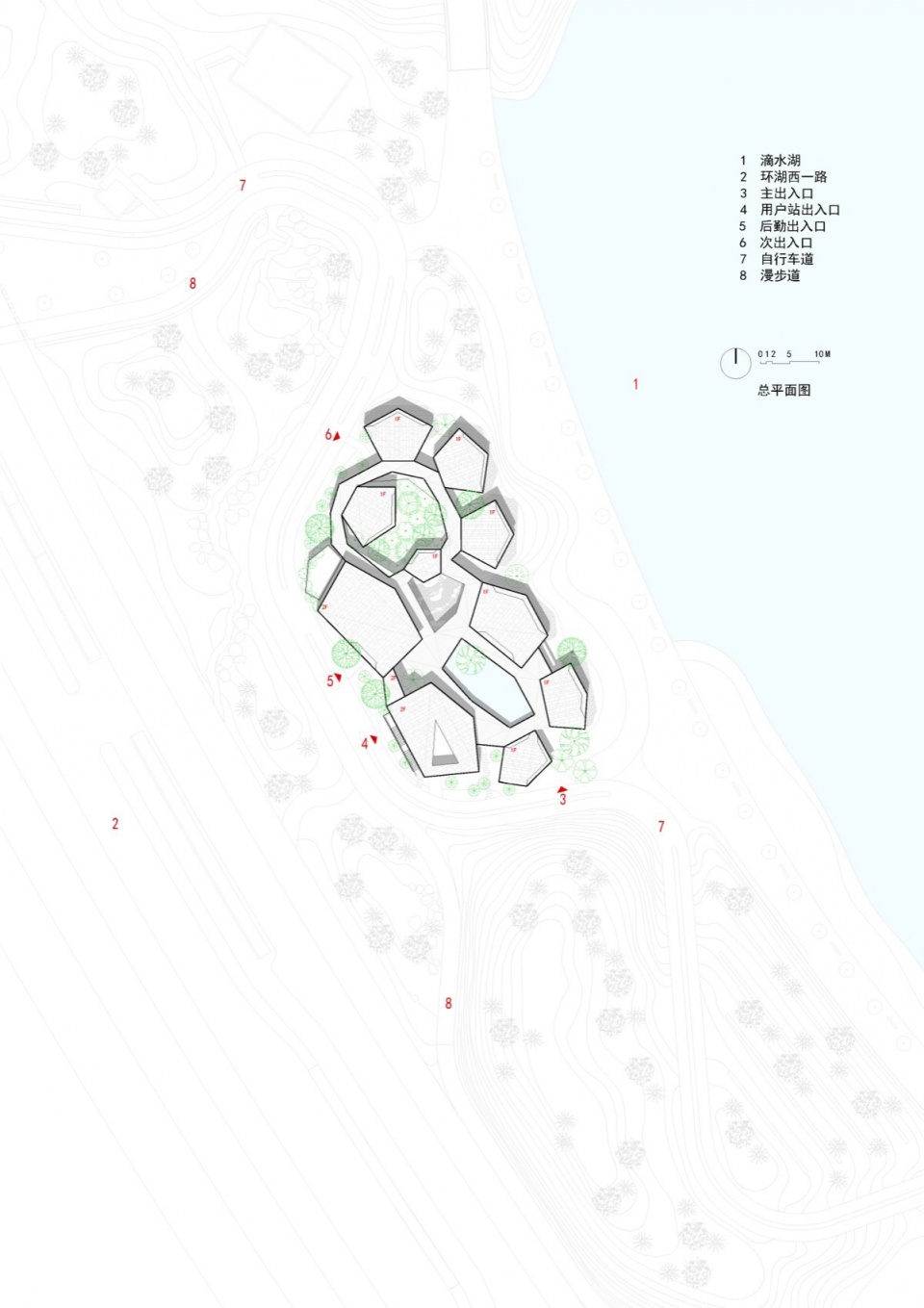
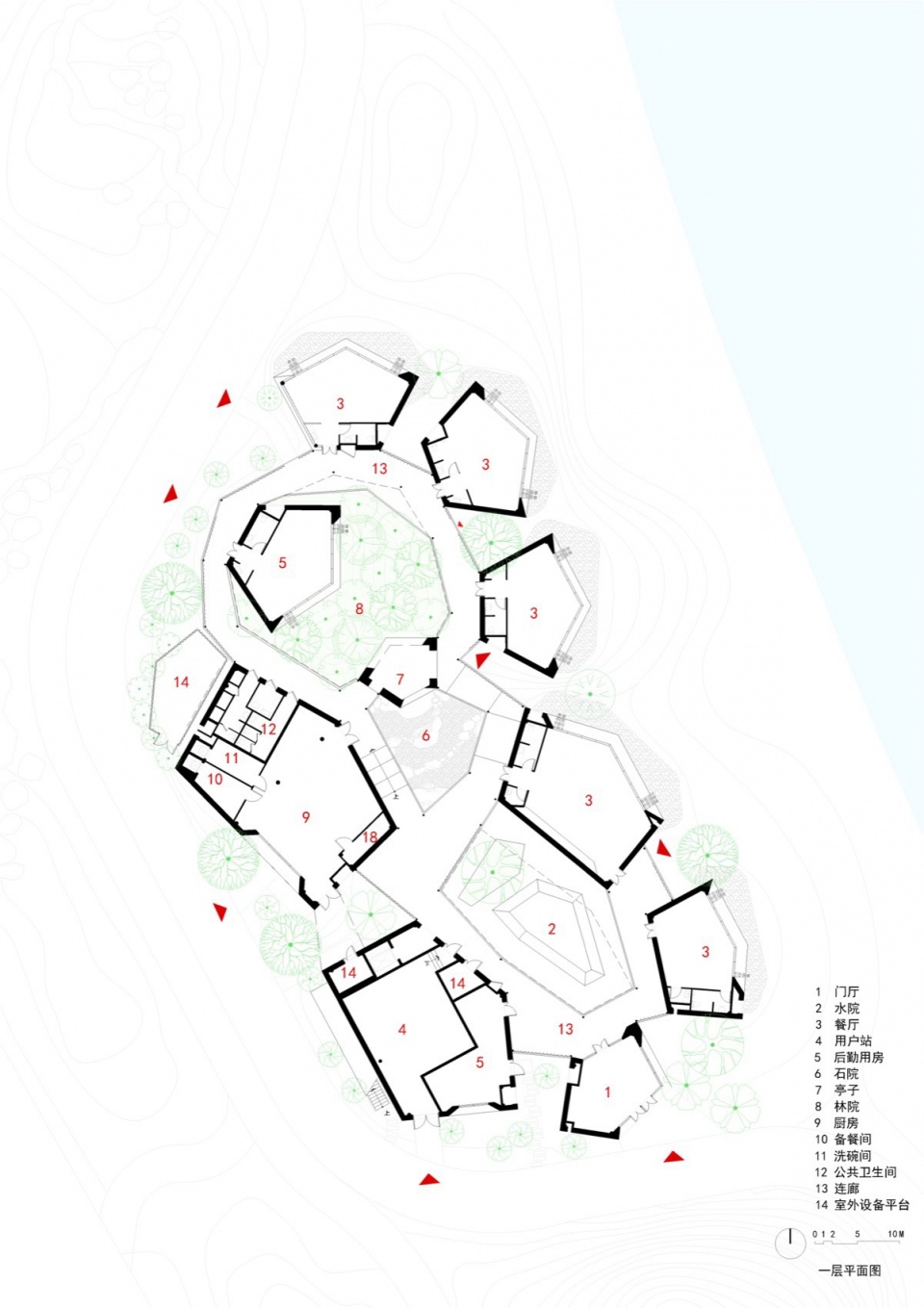
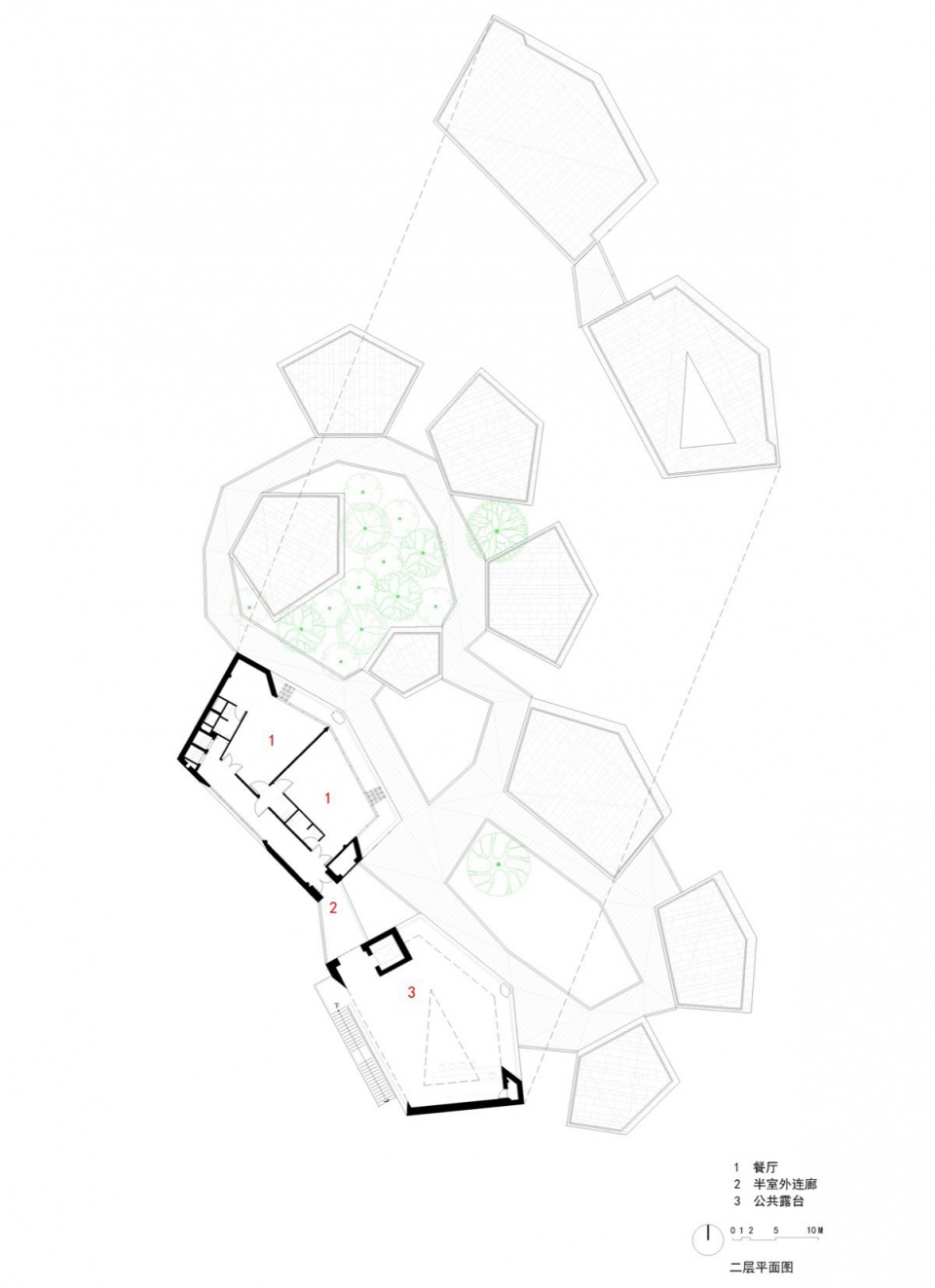
最南侧的小单元为门厅入口,迎向公园景观步道,形成先抑后扬的空间体验。第一进南院为水院,为三进院落中最疏朗开阔的一进,一池锦鲤,一株大树。水院东侧设有小单元和中单元的餐厅包间各一,西侧一个大单元的底层则为用户站和后勤用房组成的庭院背景墙,北端在廊下设置半透明金属穿孔屏风隐约透出下一进庭院。第二进中院为石院,尺度极狭,作为其前后两进之间的过渡,通过置石形成的自然错落形成总体南低北高的微地形高差。北端以小单元为一亭嵌入廊中,行而至此,面面有景。第三进北院为林院,曲折幽深,雅静秀丽,串联四个小单元的餐厅包间,营造自然生境中的诗意氛围。中院和北院西侧共同背靠的另一个大单元底层为厨房和卫生间。以空中短廊联通的两个大单元的二层分别为两个带阳台的大包间和一个公共露台,既可远眺湖景,也可俯瞰庭院。
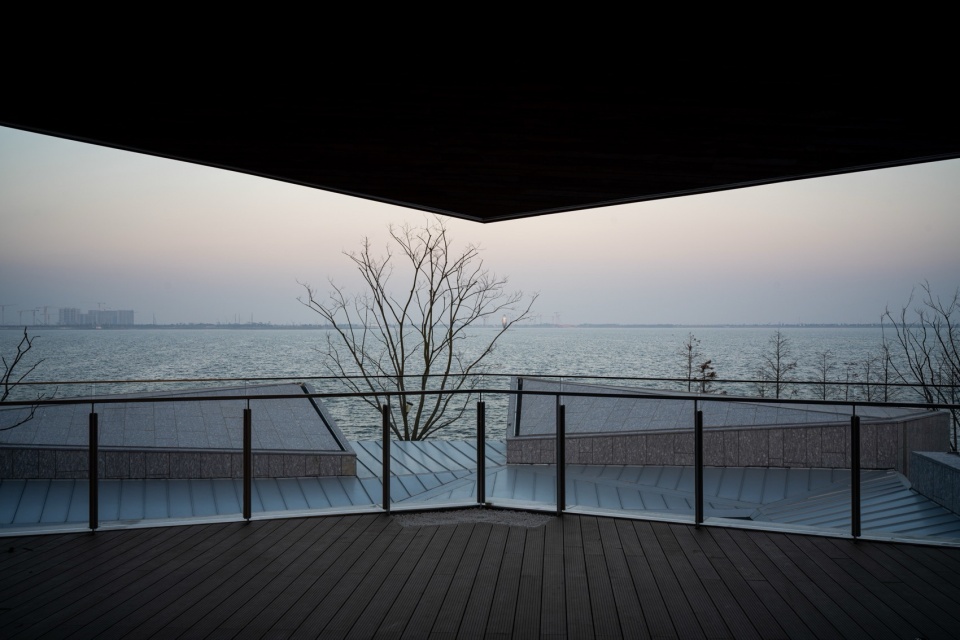
The small unit at the southern end serves as the entrance pavilion, facing the park’s walkway. The southern front courtyard, the Water Courtyard, is the most open and spacious of the three courtyards, featuring a koi pond and a tall tree. On the east side of the Water Courtyard are dining rooms in small and medium units, while the ground floor of a large unit on the west side provides a courtyard background wall composed of subscriber station and logistical rooms. At the north end, a semi-transparent perforated metal screen beneath a corridor roof provides a glimpse into the next courtyard. The middle courtyard, the Stone Courtyard, is narrow and serves as a transition between the front and rear courtyards. Its natural terrain features stone placements, creating a micro-topographical difference with a lower southern end and a higher northern end. A small unit is embedded in the veranda at the northern end as a kiosk, offering views from various directions. The northern rear courtyard, the Forest Courtyard which linking four small-unit dining rooms with a natural habitat, is winding, secluded, and tranquil. On the west side of both the Stone and Forest Courtyards, another large unit houses the kitchen and restrooms on the ground floor. The second floors of two interconnected large units feature a pair of spacious dining rooms with balconies and a public terrace, offering both lake views and courtyard vistas.
▼倚石苑三进院落鸟瞰,Aerial view of the three-courtyard layout of Clustered Rocks Court
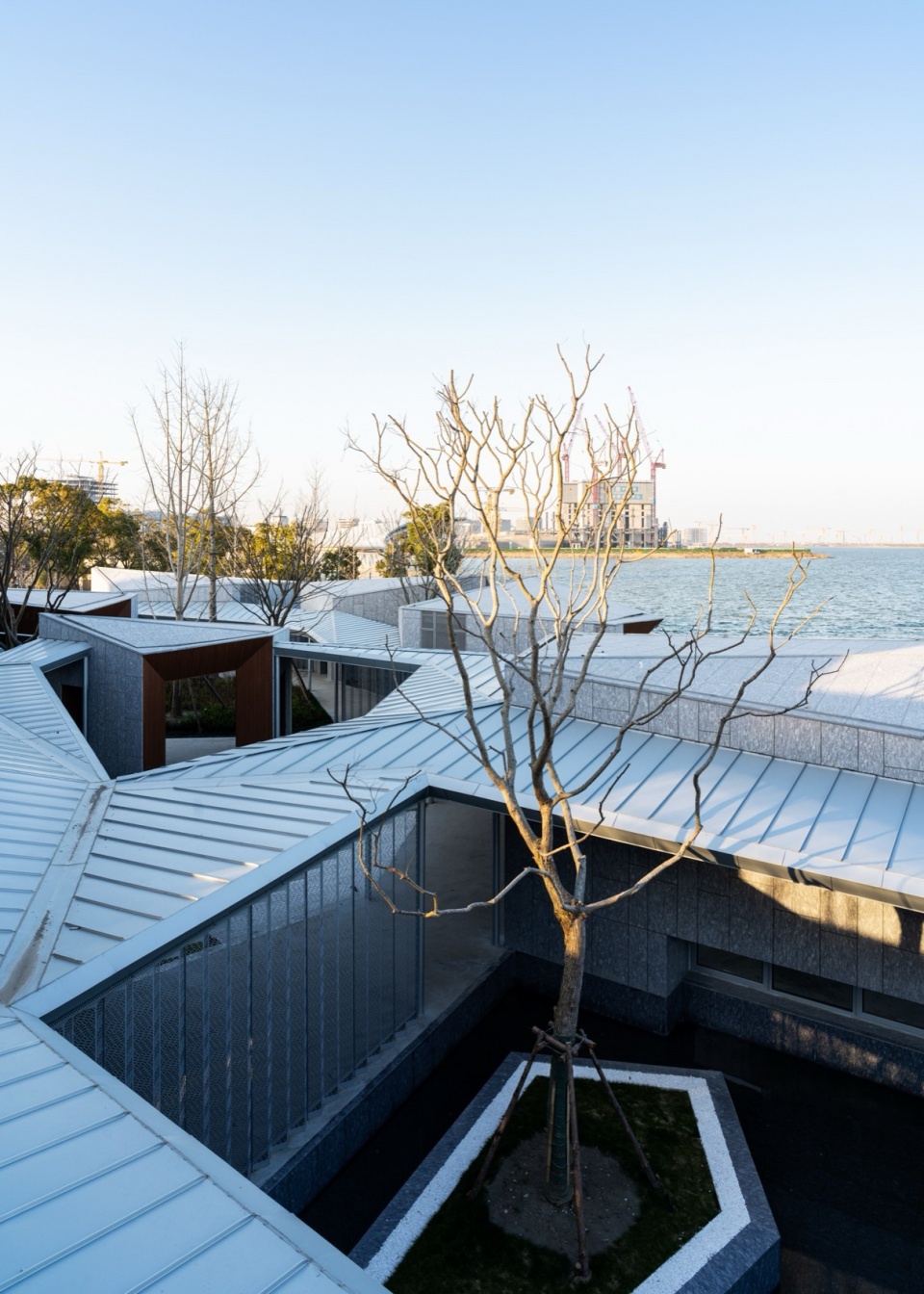
▼倚石苑林院,Forest courtyard of Clustered Rocks Court
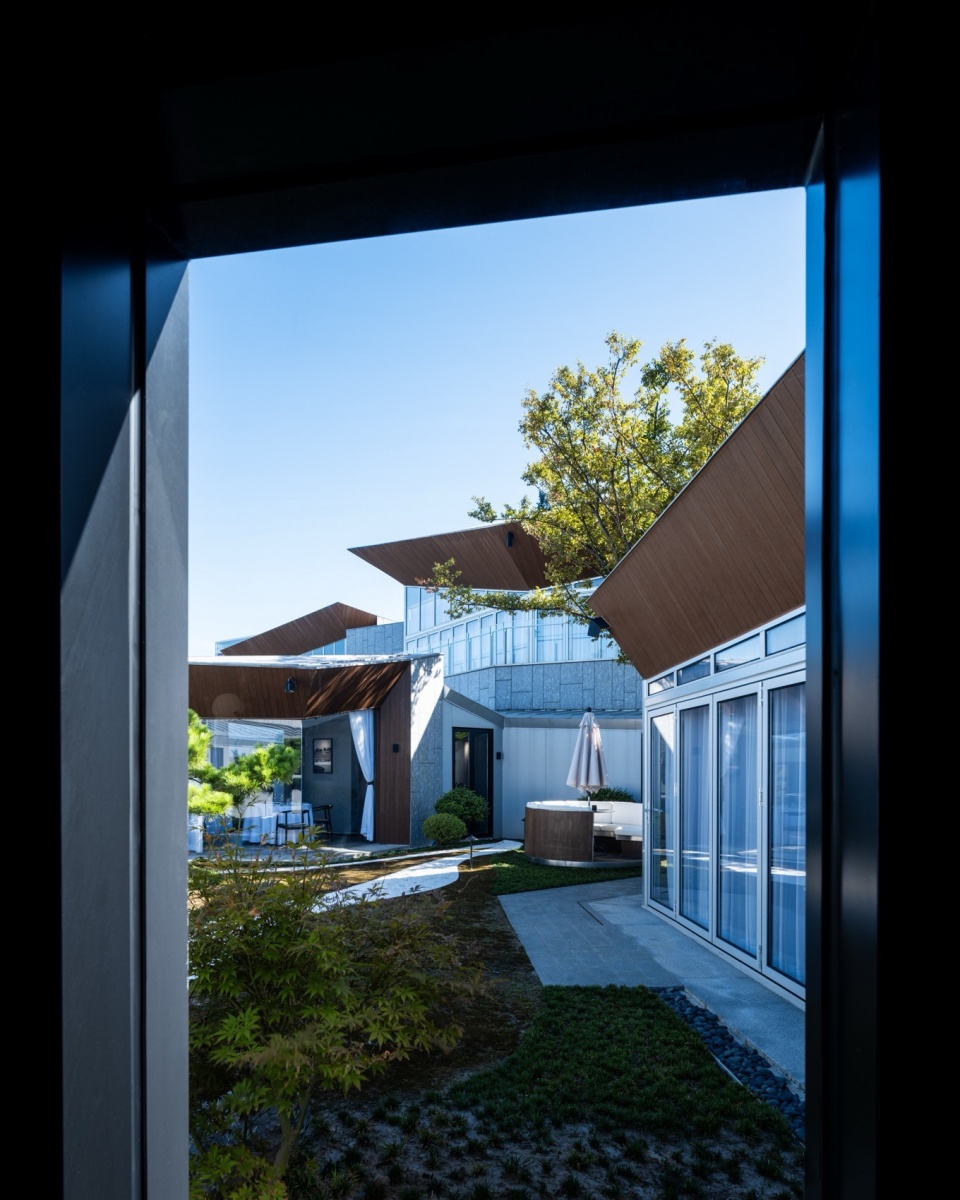
▼倚石苑 – 石院,Stone courtyard of Clustered Rocks Court
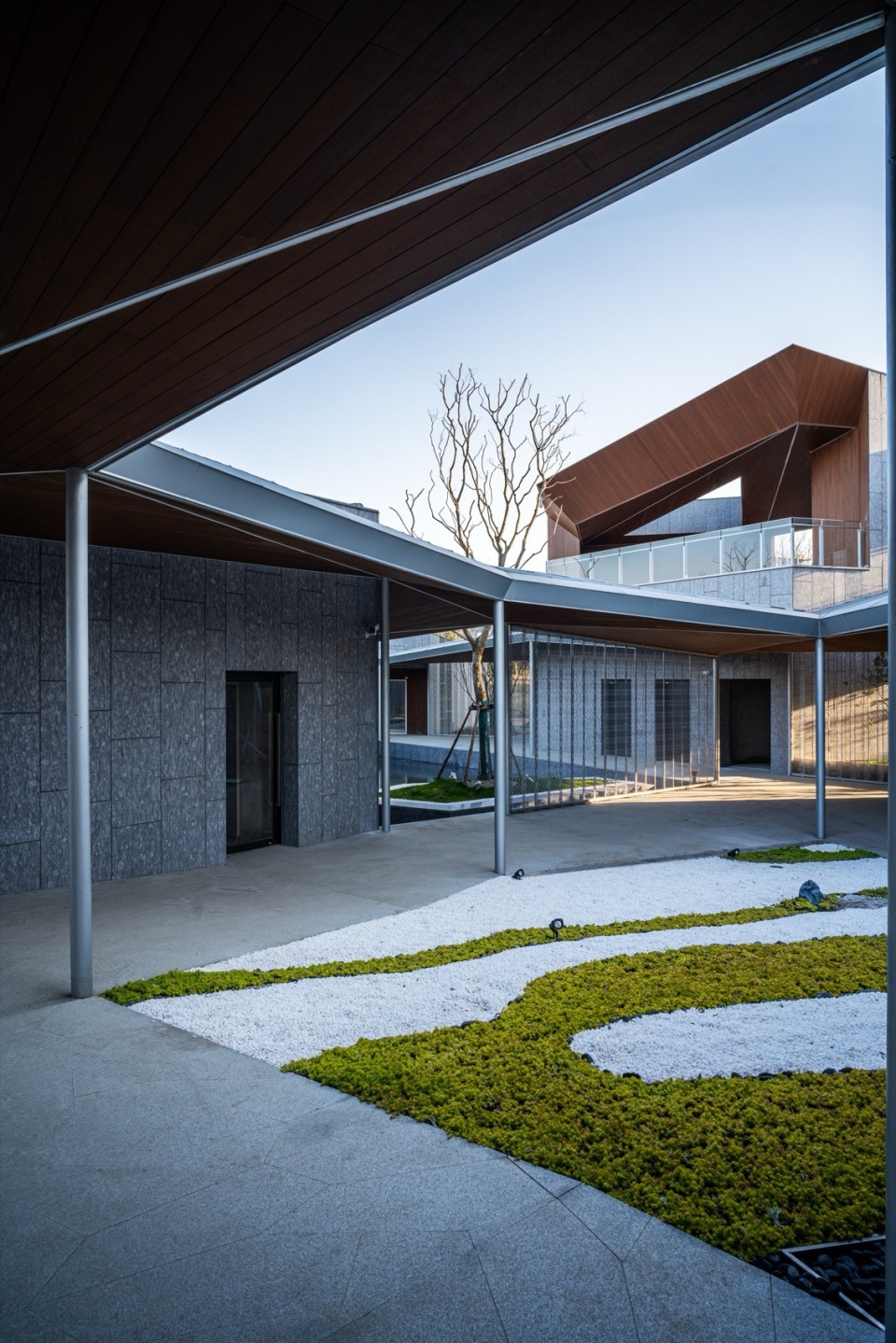
▼倚石苑 – 水院,Water courtyard of Clustered Rocks Court
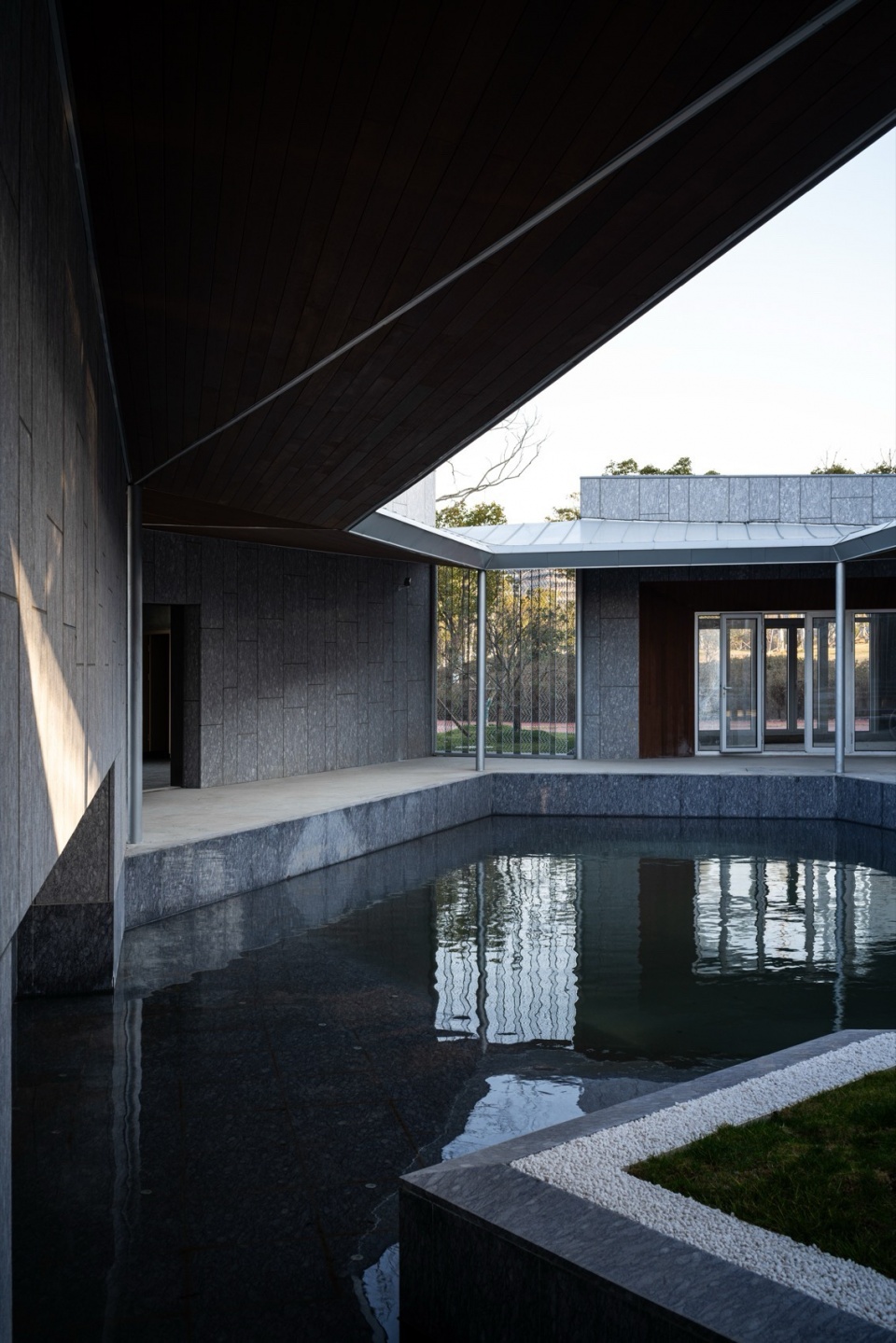
▼倚石苑回廊,Cloister of Clustered Rocks Court
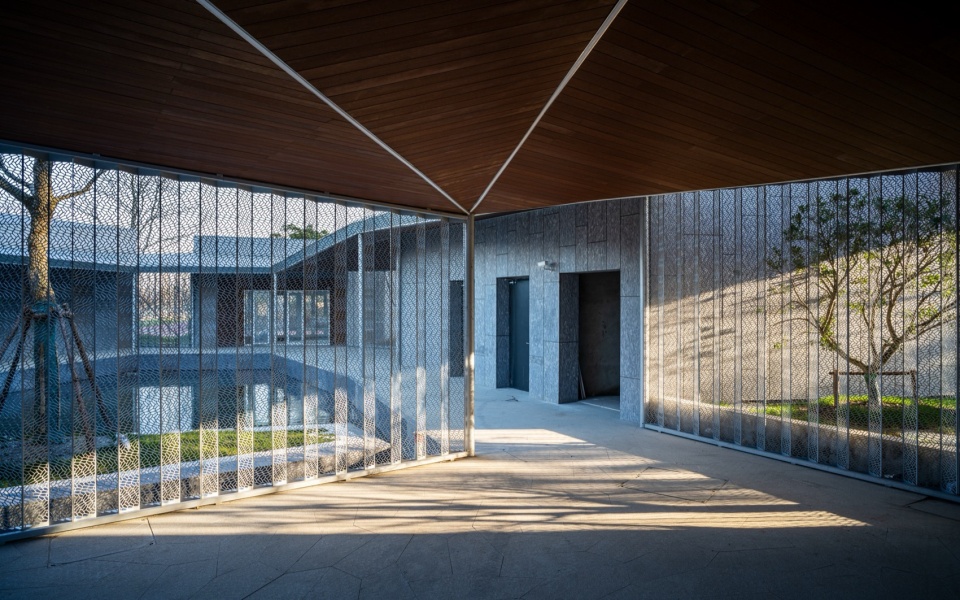
为了达到整体自然质朴,又能与公共景观带城市环境形象相匹配的效果,项目采用水冲面冷灰花岗岩板整体包覆立面与屋面,条形错缝的随机铺设方式让材料标准化痕迹尽量消隐。面湖界面采用内凹的落地折叠玻璃门窗,可根据气候条件灵活开合。所有内凹门窗洞口的倾斜侧面及顶面都用原色胶合竹板收口,与整体的冷灰调子相平衡。串联各单元的廊下采用密拼五边形花岗石铺地及局部五边形穿孔折形铝板屏风延续建筑的几何秩序,其连续的坡折屋面天花也在银灰色纤细梁格中填充胶合竹板。
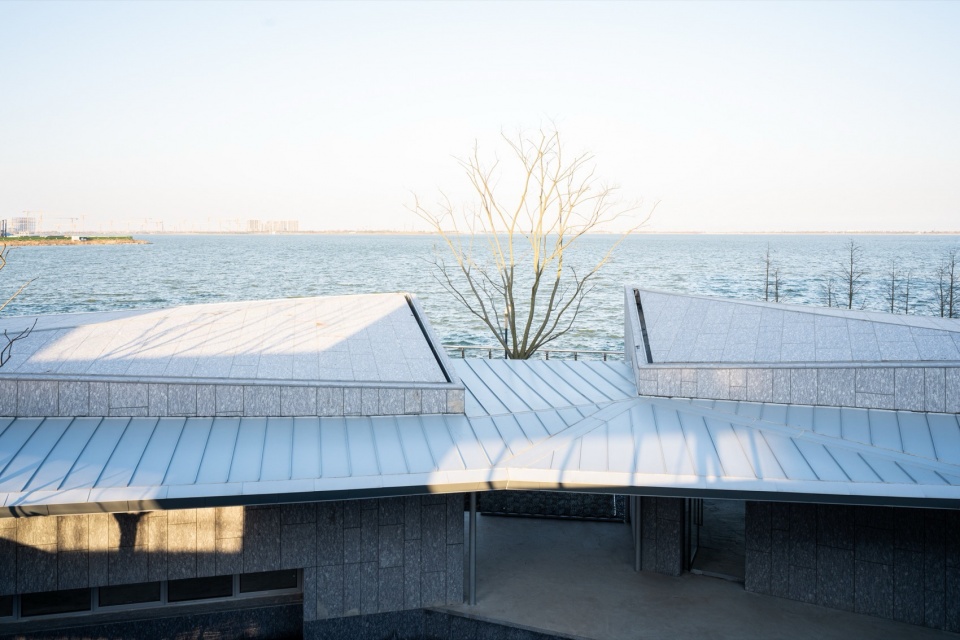
To achieve a natural, rustic appearance while aligning with the overall urban environment of the public landscape, the project uses cold gray granite panels with water-flushed finish to clad all the facade and roof. The panels are laid in a random, staggered strip pattern to minimize visible standardization. The lake-facing side features recessed, folding glass doors and windows that can be adjusted according to weather conditions. The slanted sides and tops of all recessed window openings are finished with natural color glued laminated bamboo panels, balancing the overall cold gray tone. Verandas connecting the units are paved with closely-packed pentagonal granite and partially feature perforated, folded aluminum screens, which continuing the building’s geometric order. The continuous slop folding roof ceilings are also filled with glued laminated bamboo panels within silver-gray slender beams lattice.
▼倚石苑庭院回廊屋顶,Roof of the courtyard cloister of Clustered Rocks Court
▼倚石苑二层平台,Second-floor platform of Clustered Rocks Court
明叶轩 – 综合服务建筑4#Floating Leaf Pavilion – Service Building 4
明叶轩位于黄日港北岸一处骑行道和漫步道向内弯折形成的面湖凸形场地内,周边树林茂密,其西侧隔环湖一路背靠闵联开发大厦和临港城投大厦。建筑整体规模较小,运营目标是空间灵活开放的融合餐饮业态。方案的形态意象取自宋代词人吴文英《高阳台·落梅》的词句:“啼鸟清明,叶底青圆”,屋顶宛如一片飘浮在林间草地的轻盈树叶,故名“明叶轩”。这一建筑抽象地应和中国传统建筑的屋面曲线之美、肌理之韵,屋角起翘,轻盈飞举。
▼明叶轩形体生成,Massing generation of Floating Leaf Pavilion
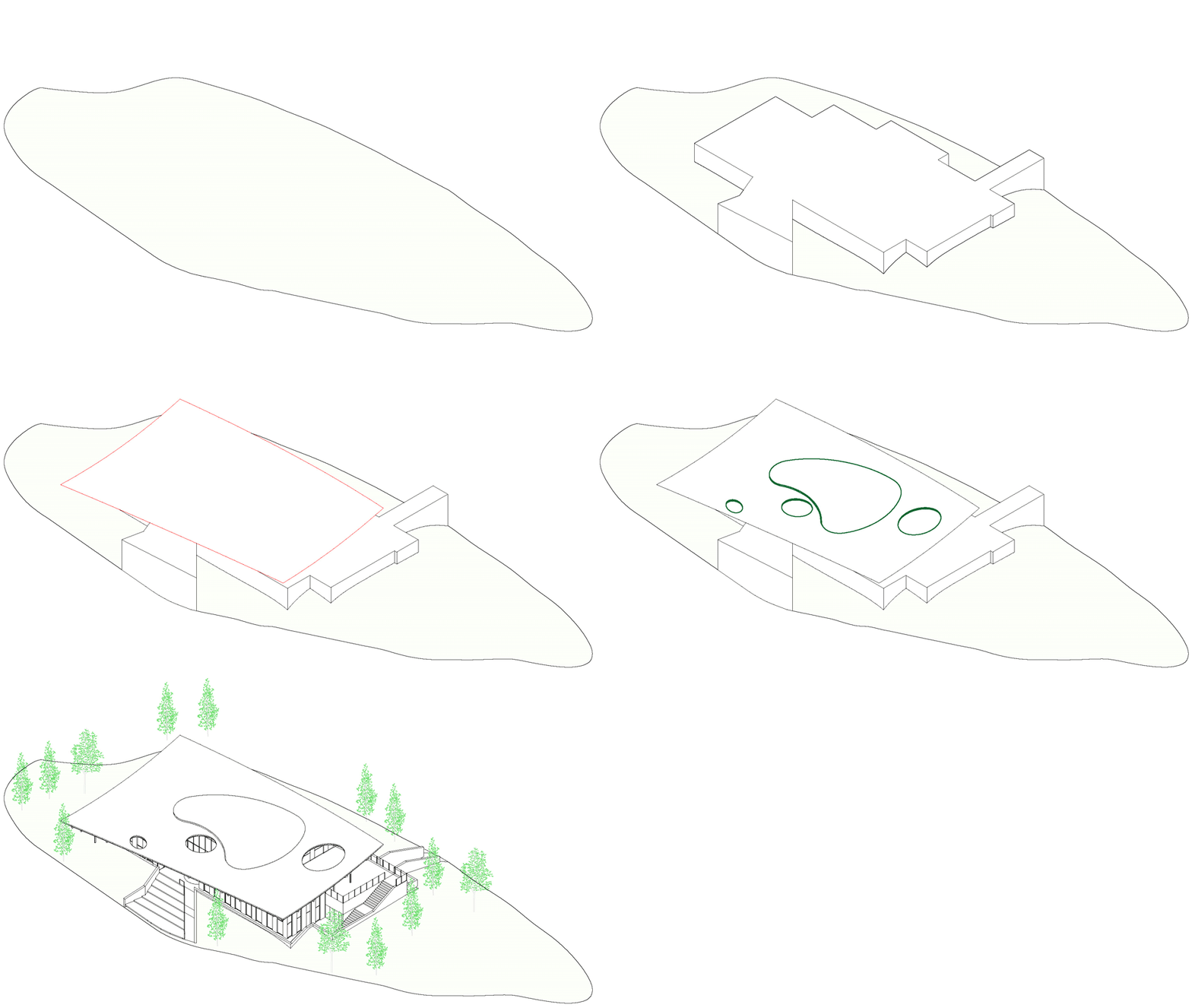
Located at a lake-facing protruding site formed by the inward bend of a cycling and walking path on the northern bank of Huangrigang River, Floating Leaf Pavilion is surrounded by dense woodland. To its west, it is separated from the Minlian Development Building and Lingang City Investment Building by the Ring Lake Road. The building is relatively small in scale and aims to offer a flexible, open space for a fusion cuisine restaurant. The design concept is inspired by a line from Song Dynasty poet Wu Wenying’s “Gaoyang Terrace: Falling Plum Blossoms”: “Crying birds in the clear morning, beneath the dense foliage, the plums are round.” The roof resembles a light leaf floating among the grass and trees, hence the name “Floating Leaf Pavilion.” This design abstractly echoes the beauty and texture of traditional Chinese roof curves, with uplifted corners creating a sense of lightness and elevation.
▼明叶轩屋面形态拟合“落叶”意象,Roof form of Floating Leaf Pavilion evoking the imagery of “fallen leaves”
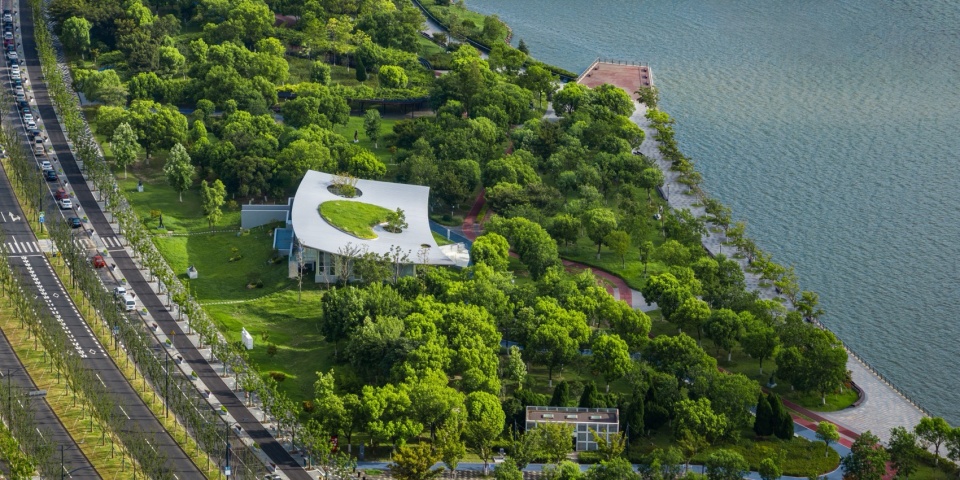
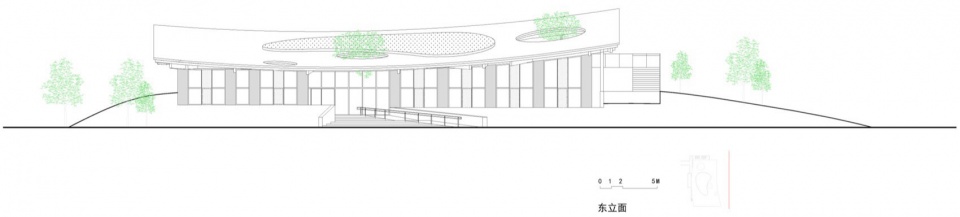
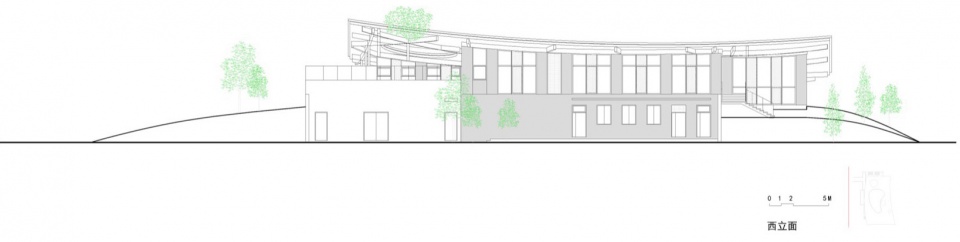
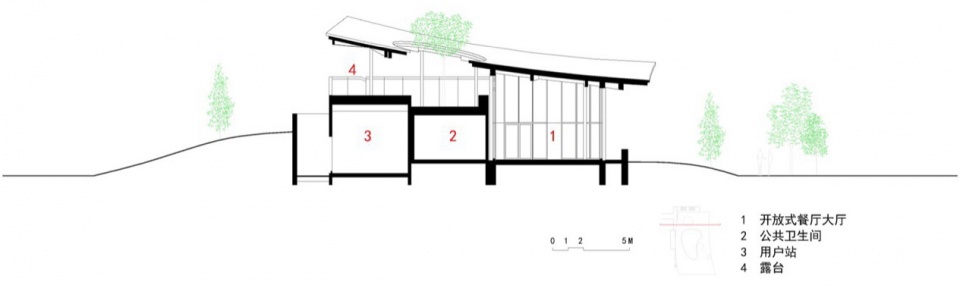
建筑整体呈现为面湖侧低、背湖侧高的态势,其内部形成东半部单层通高、西半部上下两层的空间格局。东半部通高空间为开放式餐饮大厅,西半部底层布置厨房、用户站、公共卫生间等后勤辅助用房,二层为包房。为了尽量压低建筑高度,西半部二层楼板下的厨房和用户站都稍下沉,同时建筑西侧整体堆坡处理,并以挡土墙为建筑留出下陷的后勤嵌道。配合四面出挑的轻盈屋顶,建筑呈现贴合地形水平延展的状态,与环境相融合。
The building overall presents a low profile on the lake-facing side and a higher profile on the side facing away from the lake. Internally, it features a single-story open dining hall in the eastern half, and a two-story arrangement in the western half whose ground floor houses the kitchen, subscriber station, and public restrooms, with the second floor dedicated to private dining rooms. To minimize the building’s height, the kitchen and subscriber station are slightly sunken. Additionally, the building’s western side is treated with a sloped terrain and a retaining wall, creating a recessed space for logistical access. Complemented by the lightweight, cantilevered roof on all sides, the building visually blends with the topographic relief, extending horizontally and harmonizing with the surrounding environment.
▼明叶轩北侧鸟瞰,North side aerial view of Floating Leaf Pavilion
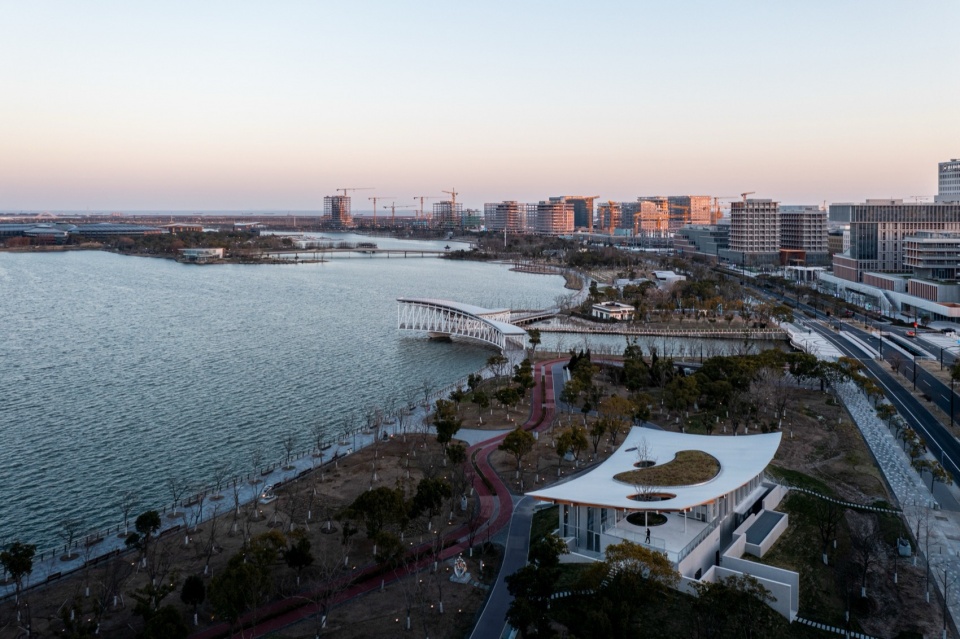
▼明叶轩东侧鸟瞰,East side aerial view of Floating Leaf Pavilion
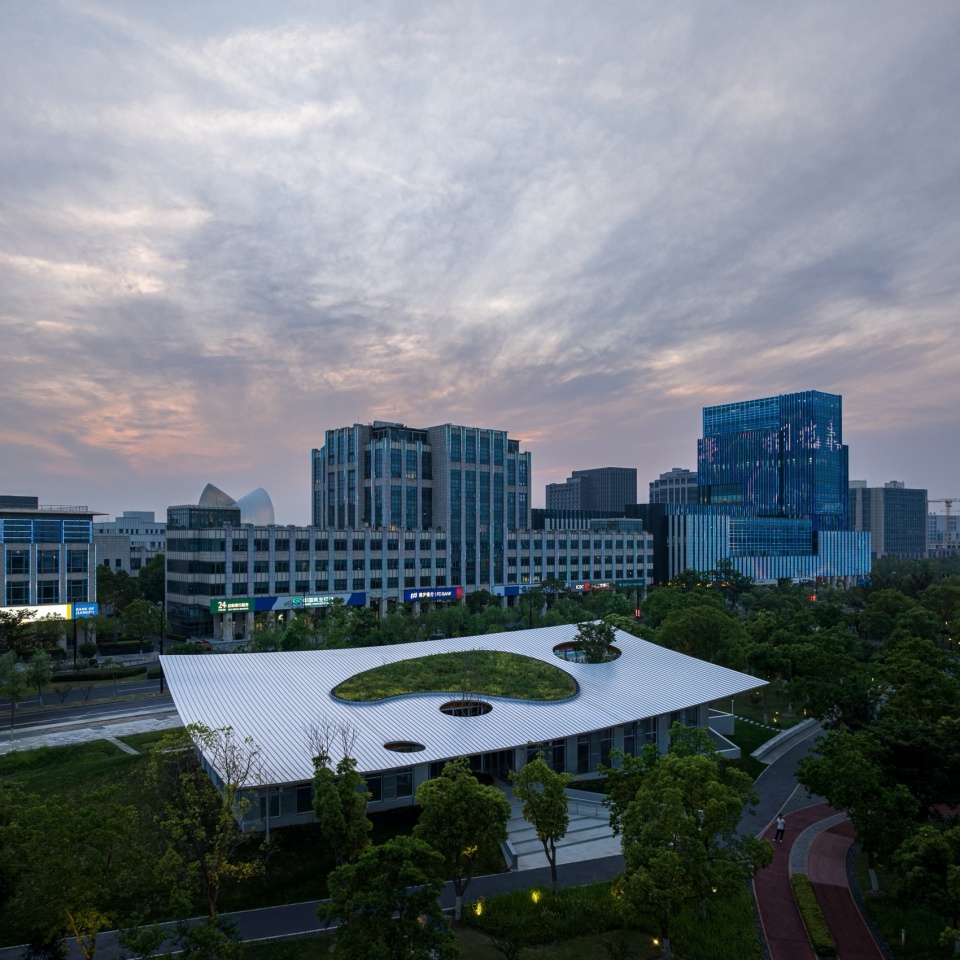
▼明叶轩西侧鸟瞰,West side aerial view of Floating Leaf Pavilion
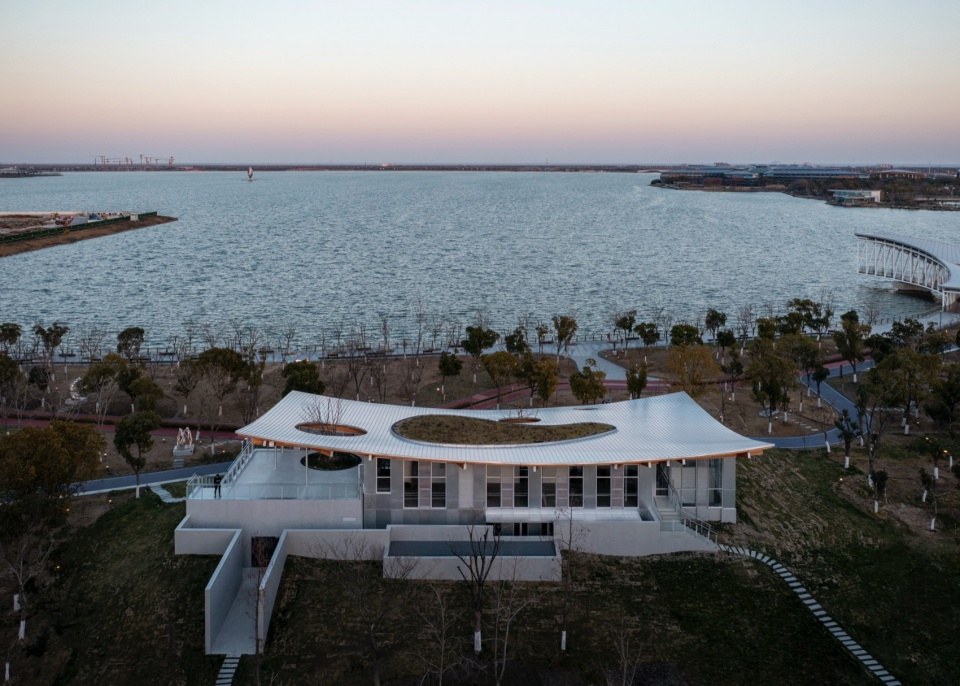
▼明叶轩屋顶鸟瞰,Aerial view of the roof of Floating Leaf Pavilion
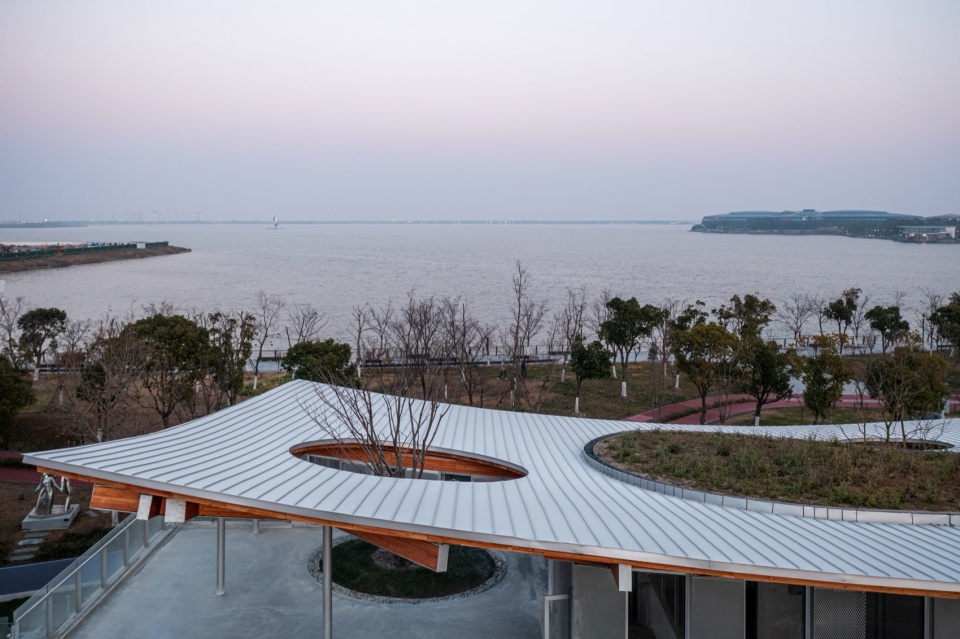
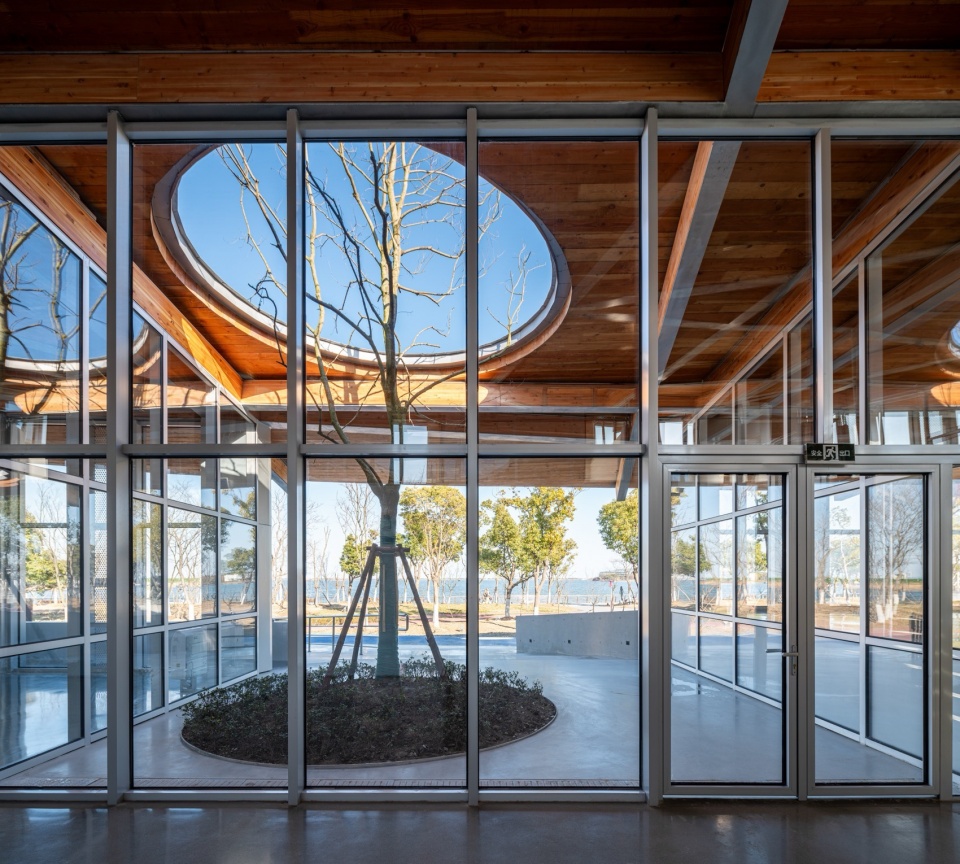
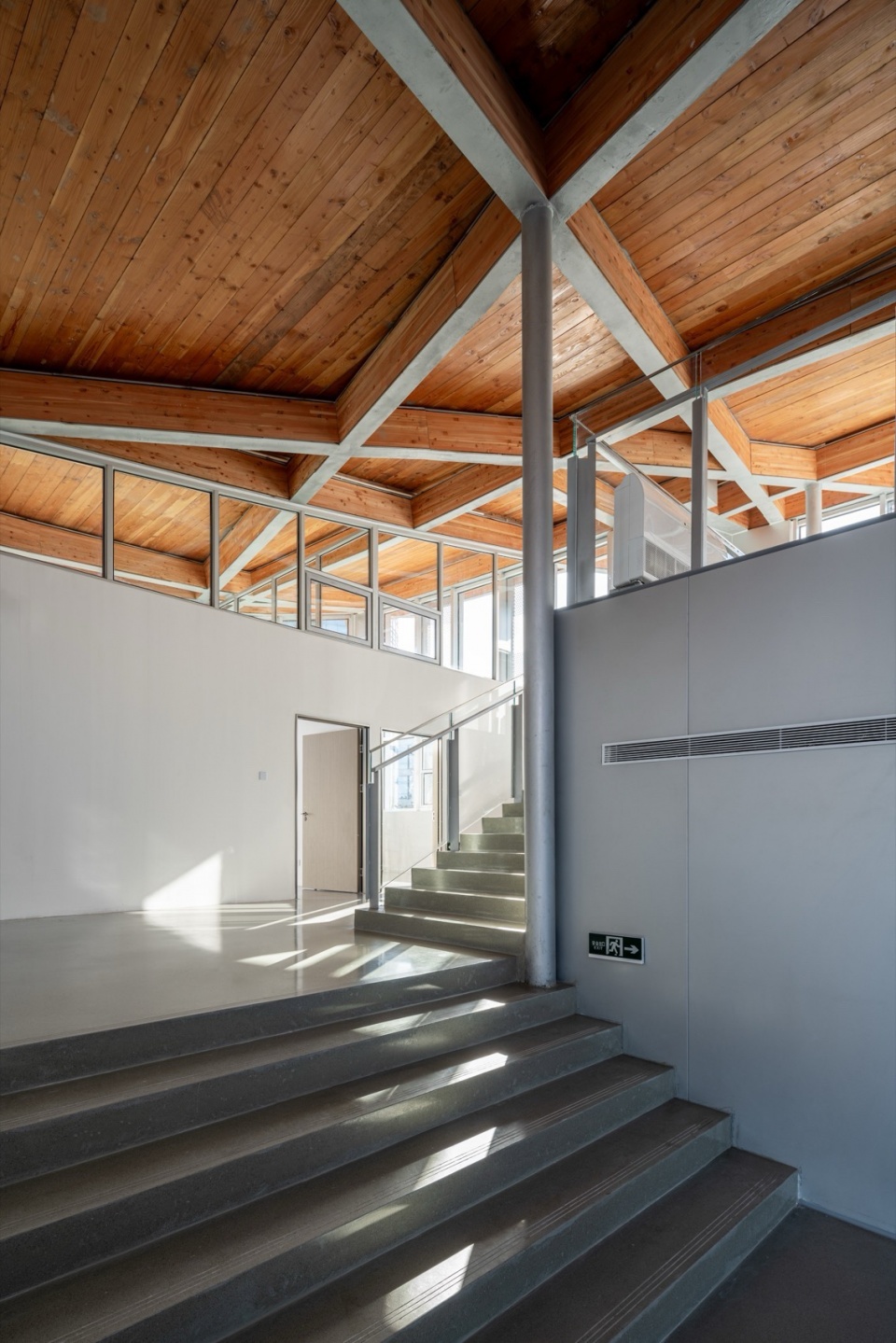
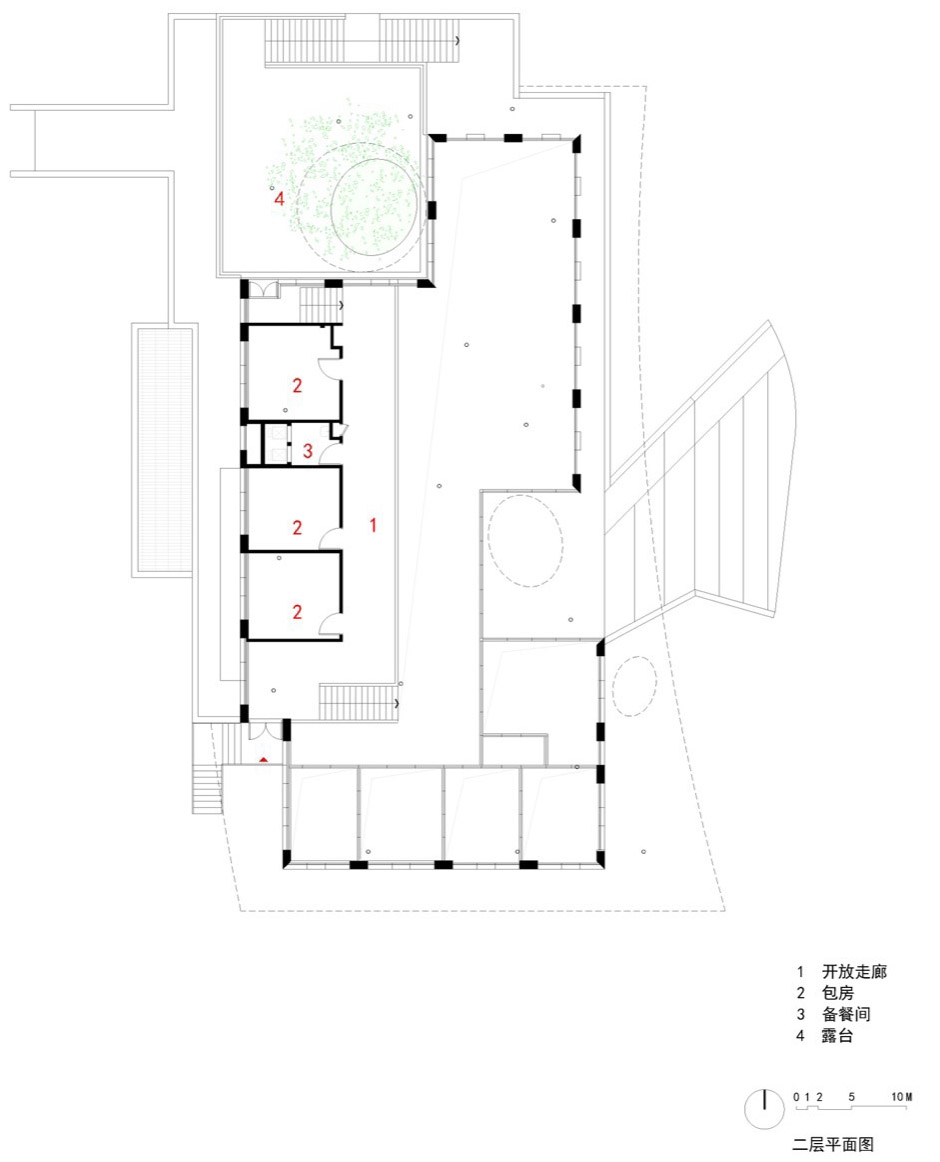
主入口面湖居中凹入设置,并在外挑覆盖的屋顶上开出一个椭圆洞口,下植大树穿出树冠,形成入口庭院。底层的大厅通过南端一个抬高的平台与二层包房转折错层连接,形成连续的空间体验,平台上也布置数间包房。二层包房以一条开放走廊俯瞰一层大厅,并在北端通过转折台阶上行到达西北角位于开关站和公共卫生间之上、大屋顶之下的露台空间。屋顶在此处开了一个椭圆大洞透天,有大树从露台向上穿出,形成别有洞天的屋上景致。主入口稍南侧的屋面挑檐上留有一个较小的椭圆洞口,作为屋面最低点自然排水的泄水口,雨天时会形成特别的落水景观。银色钛锌板覆盖的屋顶中部是一个高出少许的卵形佛甲草大花坛,如同一个漂浮的绿岛。
The main entrance is set centrally recessed on the lake-facing side, featuring an elliptical opening in the cantilevered roof. A large tree is planted through this opening, forming an entrance courtyard. The ground-floor hall connects to the second-floor dining rooms via a raised platform at the southern end, creating a continuous spatial experience; the platform also accommodates several private rooms. The second-floor overlook the hall through an open corridor and are accessible via a stepped transition at the northern end, leading to a terrace space which located above the subscriber station and public restrooms and beneath the large roof in the northwest corner. At this location, the roof has a large elliptical opening, allowing a tree to rise through it, creating a unique rooftop view. Slightly south of the main entrance, the roof features a smaller elliptical opening for natural drainage at the roof’s lowest point, which creates a distinctive water flow spectacle during rain. The central part of the roof covered with silver titanium-zinc sheets is a slightly elevated oval flower bed with sedum lineare , resembling a floating green island.
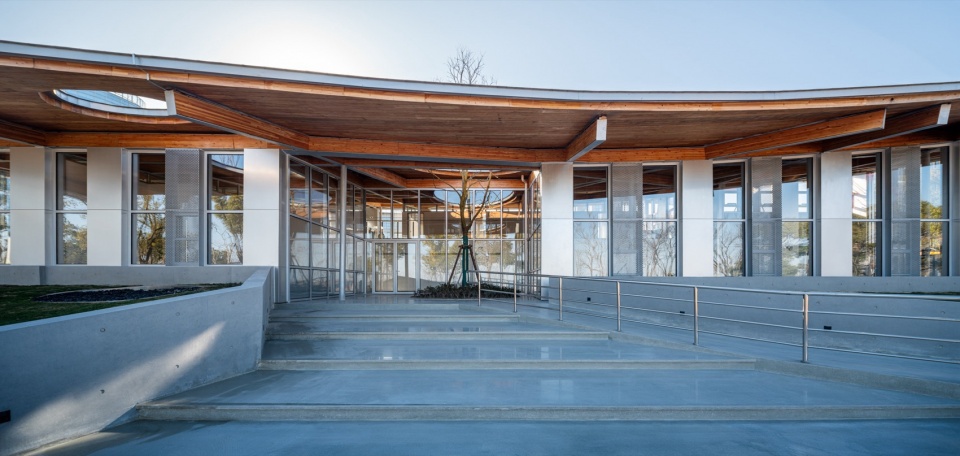
▼明叶轩东侧入口,East entrance of Floating Leaf Pavilion
▼明叶轩北侧,North side of Floating Leaf Pavilion
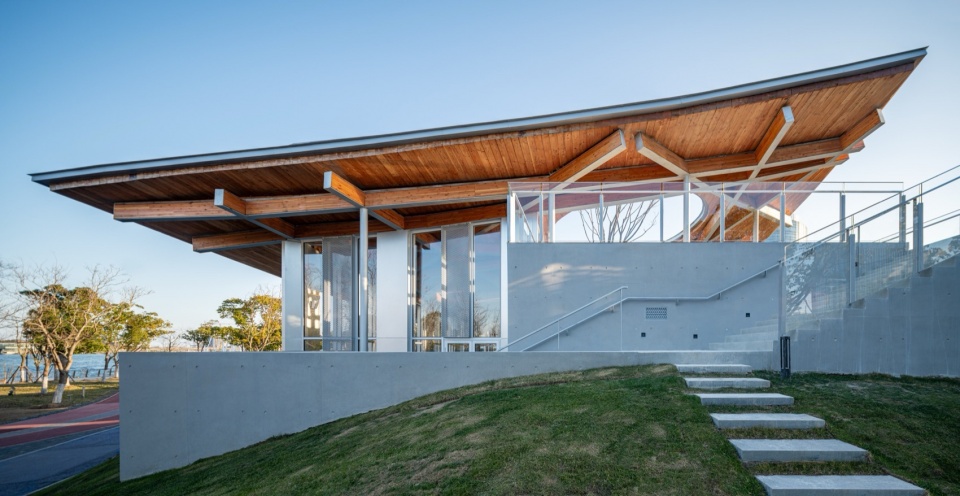
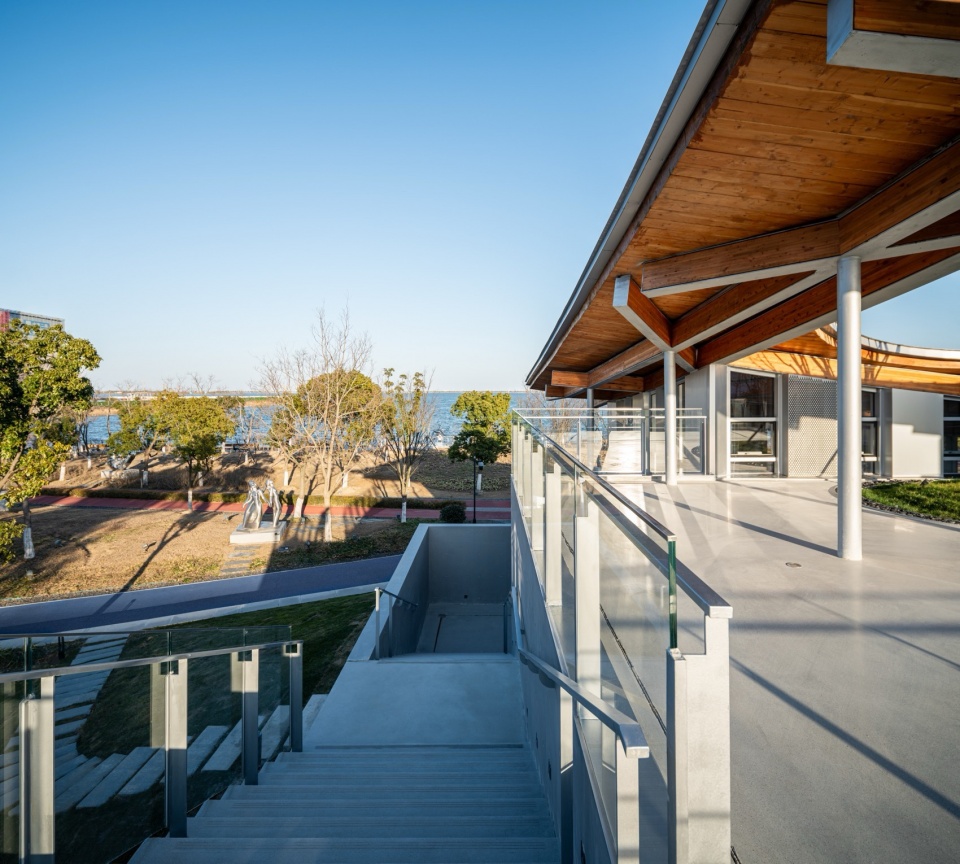
▼明叶轩由露台通向湖边的台阶,Steps from the terrace to the lake at Floating Leaf Pavilion
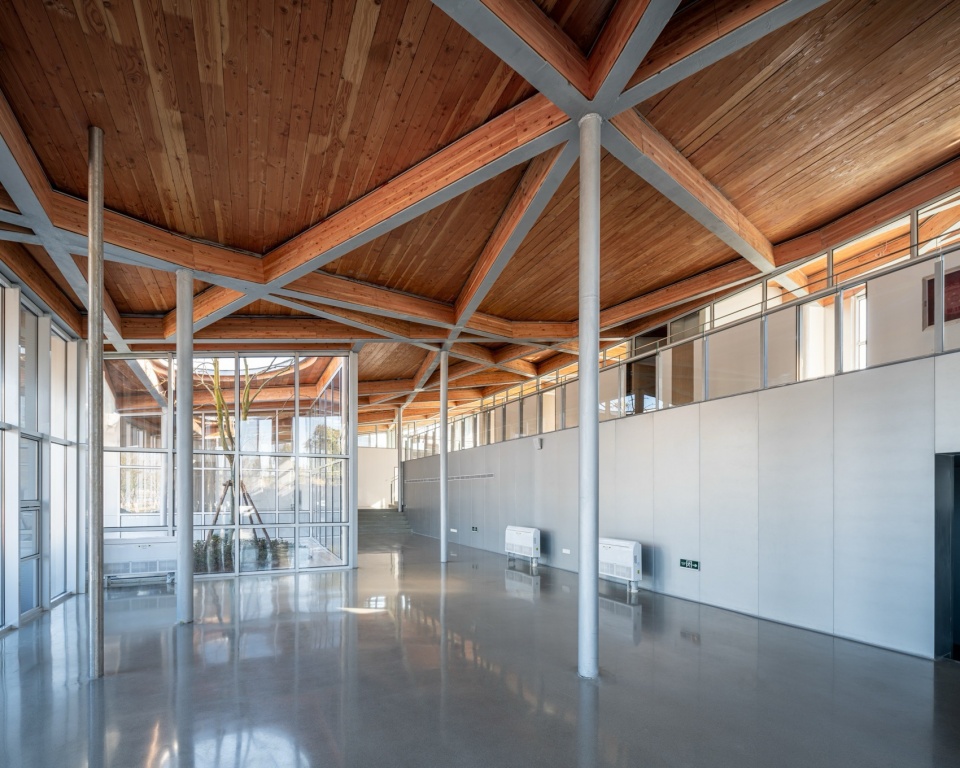
▼“叶脉”般交错的镶木工字钢曲梁格构,“Vein-like” interwoven wood-inlaid I-beam curved steel grid structure
▼明叶轩室内看向入口庭院,Interior view from Floating Leaf Pavilion towards the entrance courtyard
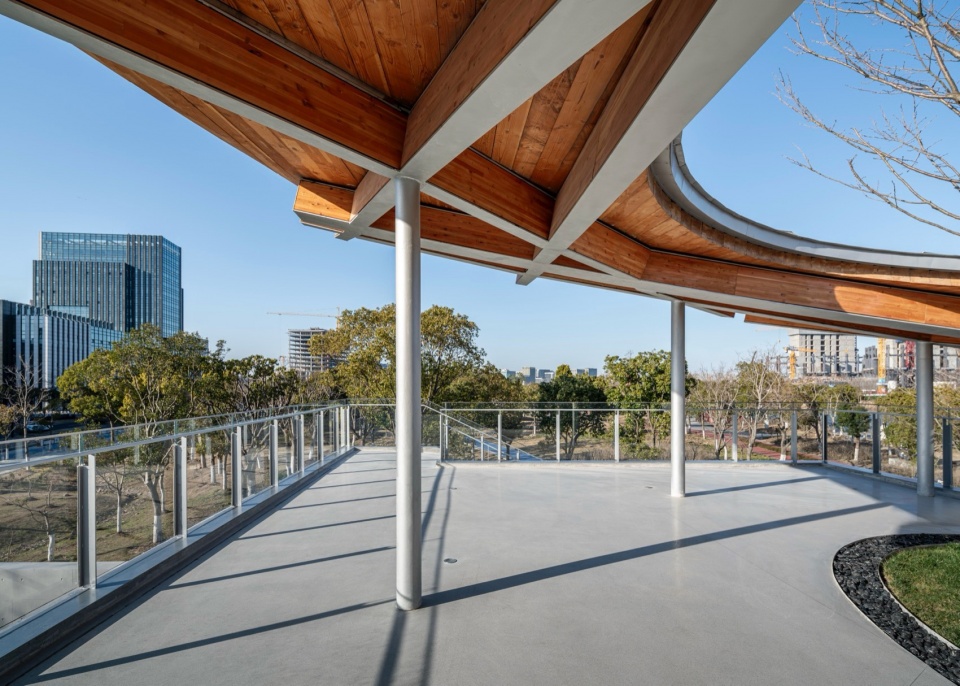
▼明叶轩二层露台,Second-floor terrace of Floating Leaf Pavilion
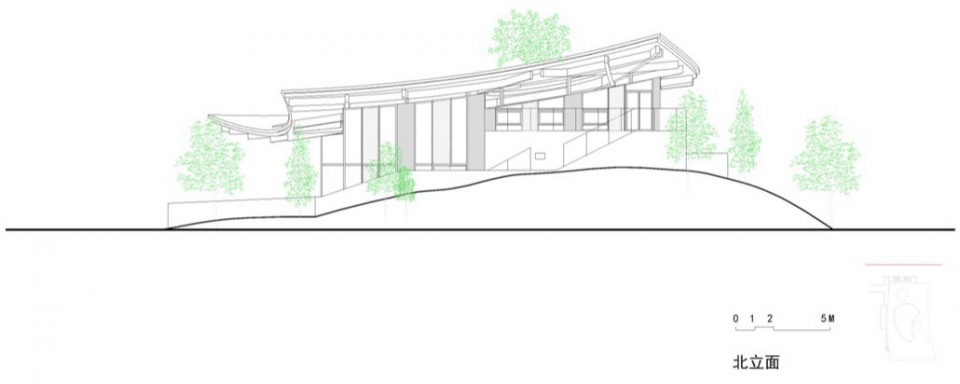
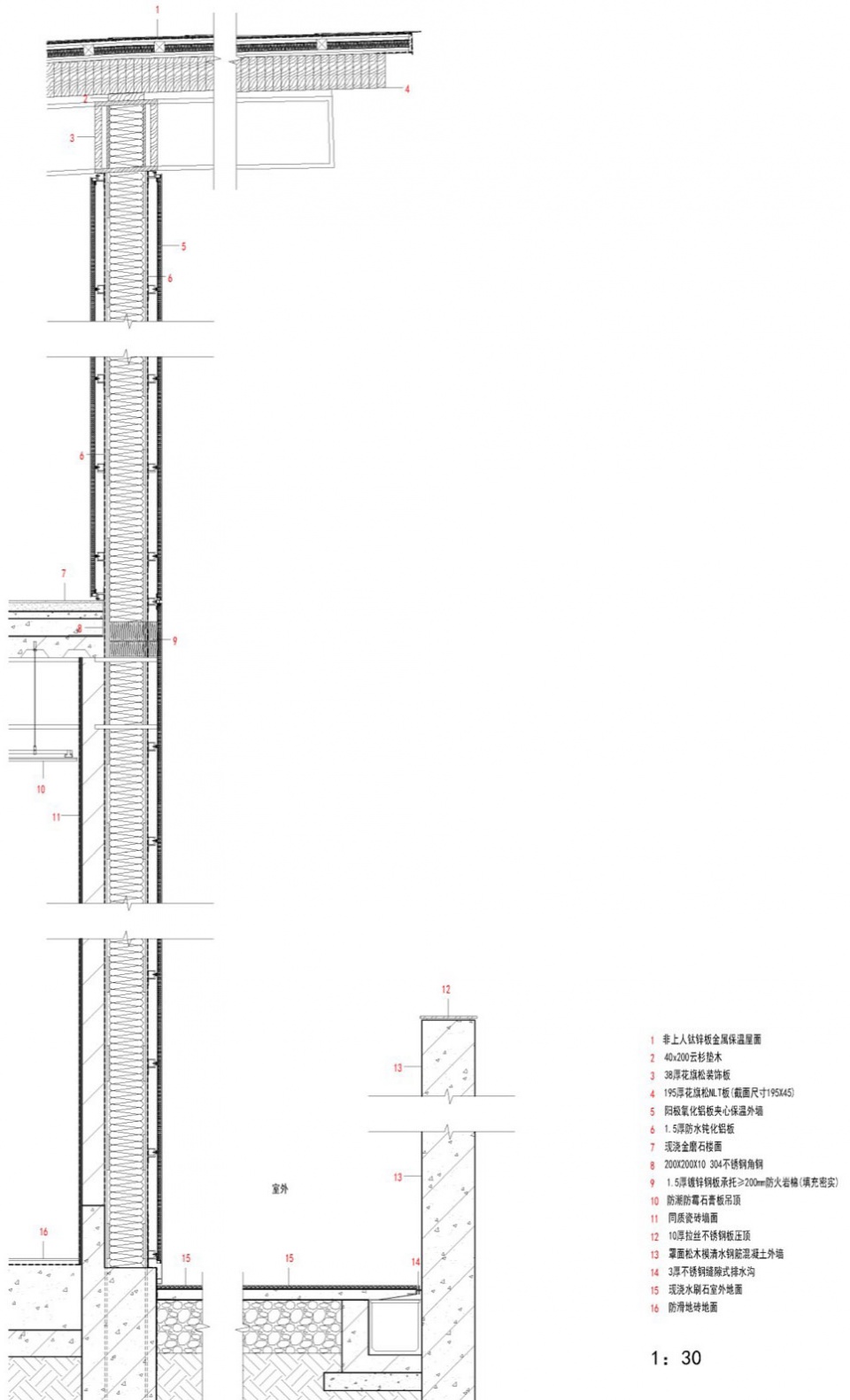
屋面形态拟合“落叶”意象,一片面湖弯折内凹、倾斜翘曲的双曲面出挑屋面形成中部低匐、四角上扬的飞檐造型。该曲面采用NLT钉接胶合木的实木拼接体系构成,并通过与屋面曲面拟合的、像“叶脉”般有机交错的镶木工字钢曲梁格构来承托屋面,并成为控制室内氛围的特征强烈的露明天花。屋面下的围护立面主要由间隔排列的玻璃窗和阳极氧化铝板复合墙体竖向条带构成,支撑在混凝土的基础导墙和后勤台基体量上。非透明的复合墙体内芯是特殊适配的承重格构钢柱,并为整个屋面提供足够的侧向刚度;建筑内部在不同的梁格交点随机布置的纤细圆钢柱则是只承受竖向力的摇摆柱,使空间呈现出自由状态。银灰色系的漫反射材料和玻璃一起使建筑体量趋于消隐在周围环境之中,而翘曲屋顶底面明快轻盈的温暖木色更强化了屋顶的漂浮感。
The roof design evokes the image of “fallen leaves,” with a lake-facing, inward-bent, and inclined hyperbolic surface forming a central low-lying area and upward-curved eaves at the corners. This curved surface is constructed using a solid wood splicing system of NLT (Nailed Laminated Timber) and supported by an intricate lattice of curved timber-set I-beams, which are designed to fit the roof’s curvature and resemble “leaf veins.” This structure also serves as a striking exposed ceiling that enhances the interior atmosphere. The enclosing facade under the roof consists of interval arranged vertical strips of glass windows and anodized aluminum sheeting composite wall, supported by concrete foundation guide walls and concrete pedestal of logistical volume. The inner core of non-transparent composite wall include specially adapted load-bearing lattice steel columns that provide the necessary lateral stiffness for the entire roof. Inside the building, slender round steel columns randomly placed at different beam intersections are swing columns that only bear vertical loads, creating a sense of spatial freedom. The silver-gray diffuse reflective materials and glass blend the building volume fading into its surroundings, while the warm wooden tones of the curved roof bottom surface further enhance its floating appearance.
▼明叶轩一层室内,Ground floor interior of Floating Leaf Pavilion
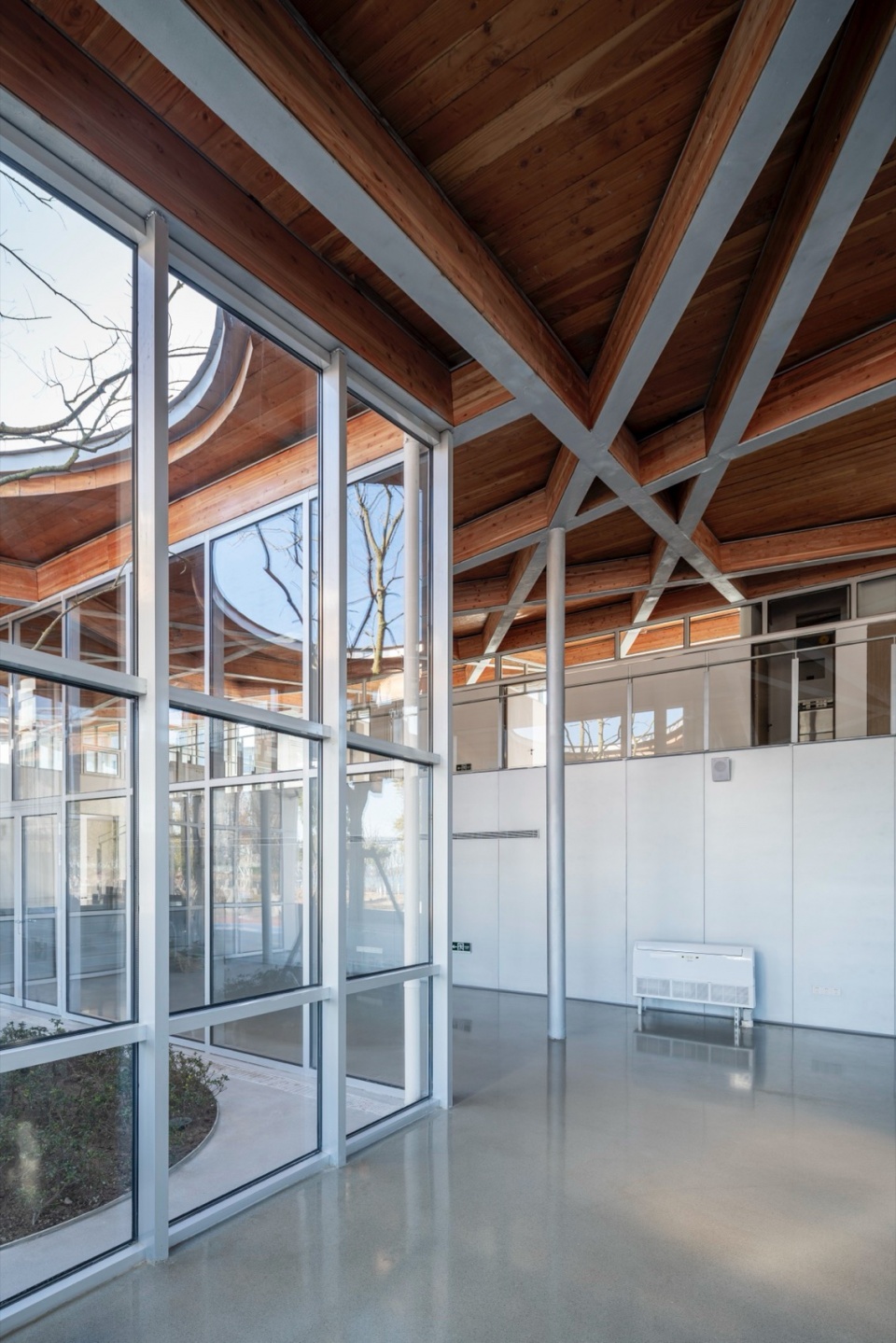
▼明叶轩连续的空间体验,Continuous spatial experience of Floating Leaf Pavilion
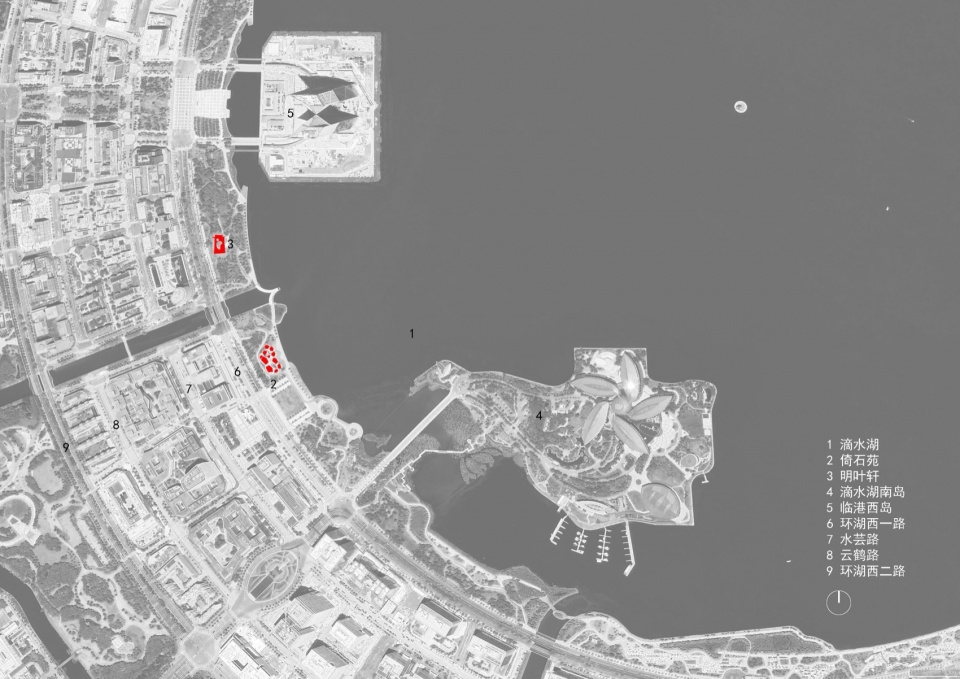
▼区位,Location map
▼倚石苑总平面图,Master plan of Clustered Rocks Court
▼倚石苑一层平面,Ground floor plan of Clustered Rocks Court
▼倚石苑二层平面,Second floor plan of Clustered Rocks Court
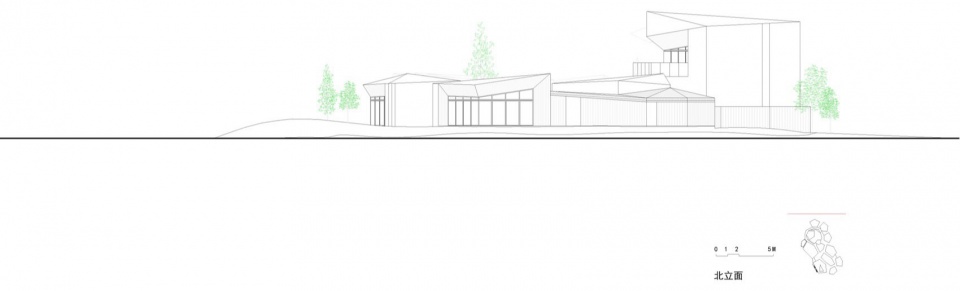
▼倚石苑北立面,North elevation of Clustered Rocks Court
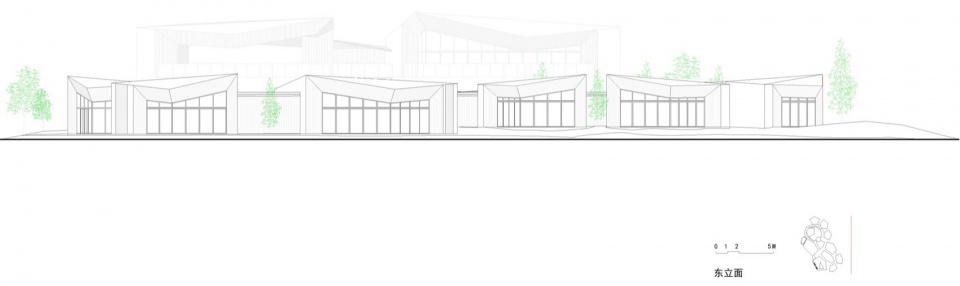
▼倚石苑东立面,East elevation of Clustered Rocks Court
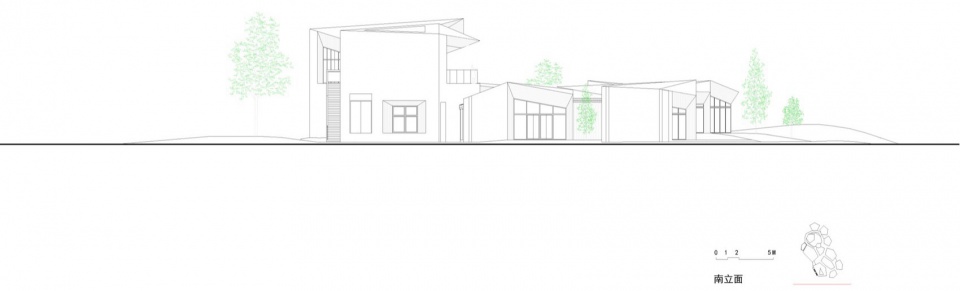
▼倚石苑南立面,South elevation of Clustered Rocks Court
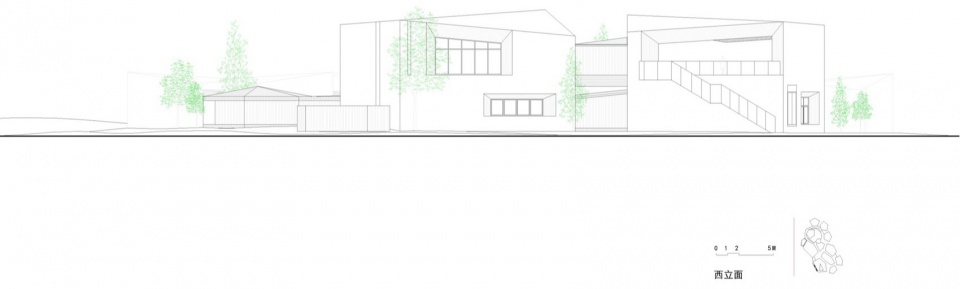
▼倚石苑西立面,West elevation of Clustered Rocks Court
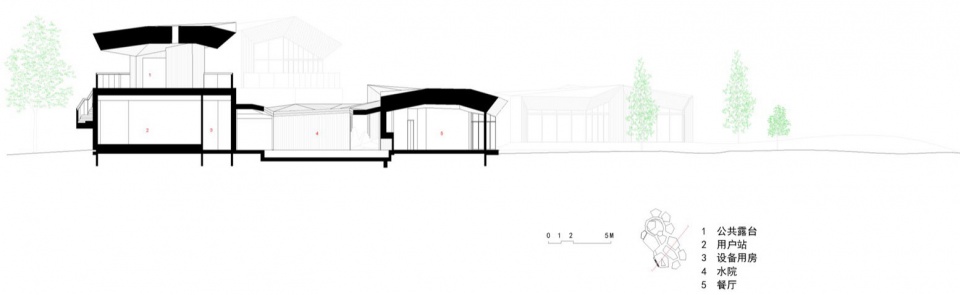
▼倚石苑剖面1,Section 1 of Clustered Rocks Court
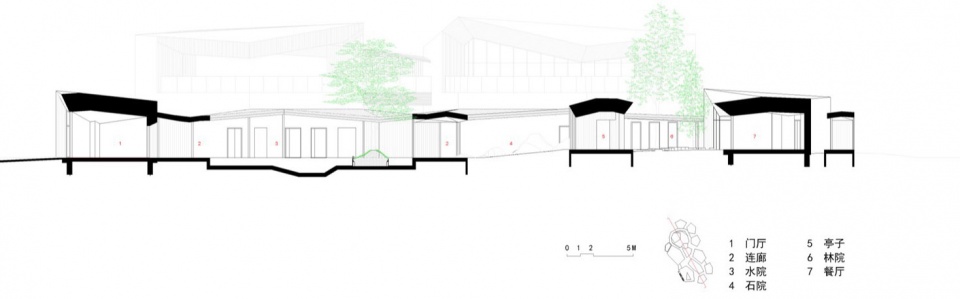
▼倚石苑剖面2,Section 2 of Clustered Rocks Court
▼倚石苑详图1,Detail drawing 1 of Clustered Rocks Court
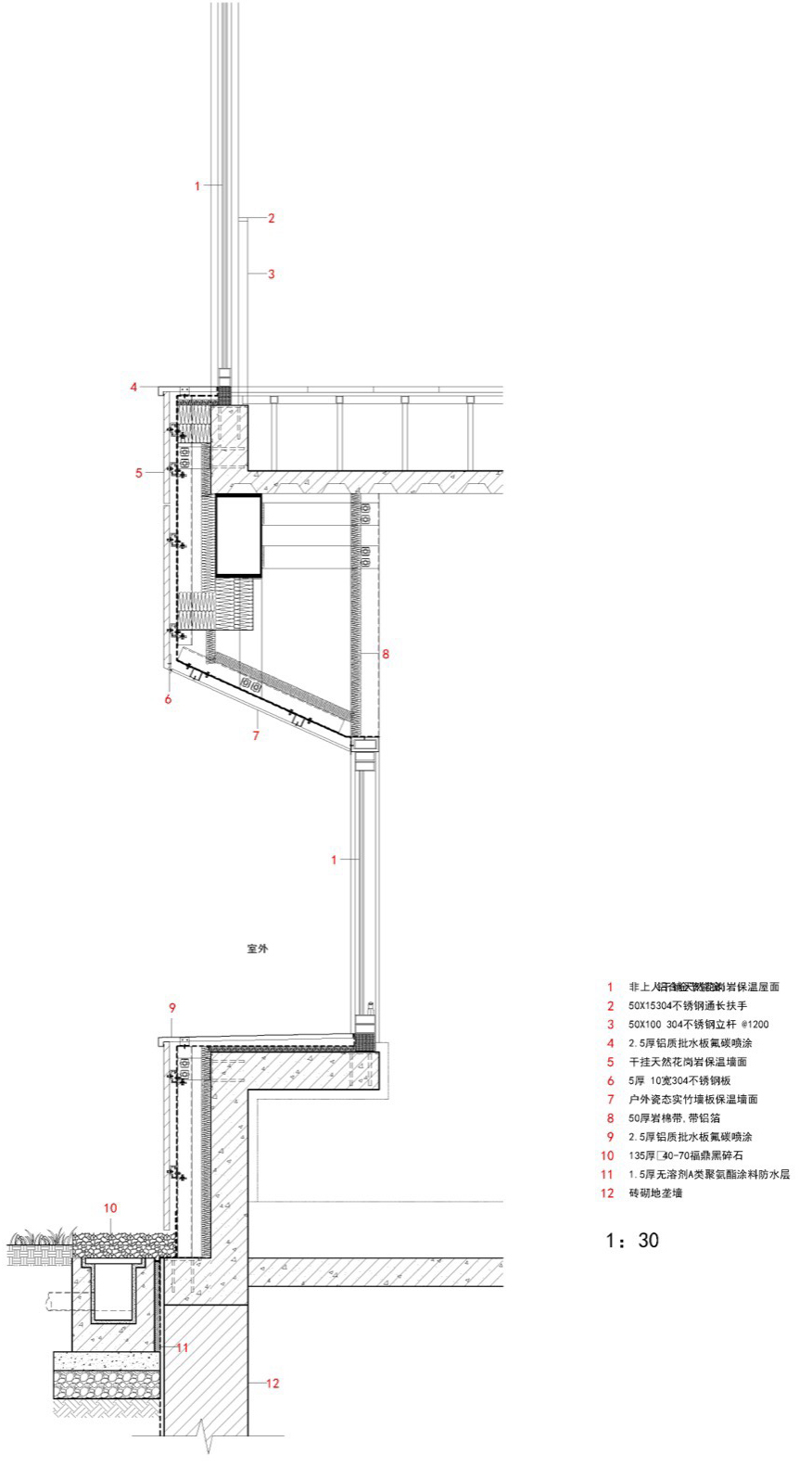
▼倚石苑详图2,Detail drawing 2 of Clustered Rocks Court
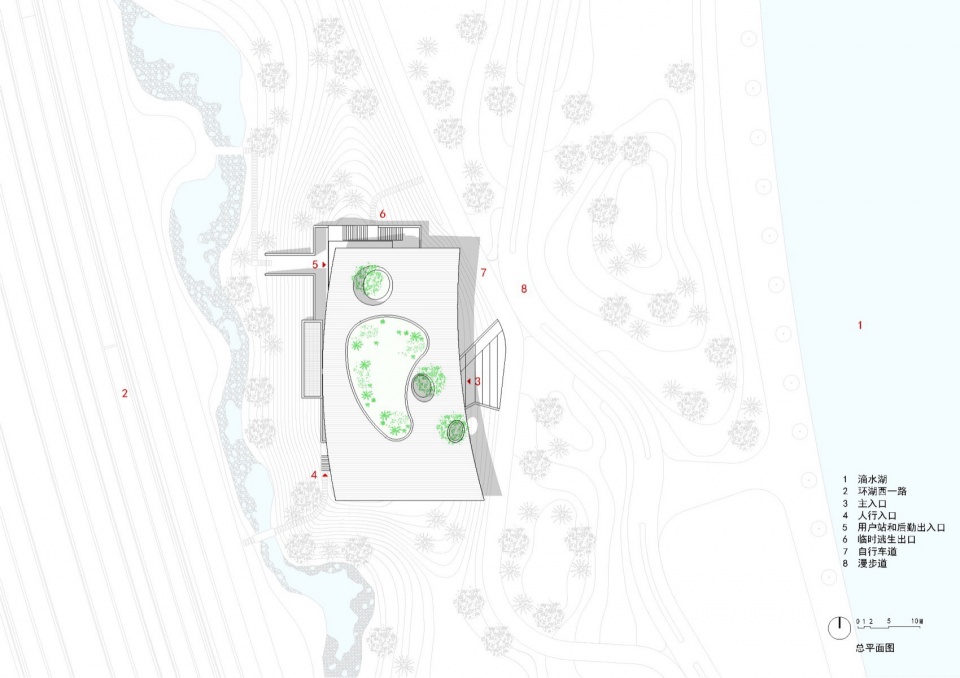
▼明叶轩总平面图,Master plan of Floating Leaf Pavilion
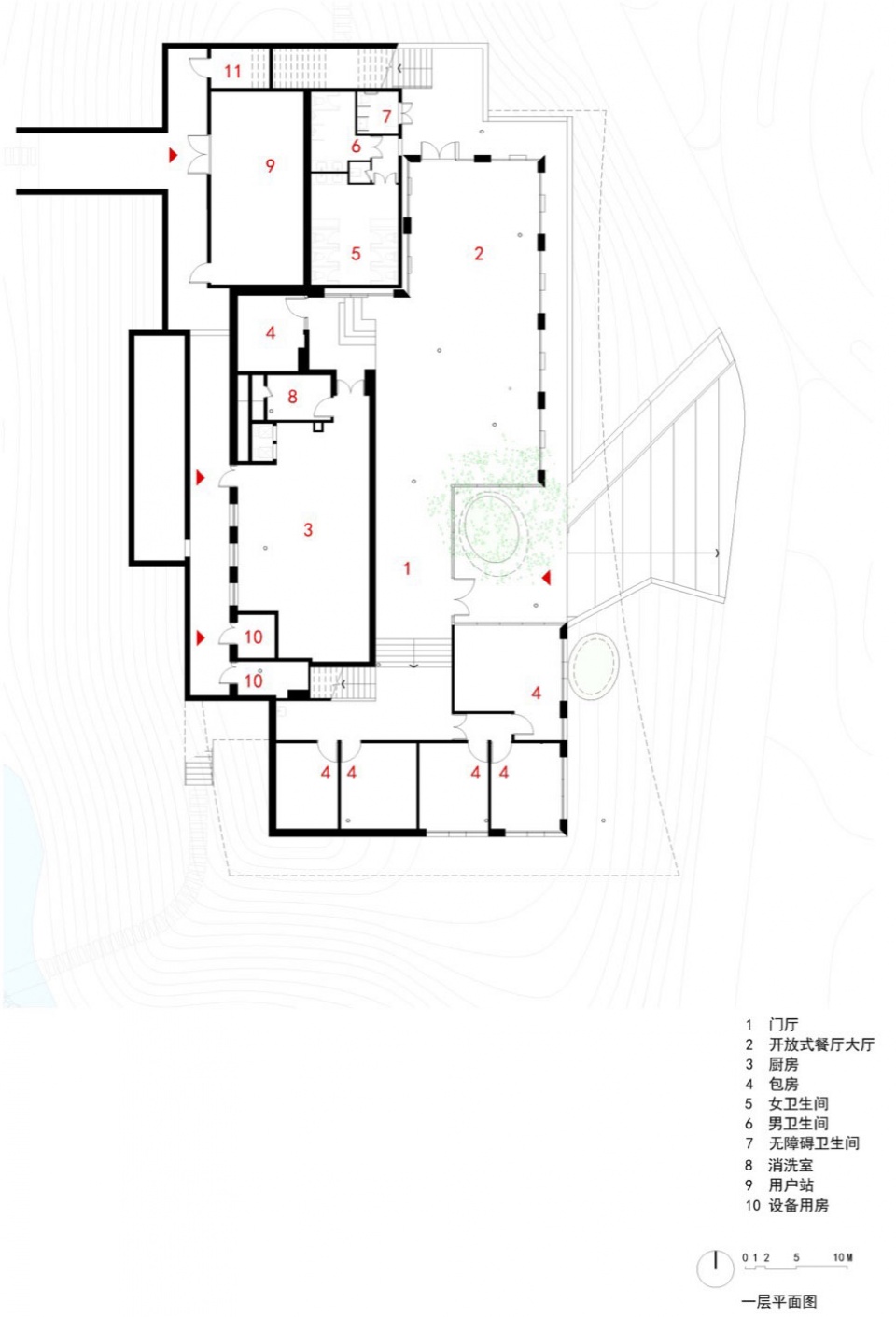
▼明叶轩一层平面,Ground floor plan of Floating Leaf Pavilion
▼明叶轩二层平面,Second floor plan of Floating Leaf Pavilion
▼明叶轩东立面,East elevation of Floating Leaf Pavilion
▼明叶轩北立面,North elevation of Floating Leaf Pavilion
▼明叶轩西立面,West elevation of Floating Leaf Pavilion
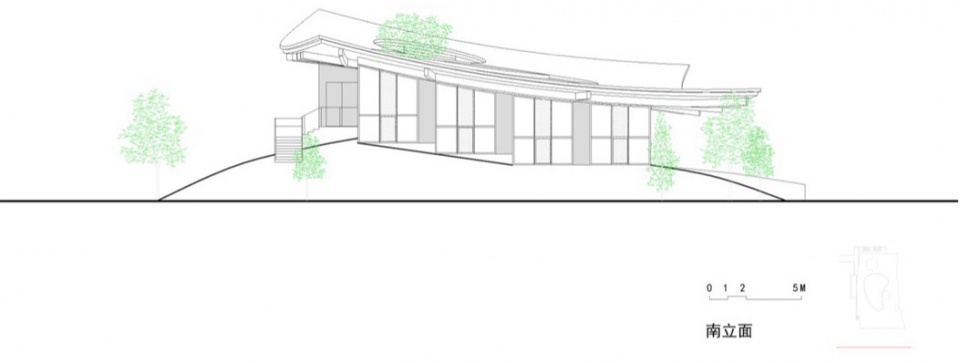
▼明叶轩南立面,South elevation of Floating Leaf Pavilion
▼明叶轩剖面1,Section 1 of Floating Leaf Pavilion
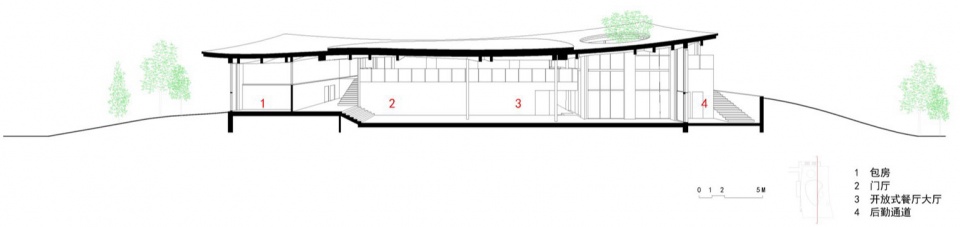
▼明叶轩剖透视2,Sectional perspective 2 of Floating Leaf Pavilion
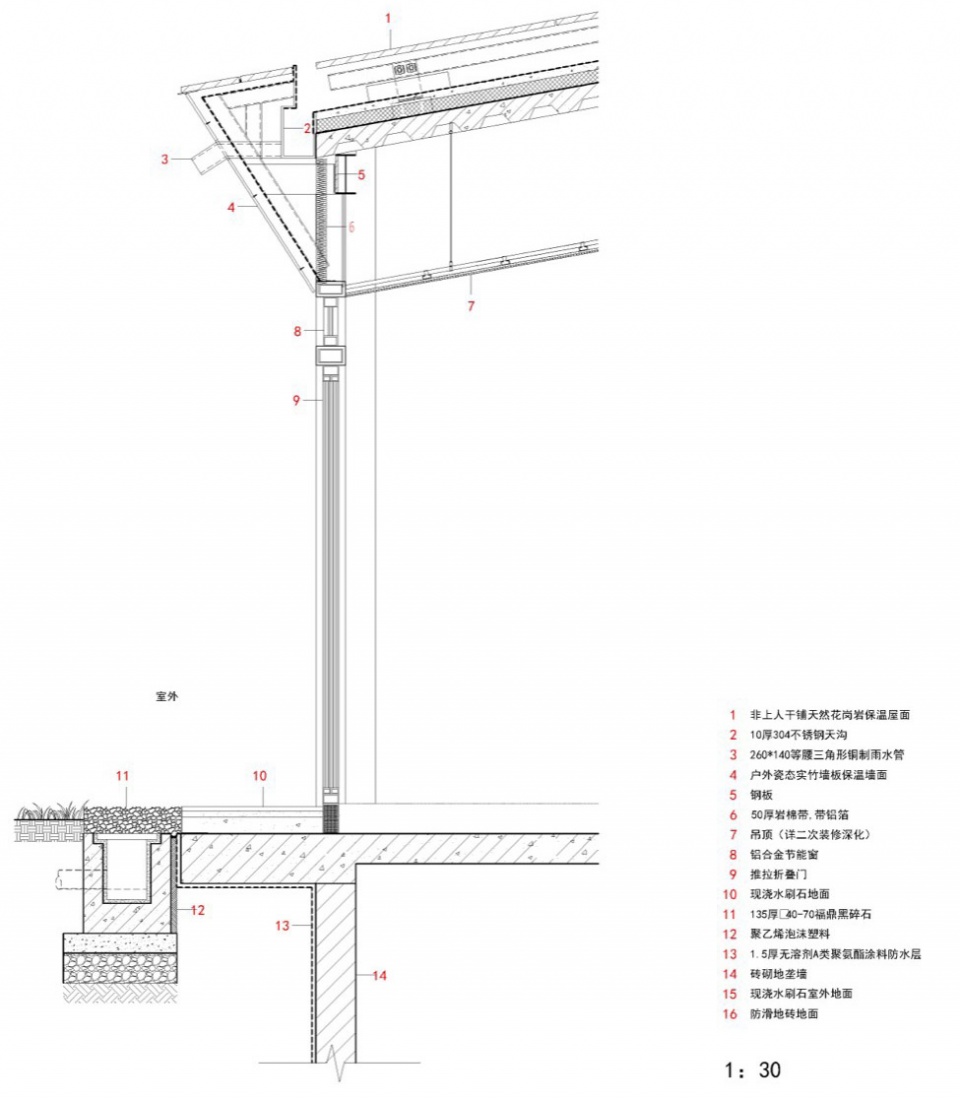
▼明叶轩详图,Detail drawing of Floating Leaf Pavilion
项目档案
Credits and Data
Project Name: Clustered Rocks Court & Floating Leaf Pavilion, Two Service Buildings in the Landscape Belt Around the Dishui Lake, Lin-Gang Special Area, Pudong, Shanghai
Architects: ZHOU Wei + ZHANG Bin / Atelier Z+
Partner in Charge: ZHANG Bin
Project Architect: LI Qin, Wang Jiaqi (Landscape Design, Construction Coordination)
Project Team: HUANG Ruiqi, CAI Han, YANG Xinyue, HONG Kaiyue, LI Wenying, LIU Xiaoman, XU Yue, LIU Shaoshuai, TAO Yuhang, ZHANG Yunfan, SHI Aiwei (Intern), SHAN Zhuyan (Intern), LI Mengyao (Intern), XU Xinyi (Intern), ZENG Gangjun (Intern), ZHANG Lehan (Intern)
Landscape Consultant: Shanghai Zhixiu Architectural Planning and Design Co., Ltd / HE Qian
Structure Consultant: Shanghai Mozheng Architectural Design Co., Ltd / GUO Qiang, ZHANG Ziye, CHEN Xuyucheng
M & E Consultant: Shanghai Zhisheng Architectural Decoration Design Co., Ltd. / YU Xiaoming, FAN Xin, MAO Bei
Lighting Consultant: Lighting Engineering Institute of Shanghai Tongji Architectural Interior Design Engineering Co.,Ltd. / HE Di, LI Ying
Design General Contractor: Arch-union Architects
Project Leader: HAN Li
Architecture Design: KONG Xiangping, JIN Jinqi
Structure Design: HUANG Tao, SUN Haxun
HVAC Design: WANG Yong
Drainage Design: CHEN Jiandong
Strong Current Design: WEI Dawei, ZHANG Qing
Weak Current Design: WEI Dawei, ZHANG Qing
Location: Within the Zone E2 and Zone F on Both Sides of Huangrigang River in the Landscape Belt around Dishui Lake, Lin-Gang Special Area
Service Building 3: 188 West-1 Ring Lake Road, Lin-Gang Special Area
Service Building 4: 288 West-1 Ring Lake Road , Lin-Gang Special Area
Client: Shanghai Harbour City Development (Group) Co., Ltd.
Construction General Contractor: Shanghai Nanhui Construction Engineering (Group) Co., Ltd
Design Period: 2020.10-2022.02
Construction Period: 2021.08-2023.03
Site Area: Service Building 3: 3,557m²
Service Building 4: 1,730m²
Building Area: Service Building 3: 1,228m²
Service Building 4: 631m²
Gross Floor Area: Service Building 3: 1,339m²
Service Building 4: 800m²
Structure: Service Building 3: Steel Frame Structure
Service Building 4: Steel Frame Structure+ NLT (Nailed Laminated Timber) Roof Structure
Building Story: 2 Stories
Principal Use: Restaurant, Kitchen, Restroom, Electric Power Subscriber Station
Primary Materials: Granite Slab, Fair-faced Concrete, Titanium Zinc Sheeting, Aluminum Plate and Profile, Perforated Aluminum Plate, Steel Profile, Fluorocarbon Coating, Slab Glass, Douglas Fir Glued Laminated Timber, Glued Laminated Bamboo Wall Panel and Flooring, Rigid Sand Curing Agent Concrete Wear-resistant Floor
Primary Interior Materials: Cast-in-situ Epoxy Terrazzo Floor, In-situ Golden Millstone, Anodized Aluminum Sheeting, Glazed Glass, Ceramic Tile, Painting
Primary Landscape Materials: Cast-in-situ Granitic Plaster Pavement, Creek Pit Stone, Granite, Cobblestone, Wear Resistant Concrete
Photography: YANG Min