马斯克佩通族帕瓦仪式棚,加拿大 / Oxbow Architecture + Richard Kroeker
Oxbow Architecture 与 Richard Kroeker 合作,荣幸地宣布马斯克佩通族帕瓦仪式棚荣获两项建筑界最高荣誉:Architizer A+奖以及由加拿大皇家建筑学会(RAIC)与加拿大艺术委员会颁发的2026年总督建筑奖章。这份殊荣属于马斯克佩通·索托族(Muscowpetung Saulteaux Nation)。这一成功彰显了马斯克佩通族领导层对其族人的坚定承诺,也是马斯克佩通族的 Myke Agecoutay 与 Jeff Cappo 悉心指导的成果。
Oxbow Architecture, in collaboration with Richard Kroeker, is proud to announce that the Muscowpetung Powwow Arbour has received two of architecture’s most prestigious honours: the Architizer A+ Award and the 2026 Governor General’s Medal in Architecture, presented by the Royal Architectural Institute of Canada (RAIC) and the Canada Council for the Arts. This recognition belongs to Muscowpetung Saulteaux Nation. Its success demonstrates the commitment of Muscowpetung’s Leadership to its people and is a result of the careful guidance of Muscowpetung’s Myke Agecoutay and Jeff Cappo.
▼极光与仪式棚,the aurora and the Muscowpetung Powwow Arbour
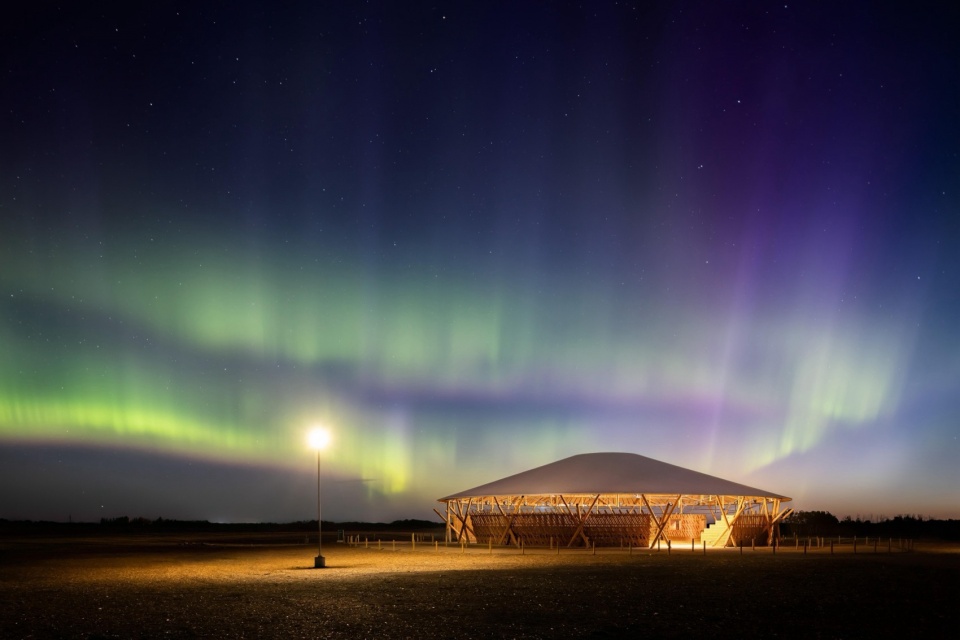
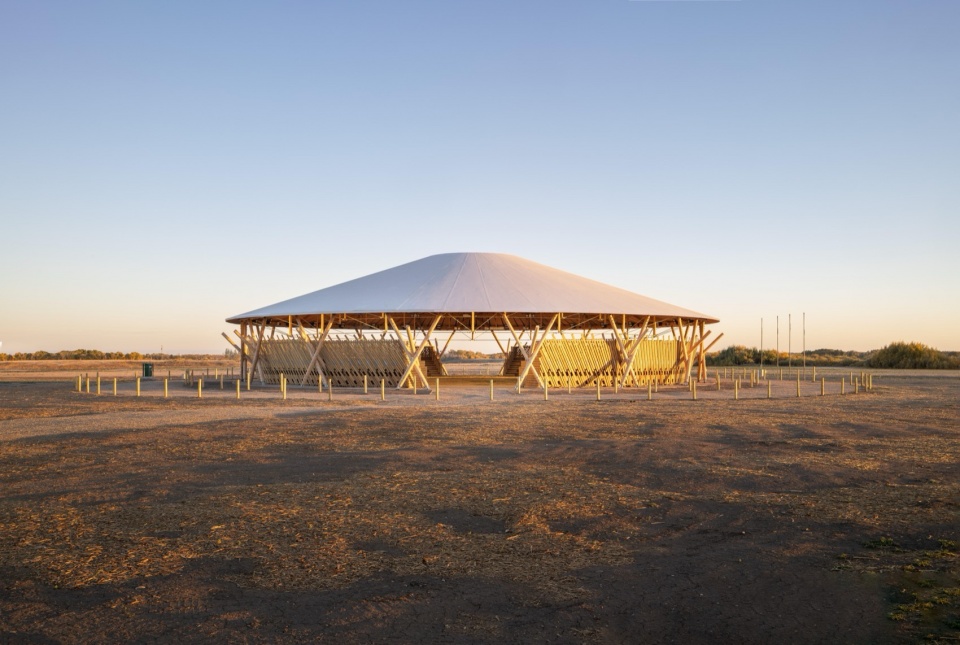
马斯克佩通族帕瓦仪式棚坐落于萨斯喀彻温省南部、条约4领地之上,是一处植根于索托族传统与社区复兴的充满活力的文化聚会场所。该建筑作为夏季帕瓦庆典的中心场地而设计,其灵感源自索托族的物质文化与圆形的象征意义。通过广泛征求长老意见而确定的无柱圆形形态,既让人联想到传统棚屋,又营造出一个轻盈的、仿佛漂浮在草原地平线上的屋顶。该项目旨在强化传统、弘扬文化,并鼓励社区成员将知识代代相传。建筑设计经由社区及部落领导层协商确定,尤其得到了当地知识守护者 Jeff Cappo 的宝贵建议。建成后的仪式棚占地1275平方米,可容纳多达2500名观众和1000名舞者。
Located on Treaty 4 territory in southern Saskatchewan, the Muscowpetung Powwow Arbour is a vibrant cultural gathering place rooted in Saulteaux tradition and community renewal. Designed as the centrepiece for summer powwow celebrations, the structure draws inspiration from Saulteaux material culture and the symbolic importance of the circle. Its clear-span circular form, informed through extensive Elder consultation, recalls traditional lodges while creating a lightweight roof that appears to float on the prairie horizon. The project’s purpose is to strengthen traditions, celebrate culture, and encourage community members to pass along knowledge to future generations. The building design was established through community and band leadership consultation, most notably with local knowledge keeper Jeff Cappo. The completed arbour spans 1,275 square metres, accommodating up to 2,500 spectators and 1,000 dancers.
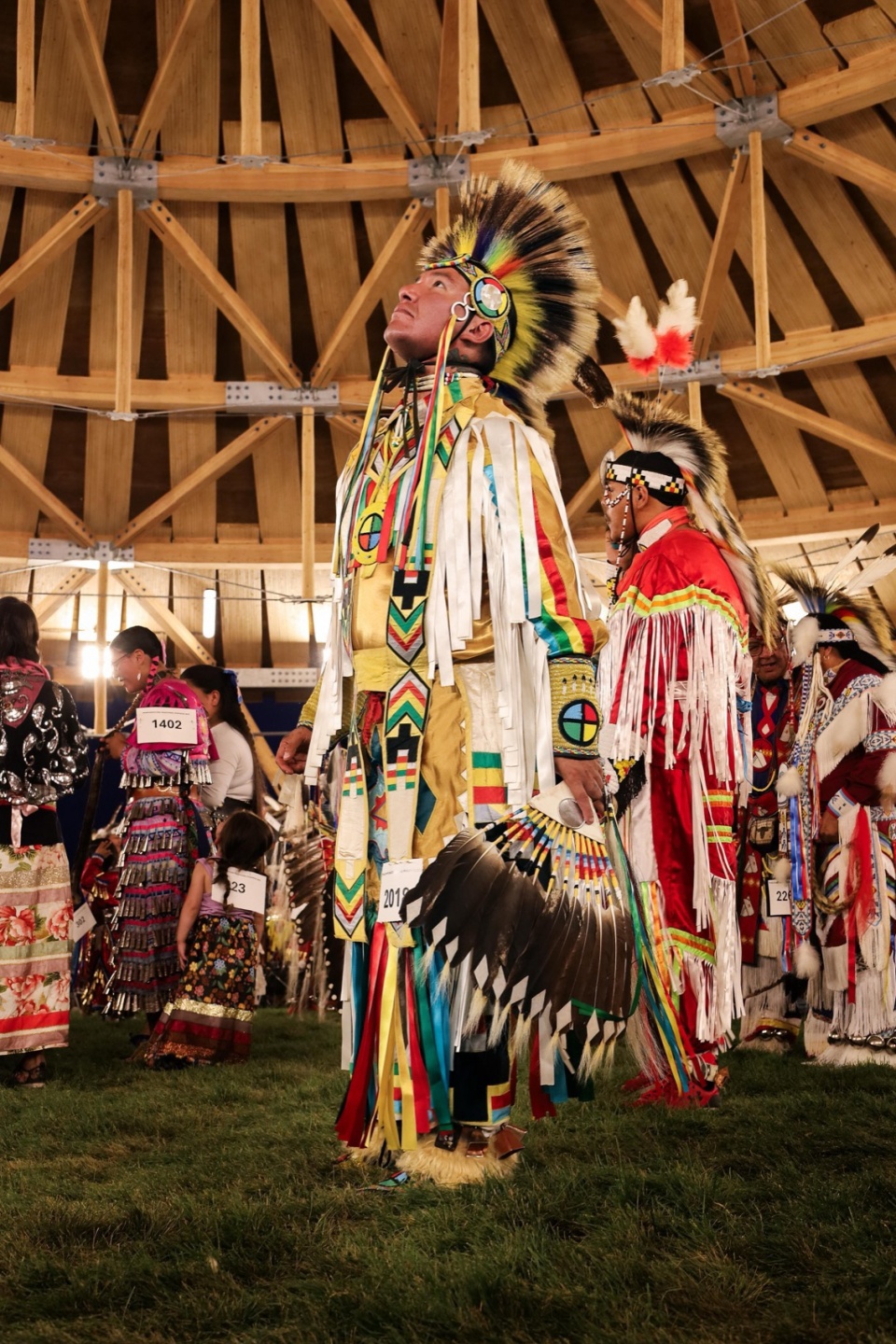
▼马斯克佩通族帕瓦仪式,the Muscowpetung Powwow event
背景Context
萨斯喀彻温省碳密集型的电网带来了严峻的建筑运营碳排放挑战——该省建筑的运营所产生的二氧化碳当量(CO₂e),可比安大略等以水电和核电为主的省份的同类型建筑高出多达700%。马斯克佩通族帕瓦仪式棚打造了一座非空调的文化建筑,通过被动式策略来实现在陆上文化活动集中的三个季节(春、夏、秋)中的热舒适性。最终形成的这份气候响应型设计,以传统的索托族知识与资源管理实践为指导,将重点完全转向降低隐含碳和实施可再生景观策略,以期在五年内实现碳中和。
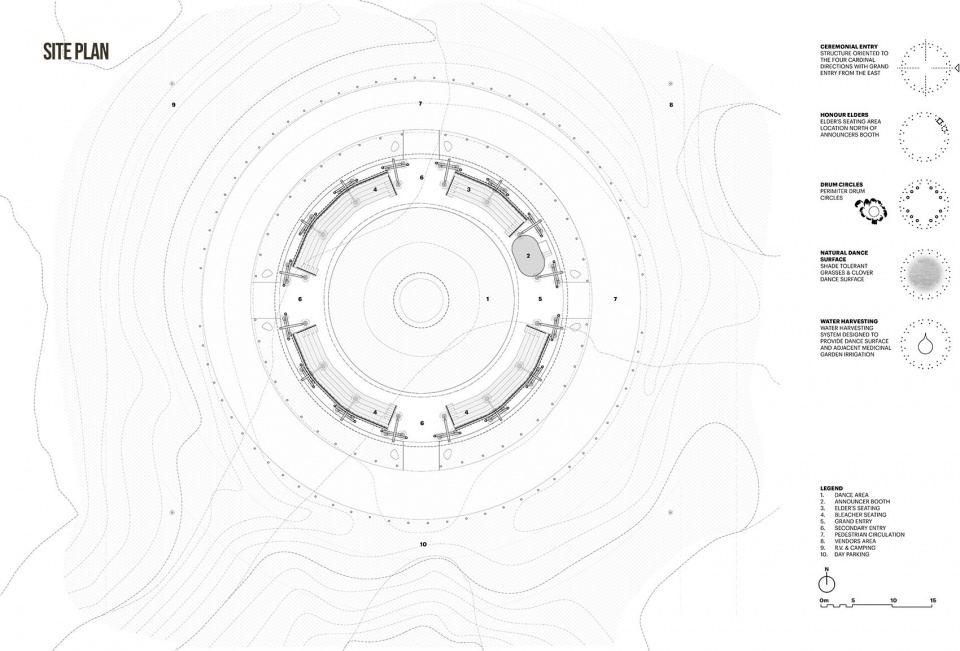
▼场地平面图,site plan
Saskatchewan’s carbon-intensive electrical grid presents a significant operational emissions challenge — building operations in the province can produce up to 700% more CO₂e than equivalent buildings in Canada’s provinces such as Ontario, where hydroelectric and nuclear power dominate the grid. The Muscowpetung Powwow Arbour delivers an unconditioned cultural building that looks at passive strategies for achieving thermal comfort for the three seasons (spring, summer, fall) where land-based cultural activities take place. The resultant climate responsive design, guided by traditional Saulteaux knowledge and resource stewardship practices, shifts it’s focus entirely to embodied carbon reduction and regenerative landscape strategies to achieve carbon neutrality within a 5 year period.
▼裙房一层平面图,Podium Ground Floor Plan
回馈型建筑Architecture That Gives Back
该项目通过鼓励在建设过程中雇佣本地劳动力来支持社区经济目标,其施工方式亦与当地资源和技能相匹配。从各个意义上说,该仪式棚都是一项再生性发展,它体现了索托族“Mino-pimatisiwin”——“美好生活”的理念,并直接回应了气候危机以及马斯克佩通族社区的需求。
The project supports community economic objectives by engaging local sources of labour in the building process, with construction approaches strategically aligned with local resources and skills. A regenerative development in every sense, the Arbour reflects the Saulteaux concept of Mino-pimatisiwin — “live a good life” — and responds directly to both the climate crisis and the needs of the Muscowpetung community.
▼外观,exterior view
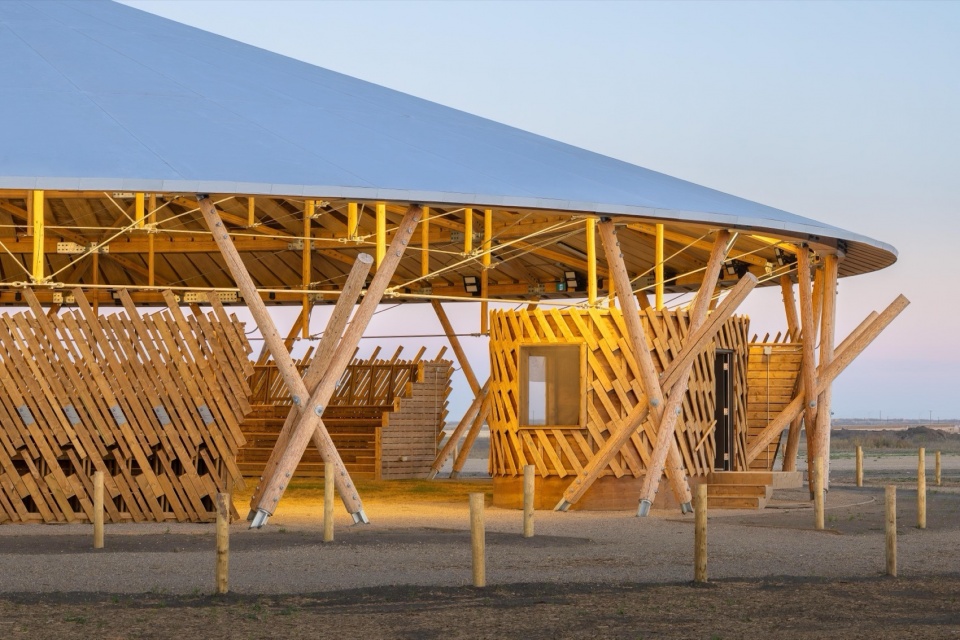
仪式棚采用本地的圆木和本地劳动力建造,通过气候响应型、资源节约型的建造方式体现了传统知识。锥形屋顶中央敞开,天光得以洒落,滋养下方的草地,使景观与建筑融为一体。除建筑学意义外,该仪式棚还作为一个文化锚点,支持家庭福祉、教育和社区聚会。该项目周围环绕着修复后的原生草原,展现了再生设计理念,其生态修复和碳封存有助于实现碳中和,同时为子孙后代延续文化传承。
Built with regionally sourced round timber and local labour, the Arbour reflects traditional knowledge through climate-responsive, resource-efficient construction. Open at its centre, the conical roof admits light to sustain the grasses below, blending landscape and architecture. Beyond its architectural significance, the Arbour serves as a cultural anchor supporting family wellness, education, and community gathering. Surrounded by restored native prairie, the project demonstrates regenerative design, with ecological restoration and carbon sequestration supporting carbon neutrality while strengthening cultural continuity for generations to come.
▼圆形的结构形式兼具文化意义与技术效率,the circular structural form supports both cultural significance and technical efficiency
一体化设计策略Integrated Design Strategy
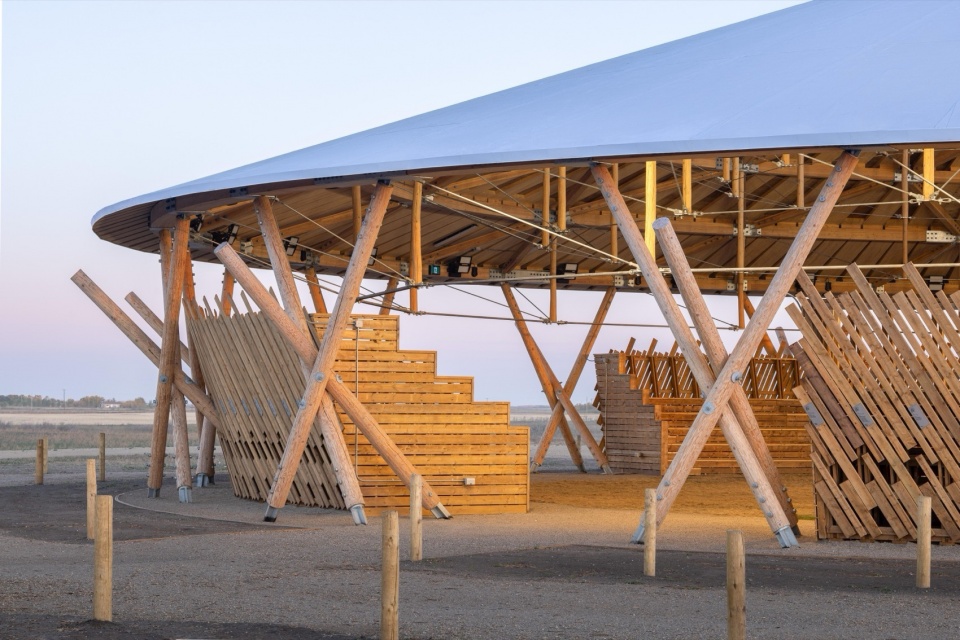
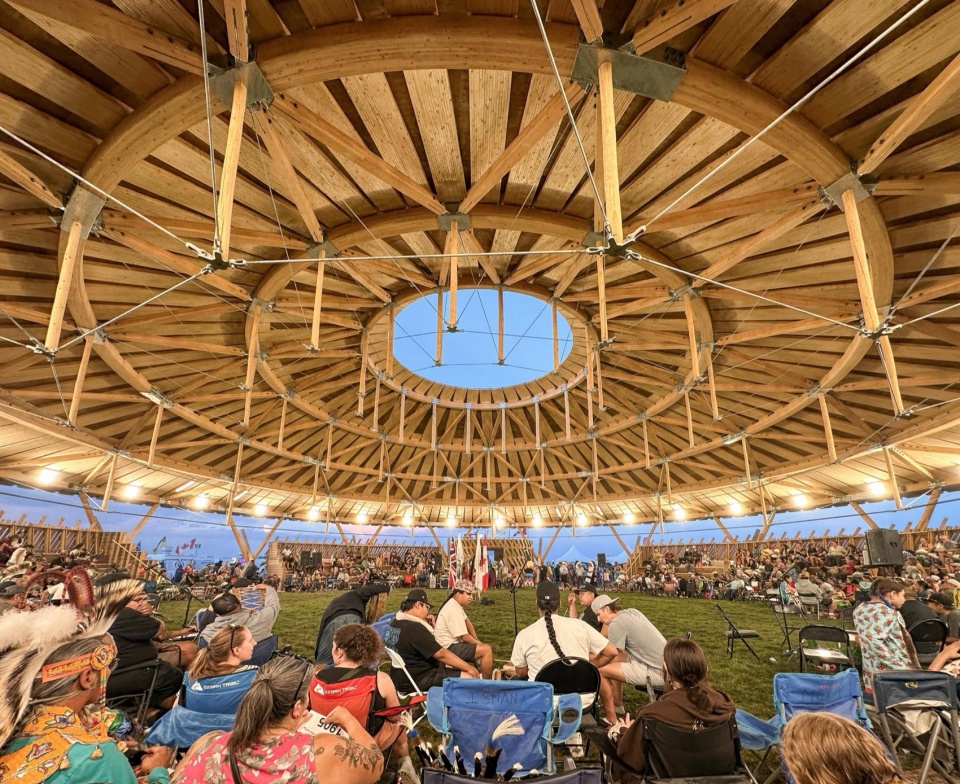
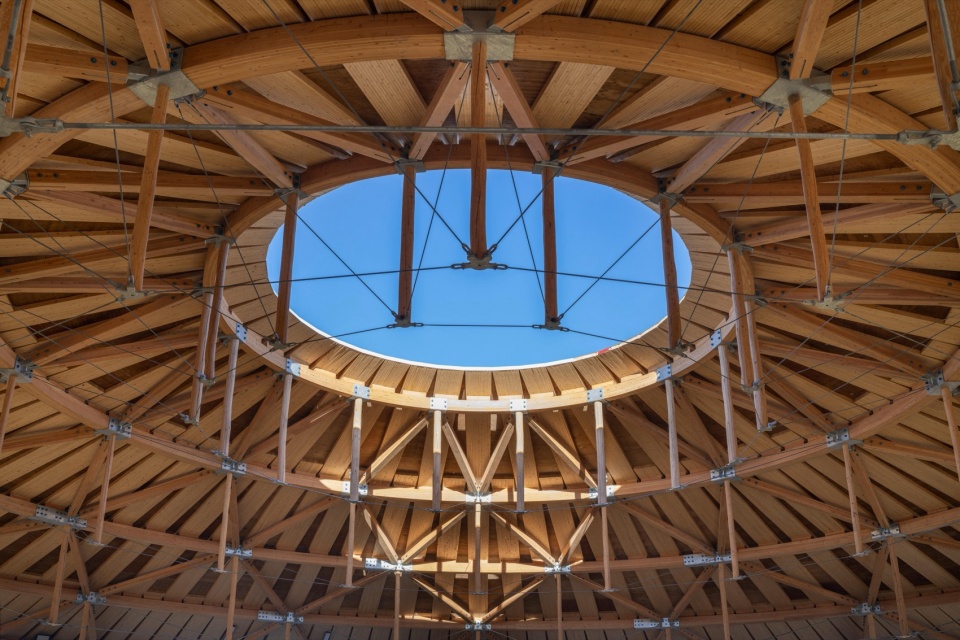
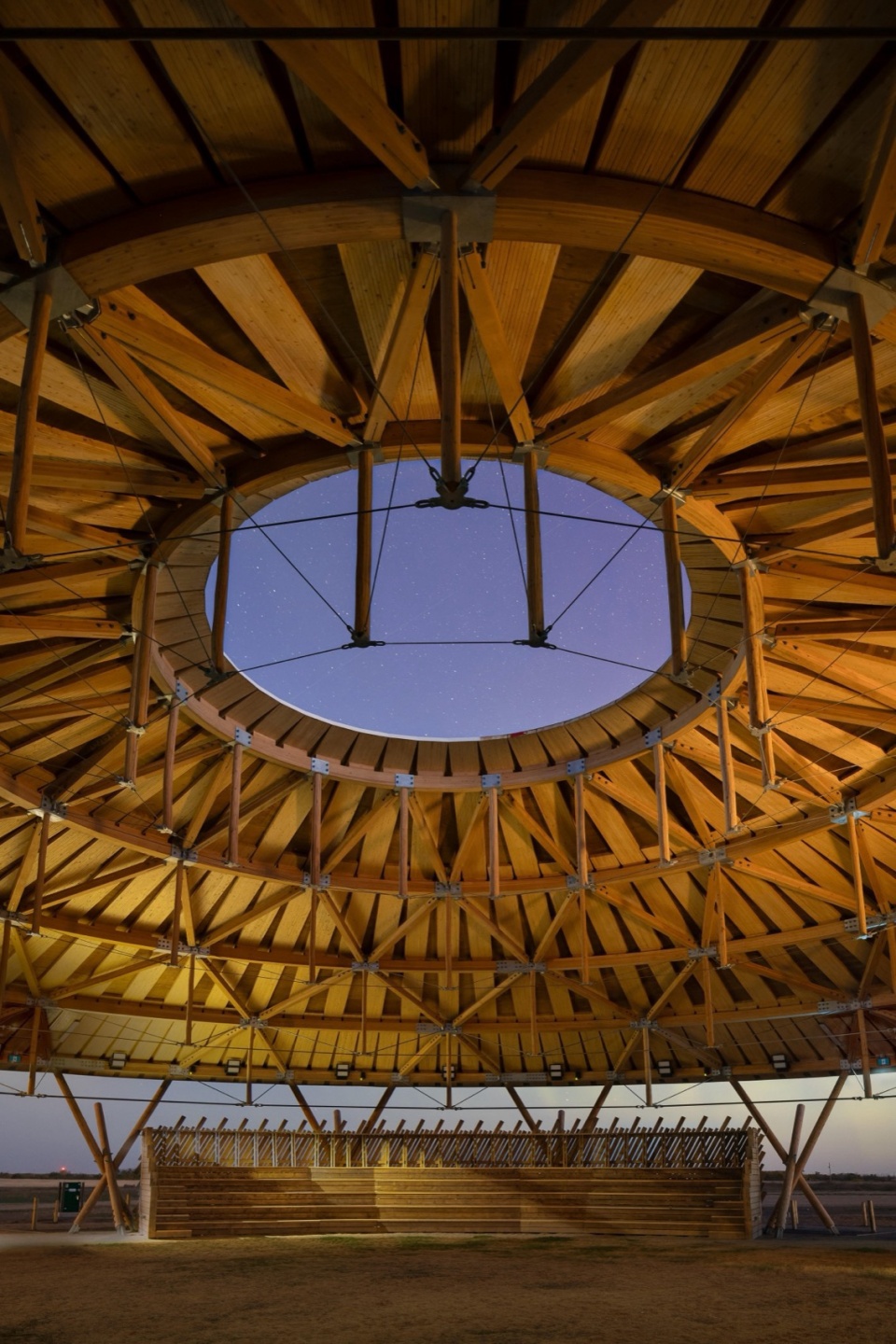
圆形的结构形式兼具文化意义与技术效率。锥形屋顶在天眼处敞开,为下方的舞池提供自然采光,同时允许耐阴的地被植物生长,并在使用期间无需人工照明。景观与结构被视为一个统一的整体系统。
The circular structural form supports both cultural significance and technical efficiency. The conical roof, open at the oculus, admits daylight to the dance area below, sustaining shade-tolerant ground cover and eliminating the need for artificial lighting during use. Landscape and structure are treated as a single integrated system.
▼除建筑学意义外,该仪式棚还作为一个文化锚点,the Arbour serves as a cultural anchor supporting family wellness, education, and community gathering
▼锥形屋顶在天眼处敞开,the conical roof, open at the oculus
成果Outcome
马斯克佩通族帕瓦仪式棚证明,植根于传统原住民知识的设计能够产生可衡量、可量化的气候成效。该项目被归类为再生性发展,其在整个生命周期内封存的碳超过其产生的碳排放,同时为土地恢复了生态效益。
The Muscowpetung Powwow Arbour demonstrates that design rooted in traditional Indigenous knowledge can produce measurable, quantifiable climate outcomes. The project is classified as a regenerative development, sequestering more carbon than it produces over its lifecycle while restoring ecological benefits to the land.
▼结构,structure
全生命周期评估Whole Life Cycle Assessment
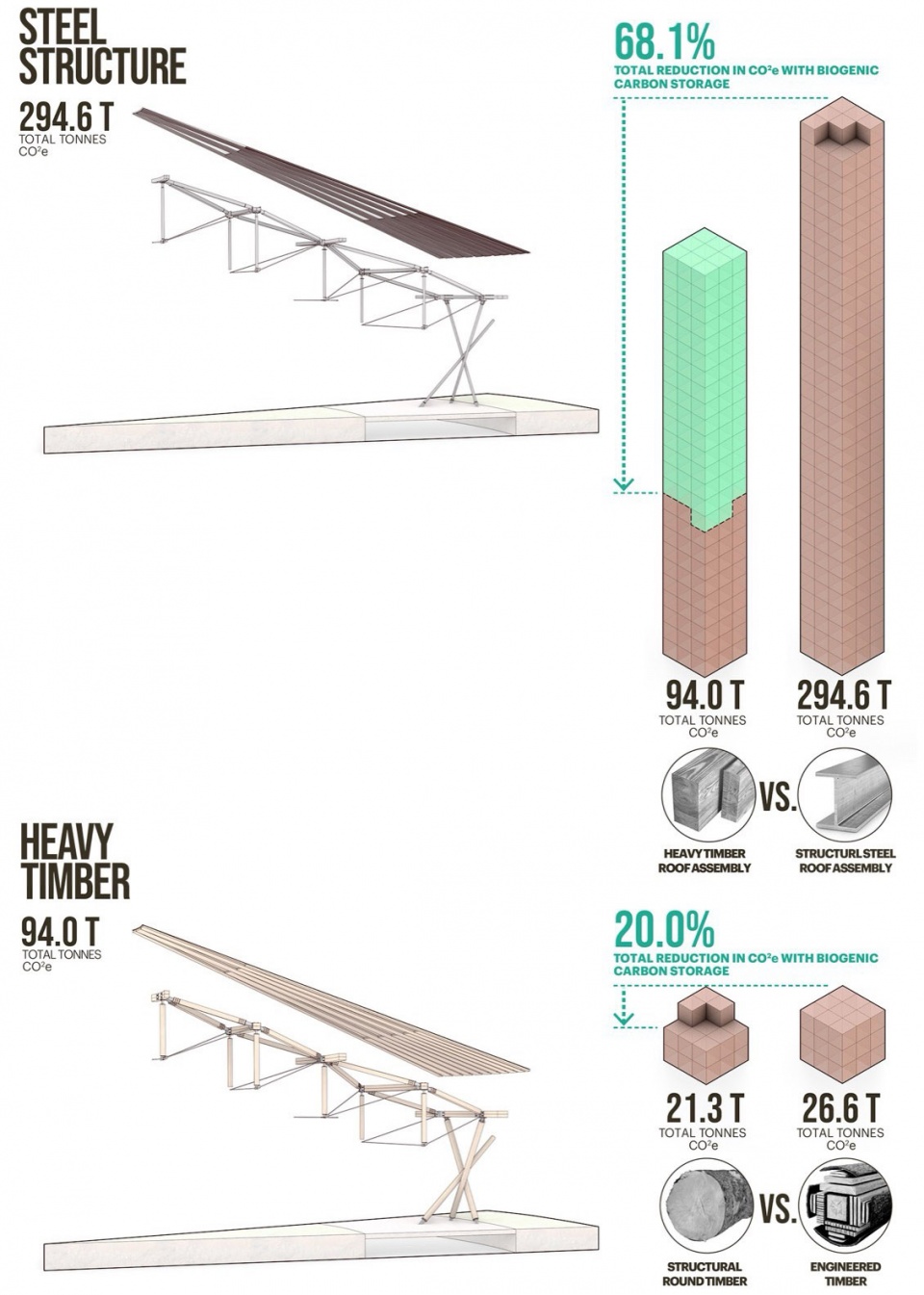
在整个设计过程中,全生命周期评估(WLCA)主导了材料选择和结构装配决策。
木材与钢材对比: 采用含生物碳储存的重型木结构,其二氧化碳当量排放相较于钢结构方案减少了68%。
结构用圆木(SRT)替代工程胶合木: 使每个结构构件的隐含碳排放额外减少了20%。
结构用圆木仅需极少的加工,保持了连续的木材纤维方向,并通过取消外包简化了供应链,从而减少了运输和制造过程中的排放。
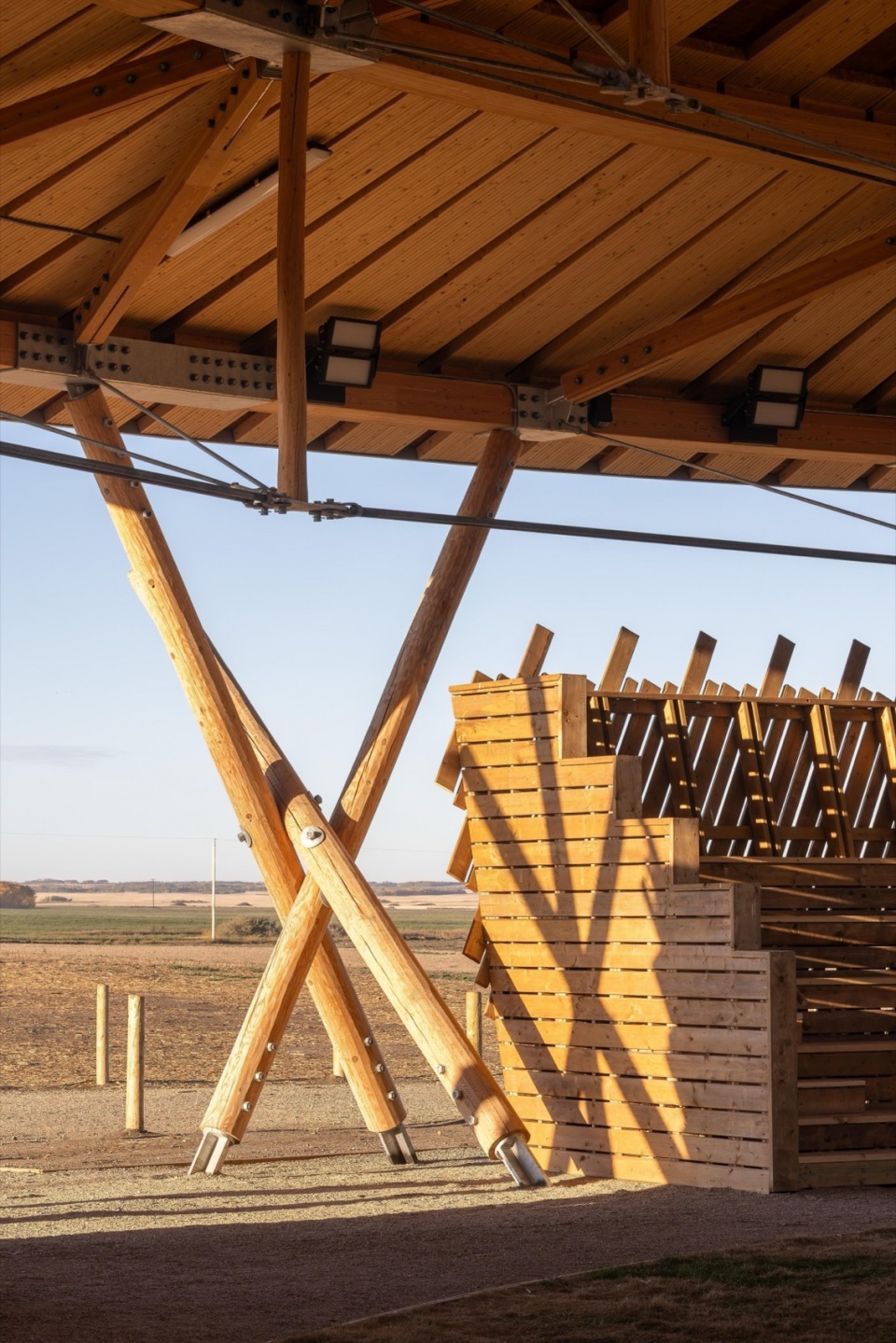
三脚柱的几何结构使较小直径的圆木即可实现结构稳定性,避免采伐用于生产规格材锯材所需的大型树木。
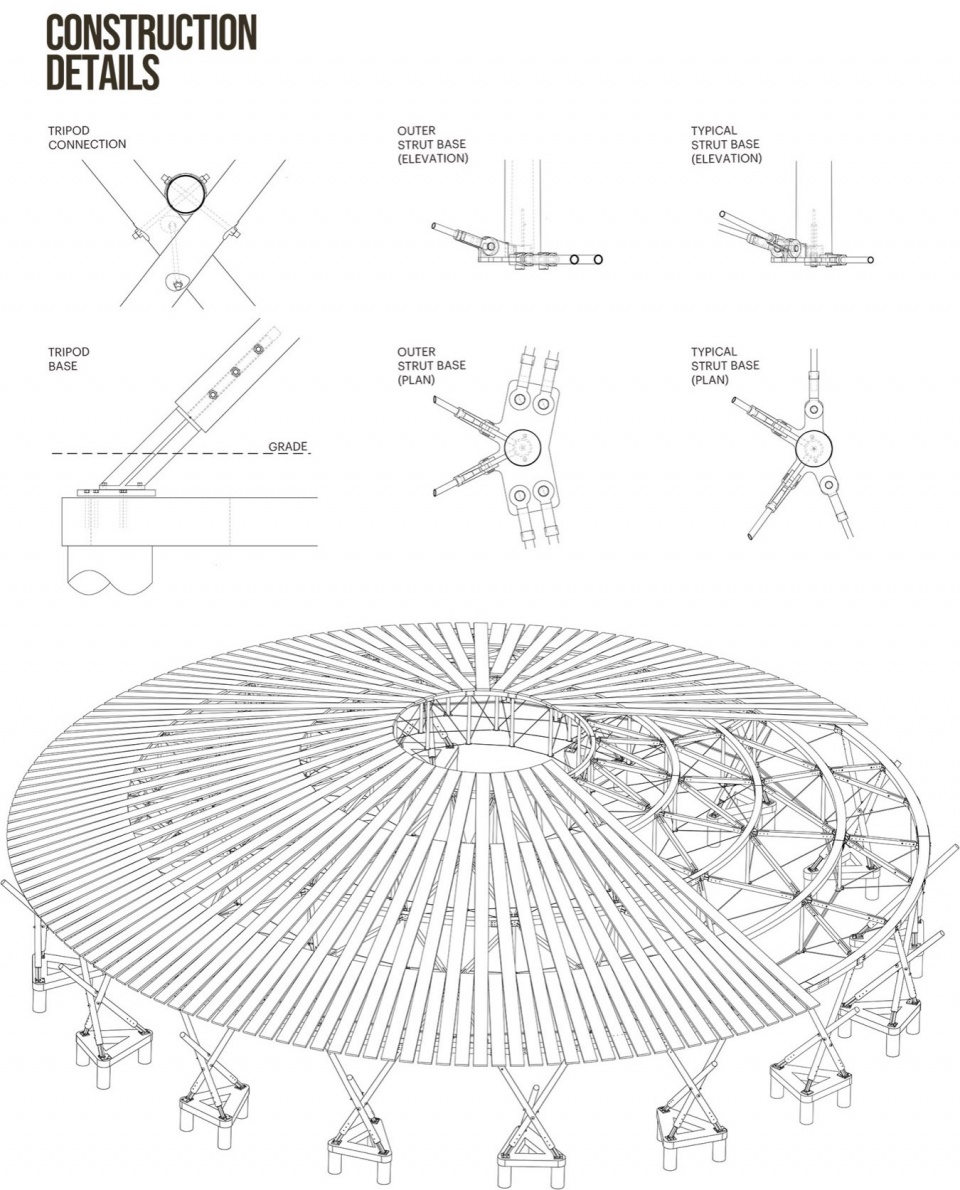
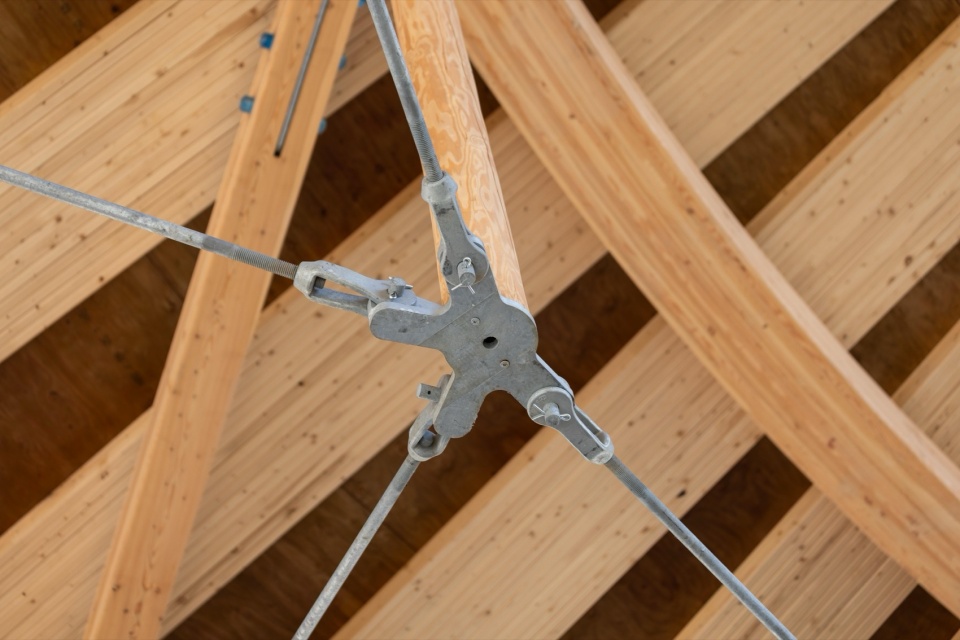
▼结构细部与轴测图,
structure details and axonometric drawing
A whole life cycle assessment (WLCA) governed material selection and structural assembly decisions throughout the design process.
Timber vs. steel comparison: heavy timber with biogenic carbon storage demonstrated a 68% reduction in CO₂e relative to a structural steel alternative.
Substitution of structural round timber (SRT) for engineered glulam reduced embodied carbon by an additional 20% per structural member.
SRT requires minimal processing, maintains continuous wood fibre orientation, and shortens the supply chain by eliminating outsourcing, thus reducing transport and manufacturing emissions.
Tripod column geometry enables structural stability with smaller-diameter round timbers, avoiding the harvesting of larger trees required for dimensional milled lumber.
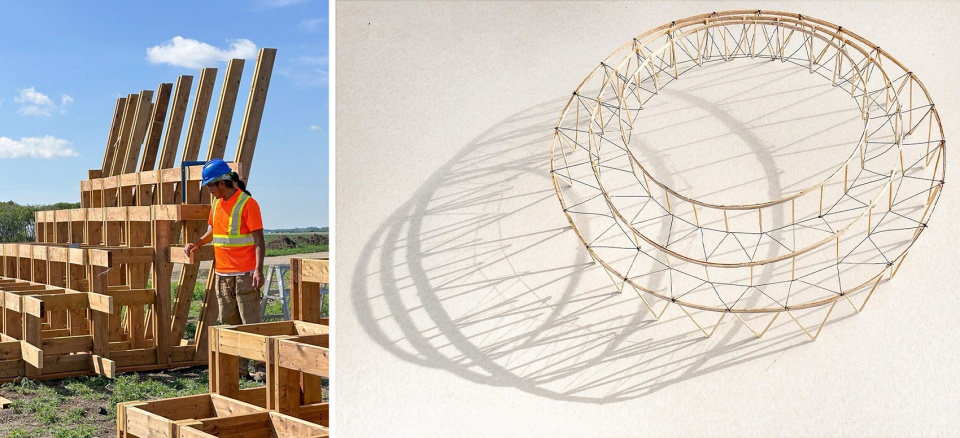
▼施工过程与模型,construction process and model
▼细部,details
景观与碳封存Landscape & Carbon Sequestration
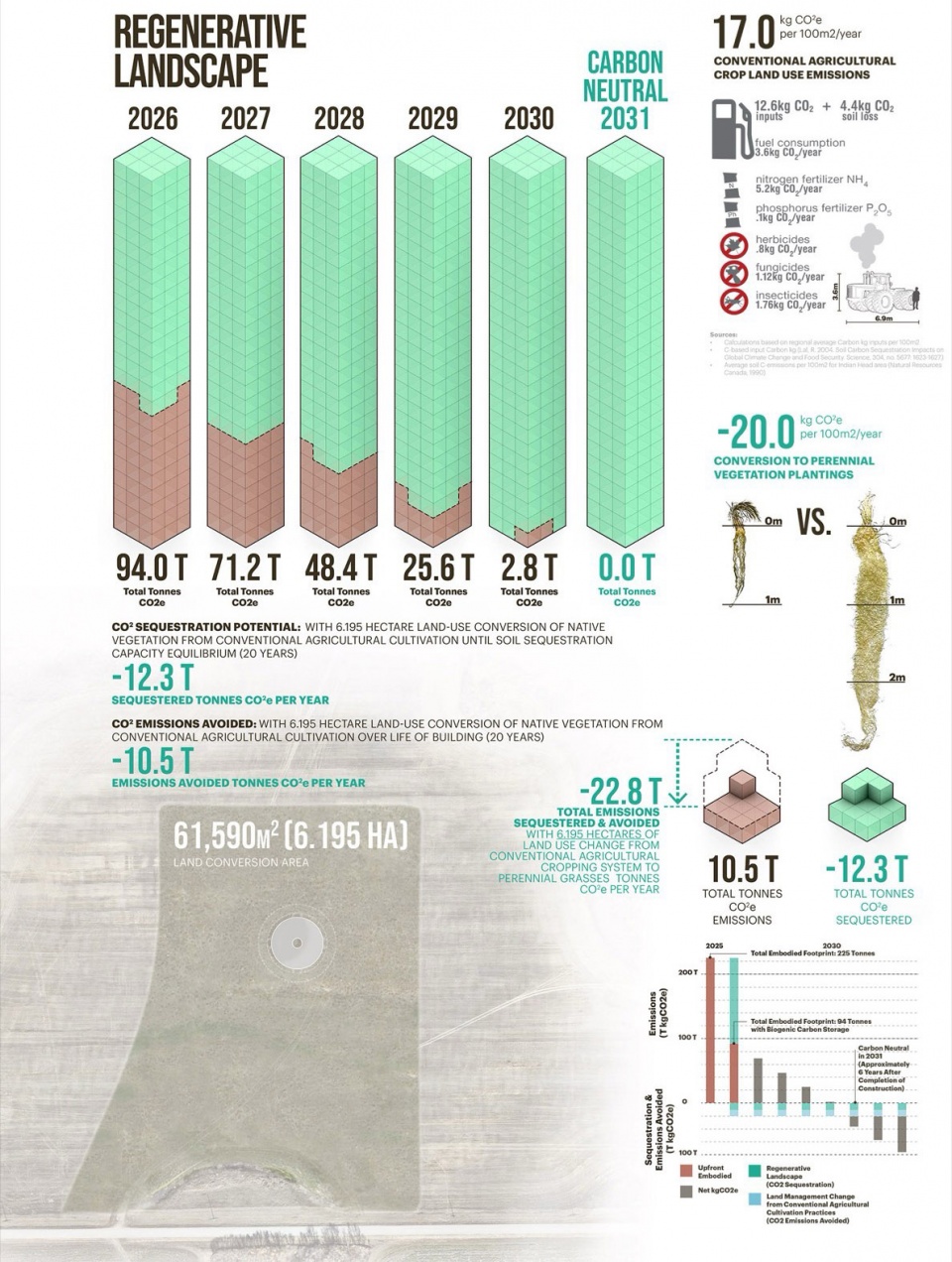
这块6.2公顷的场地将从常规农业用地转变为多年生原生草原植被。
预计年碳封存量:12.3吨二氧化碳当量/年。
通过停止集约化耕作方式避免的排放量:10.5吨二氧化碳当量/年。
综合考虑封存与减排:该项目有望在2031年前实现碳中和。
▼景观分析,analysis of landscape
▼分析图,analysis diagrams
The 6.2-hectare site is to be converted from conventional agriculture to native perennial prairie vegetation.
Annual sequestration: estimated 12.3 tonnes CO₂e/year.
Emissions avoided through cessation of intensive cropping practices: 10.5 tonnes CO₂e/year.
Combined sequestration and avoidance: the project is on track to achieve carbon neutrality by 2031.
▼内部夜景,interior view at night
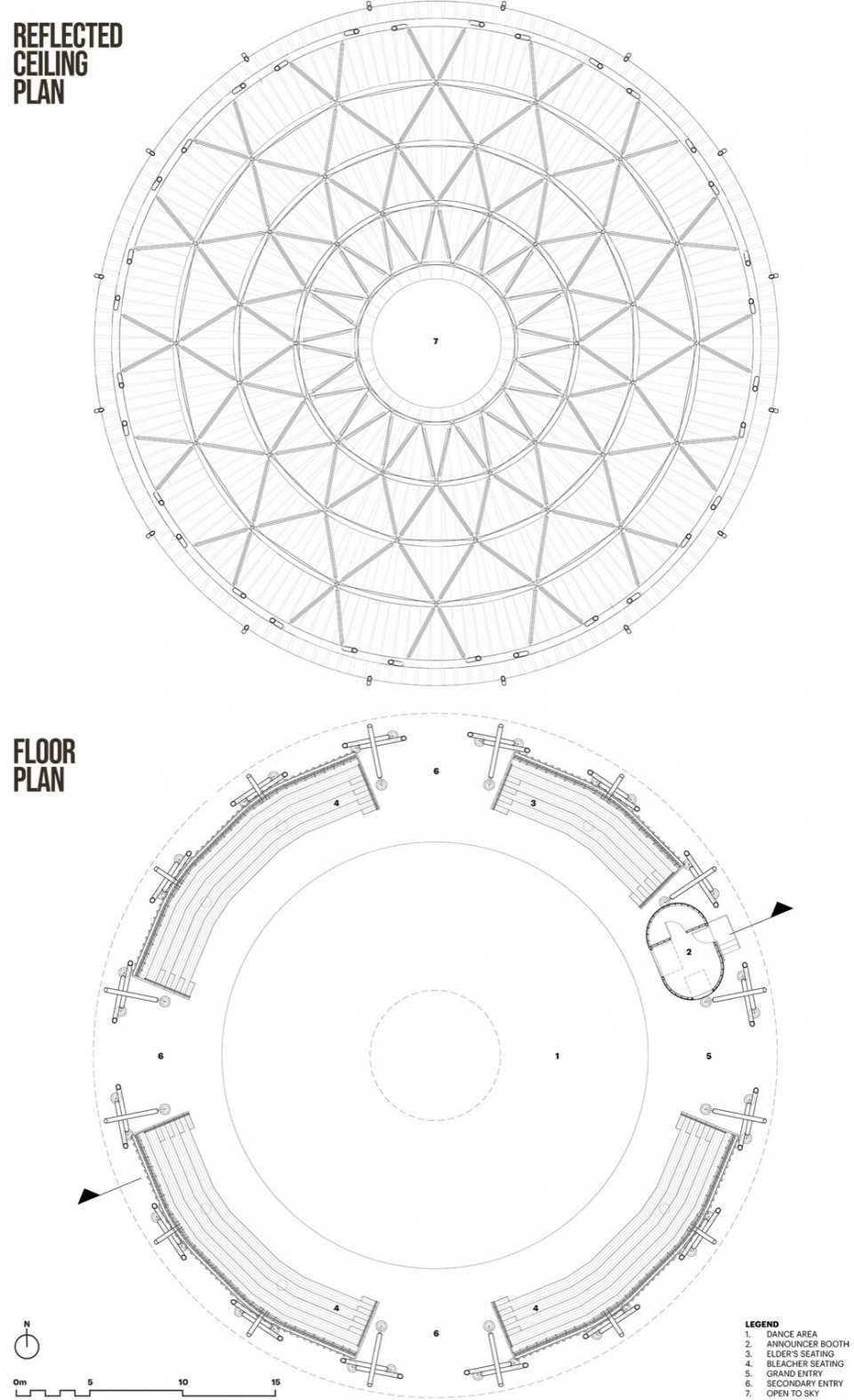
▼平面图,plans
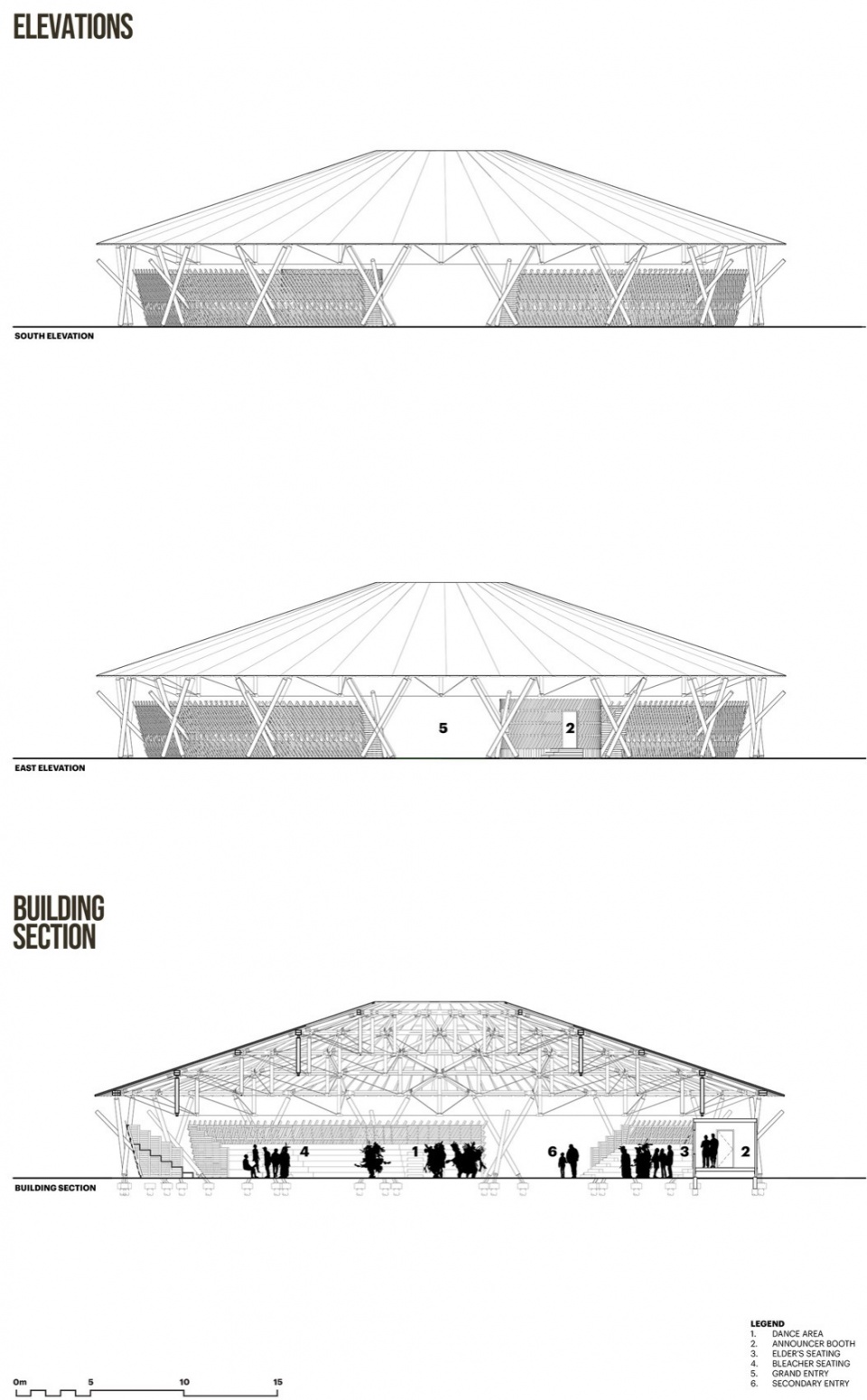
▼立面图与剖面图,elevations and section
Technical sheet
Name of lead architects:
Oxbow Architecture (Brad Pickard) & Richard Kroeker
List of contributing team members from each architecture firm:
Richard Kroeker
Oxbow Architecture
Andrea Clayton
Anna Ringstrom
Ashley Graf
Brad Pickard
Jim Siemens
Jordyn Loy
Mason Loy
Megan Florizone
Meghan Taylor
Rory Picklyk
Sam Lock
Sarah Robertson
Tanis Worme
Project name: Muscowpetung Powwow Arbour
Project address: Muscowpetung Saulteaux Nation, Saskatchewan, Canada
Project client: Muscowpetung Saulteaux Nation
Interior area and, if relevant, exterior area, in square metres
1,222 m2 (outer extent of roof circumference)
61,590m2 (land area conversion to native perennial vegetation from conventional agricultural land use)
Occupation date of the project: August 18, 2025
A list of all key consultants to be credited:
Structural engineer: Wolfrom Engineering
Electrical engineer: Ritenburg & Associates
Timber Structures Specialist: Chris J. K. Williams
Sustainability Consultant: Ha/f Climate Design
Architectural Photography: Lindsay Reid
Powwow Dancer Photography: Chris Ross