延庆里,湖北武汉 / 风物营造
走进延庆里,脚步会自然地慢下来。
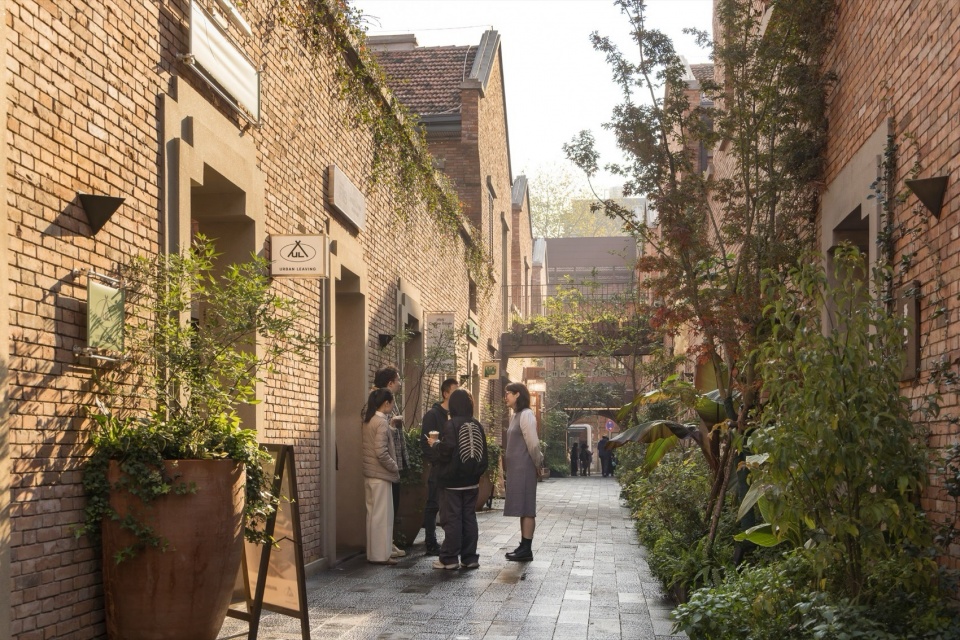
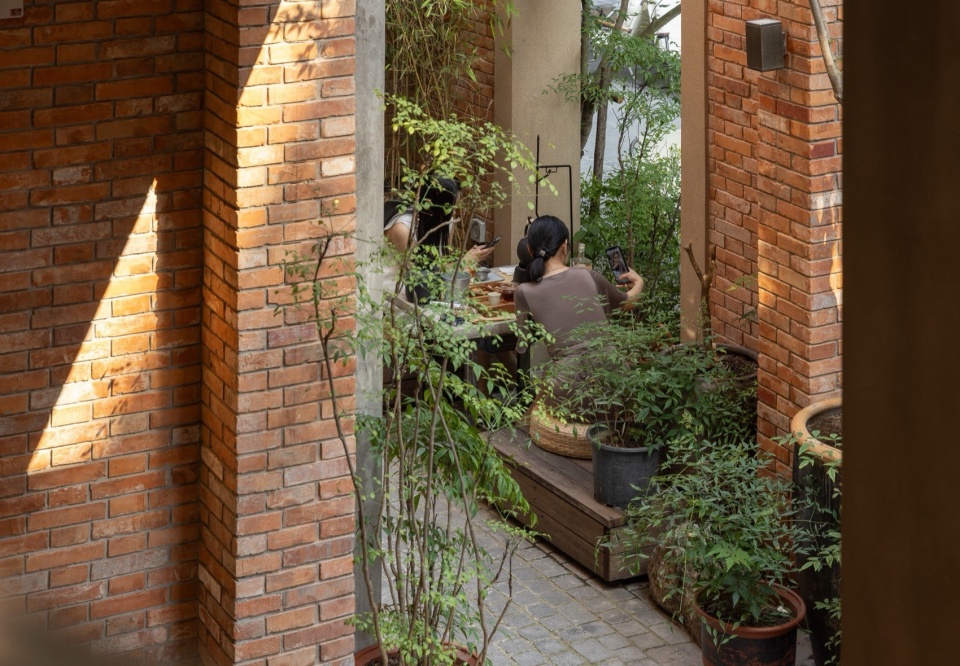
巷道里,攀缘的爬山虎正在重新爬上旧砖墙。阳光穿过新设的天幕,在碎石铺地上投下晃动的光斑。有人在主通道的台地边搁下咖啡杯,靠在红砖墙上,看巷子里的人来人往。拐角处,一群打扮精致的长者正对着老砖墙拍照——他们是这片里份的老居民,趁着项目开业回来看看。这是延庆里的日常。一个92岁的里份街区,在梳理之后,重新以鲜活的姿态融入回城市的日常生活中。
Walking into Yanqing Li, your pace naturally slows.
In the lanes, climbing Boston ivy is once again creeping up the old brick walls. Sunlight filters through the newly installed canopy, casting flickering pools of light onto the gravel-paved ground. Along the terraced edge of the main passage, someone sets down a coffee cup and leans against the red brick wall, watching people come and go through the alley. At a corner, a group of elegantly dressed elders pose for photos against the old brickwall—they are former residents of this lifen, returning to take a look now that the project has opened. This is everyday life at Yanqing Li: a 92-year-old lifen neighborhood that, after careful mending, has rejoined the daily life of the city with renewed vitality.
▼老法桐树下的延庆里主入口,Main entrance of Yanqing Lane under the old plane trees
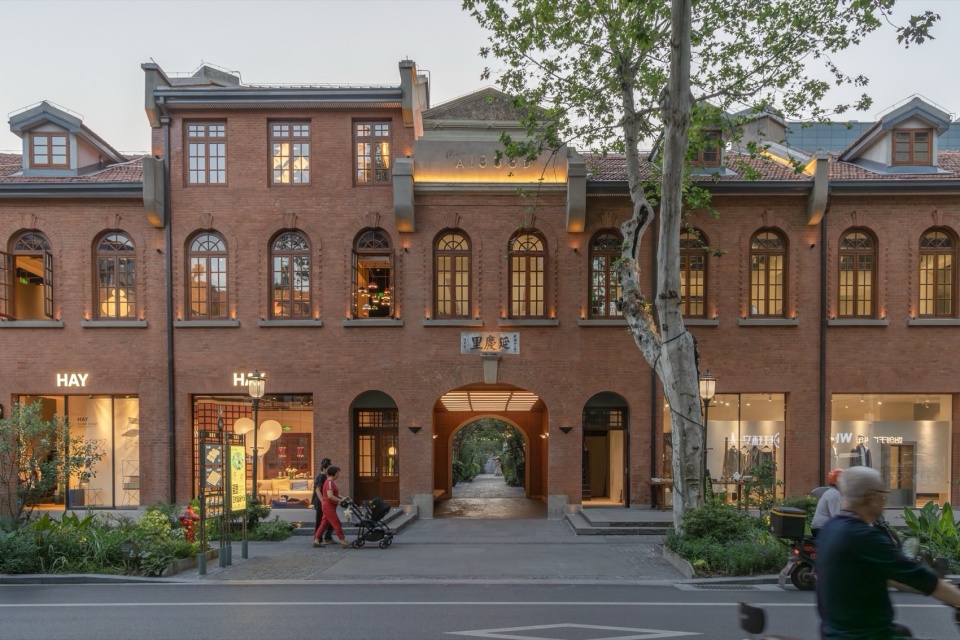
▼延庆里主入口的外街,Outer street at the main entrance of Yanqing Lane
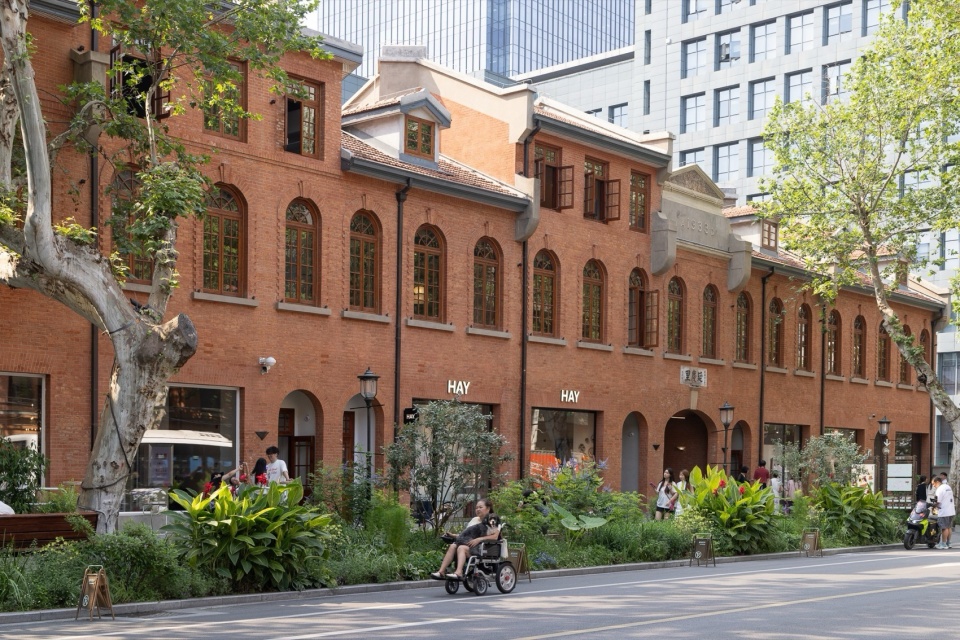
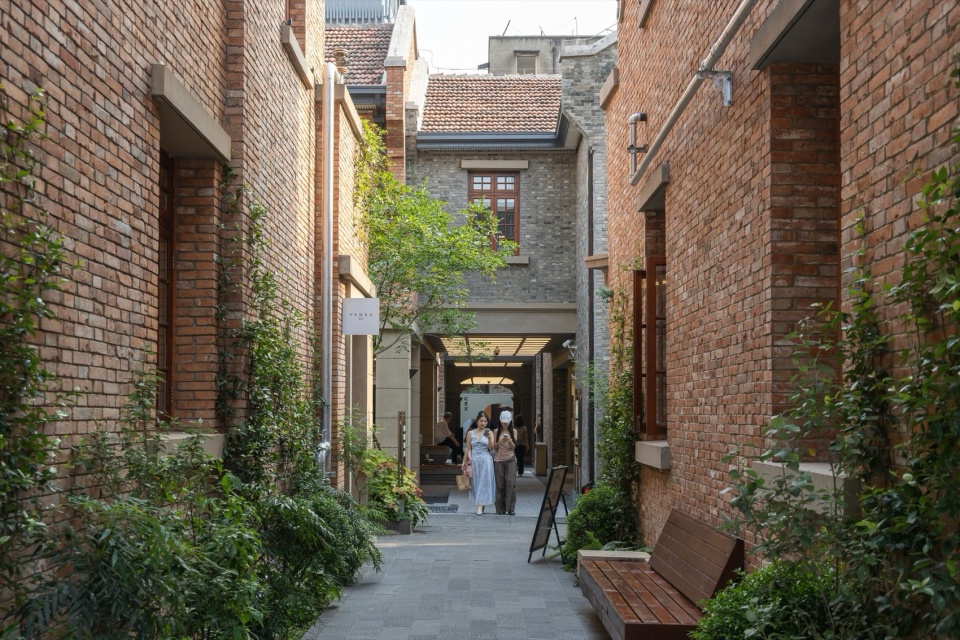
▼延庆里主街,Main street of Yanqing Lane
项目背景:被时间封存的里份Project Background: A Lifen Sealed by Time
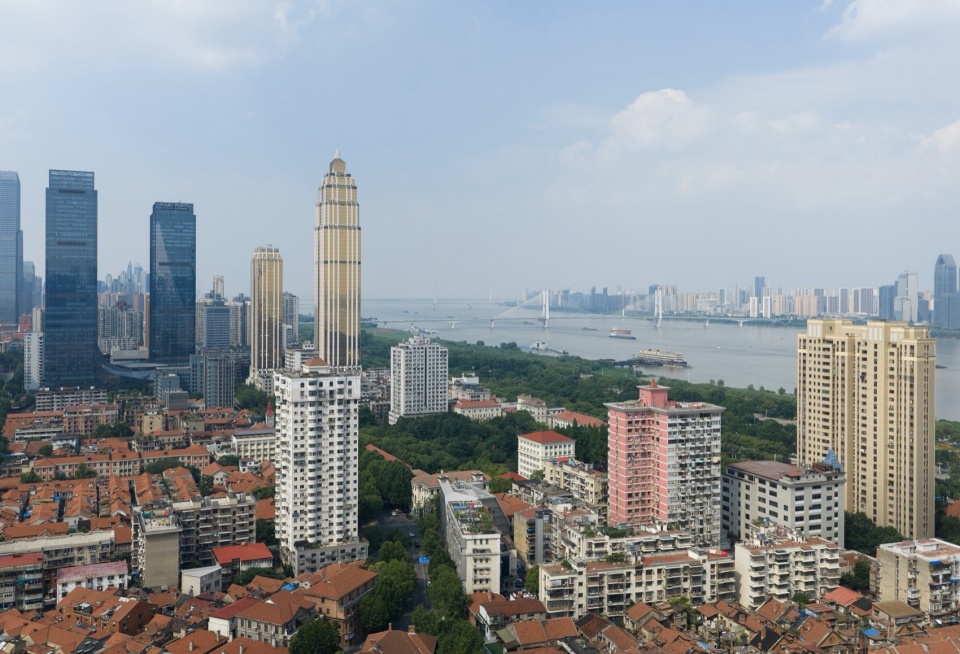
延庆里位于武汉汉口胜利街,介于江汉路与武汉天地之间——这是汉口历史风貌区的中段,也是武汉城市更新的核心地带。
作为汉口典型的联排式红砖里份,延庆里建于1933年。里份是武汉特有的居住形态,其空间结构呈现清晰的公共性序列:从公共巷道、共享天井、半私密采光井,至最内部的居住空间。
Yanqing Li sits on Shengli Street in Hankou, Wuhan, between Jianghan Road and Wuhan Tiandi—the middle stretch of Hankou’s historic district, and a core area of Wuhan’s urban renewal. A typical Hankou row-house red-brick lifen, Yanqing Li was built in 1933. The lifen is a residential form unique to Wuhan, and its spatial structure presents a clear sequence of publicness: from the public lane, to the shared courtyard, to the semi-private light well, and finally to the innermost living spaces.
▼延庆里所在地武汉汉口城市肌理,Urban fabric of Hankou, Wuhan, where Yanqing Lane is located
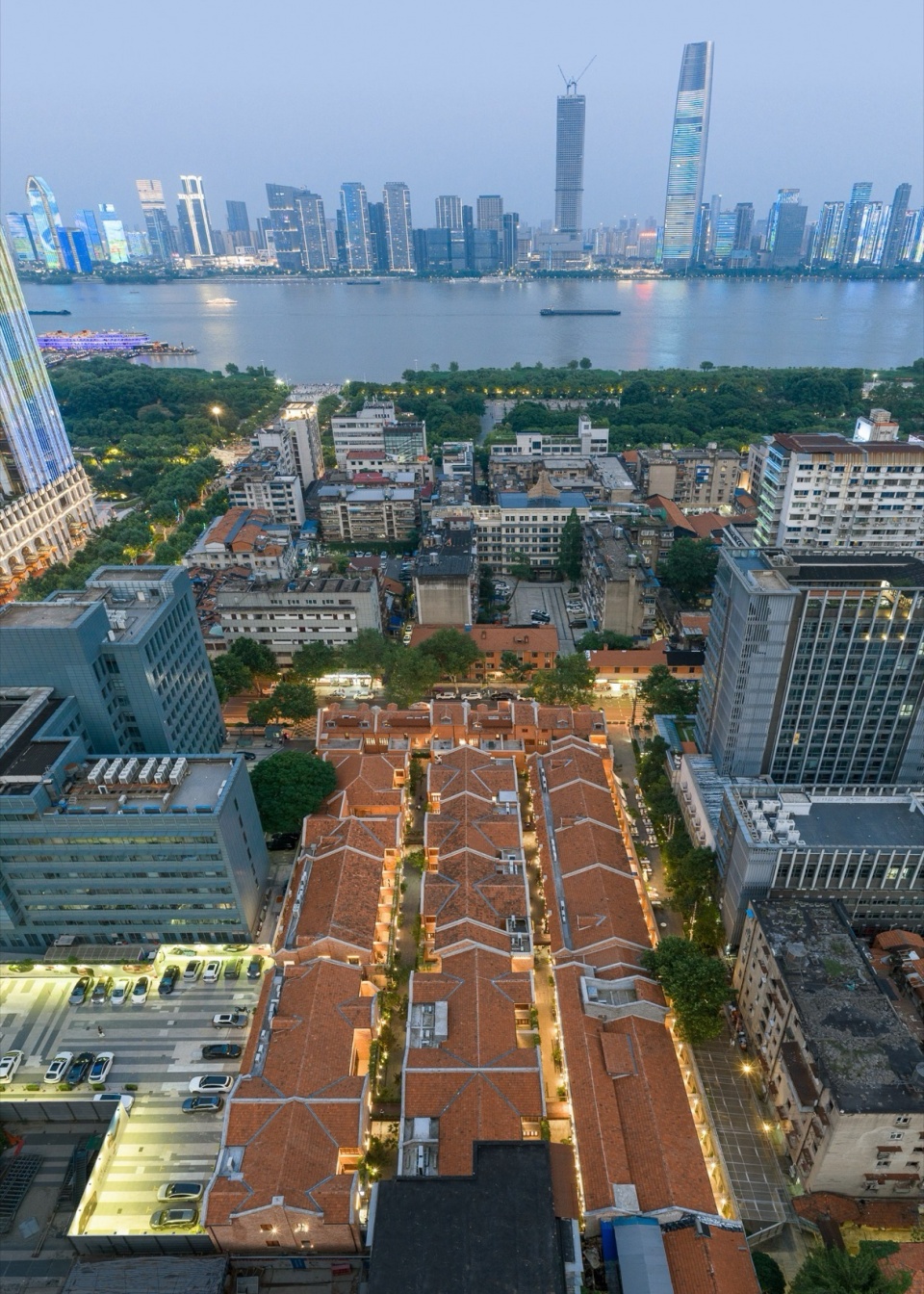
▼新旧城市肌理中老里份——延庆里,
Yanqing Lane – the old lifen in the new and old urban fabric
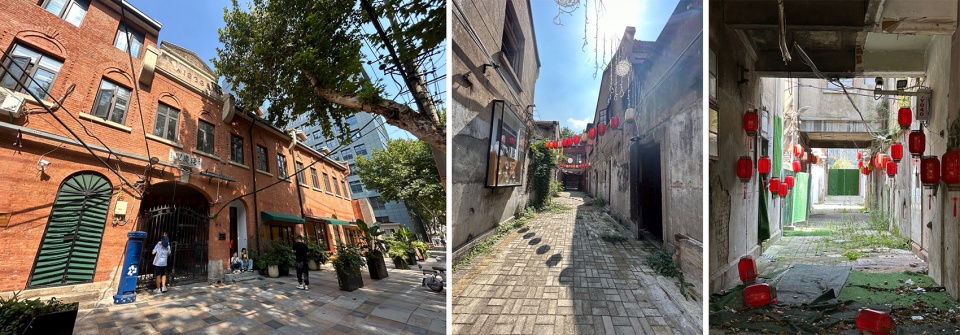
此后数十年间,随意搭建封堵了天井,种植消失,架空线缆分割了天空。南侧二曜小路沦为机动车道,建筑内外高差交错,排水系统老化。里份日渐稠密,闭塞。近年来,城市更新从“拆旧建新”转向“存量再生”,延庆里被列入汉口历史风貌区保护活化的重点项目。武汉城投与成都万华联合操盘——城投深谙在地文化脉络的梳理与活化,万华则带来了非标商业的运营经验。更新与运营并重的契机,由此开启。
Over the following decades, makeshift additions sealed off the courtyards, vegetation disappeared, and overhead cables carved up the sky. To the south, Eryao Lane was reduced to a small lane for motor vehicles; level differences crisscrossed inside and outside the buildings, and the drainage system aged. The lifen grew ever denser and more closed off. In recent years, as urban renewal has shifted from “demolish-and-rebuild” toward “regeneration of existing stock,” Yanqing Li was designated a key project in the conservation and revitalization of Hankou’s historic district. Wuhan City Investment Group and Chengdu Wide Horizon Invesment Group Co. jointly took the helm—City Investment understands deeply how to read and revive local cultural lineages, while Wide Horizon brings operational experience in non-standard commercial spaces. With this, an opportunity that gives equal weight to renewal and operation began.
▼改造前照片,Before renovation photo
一张复写纸A Sheet of Copy Paper
面对这样的场地,设计团队确立了一个基本立场:将延庆里视作一张复写纸。百年来,建造、居住、修补、增建乃至断裂,都在这里留下层积。设计不是抹去旧的笔迹、重新写上新的一页,而是让有意义的层积重新浮现,让旧的结构重新被感知和使用。反复阅读场地之后,几层最重要的“原文”逐渐清晰:巷道—天井—室内的空间序列,里份独有的街巷尺度,以及曾经覆盖砖墙的攀缘植物传统。
Confronting such a site, the design team established a basic stance: to regard Yanqing Li as a sheet of copy paper. Over the course of a century, construction, habitation, repair, additions, and even ruptures have all left their accumulated layers here. Design is not about erasing the old marks and writing a new page, but about letting the meaningful layers resurface, allowing the old structures to be perceived and used once again. After reading the site again and again, several of the most important lines of the “original text” gradually became clear: the spatial sequence of lane—courtyard—interior, the street-and-alley scale unique to the lifen, and the tradition of climbing plants that once covered the brick walls.
▼设计平面,Design plan
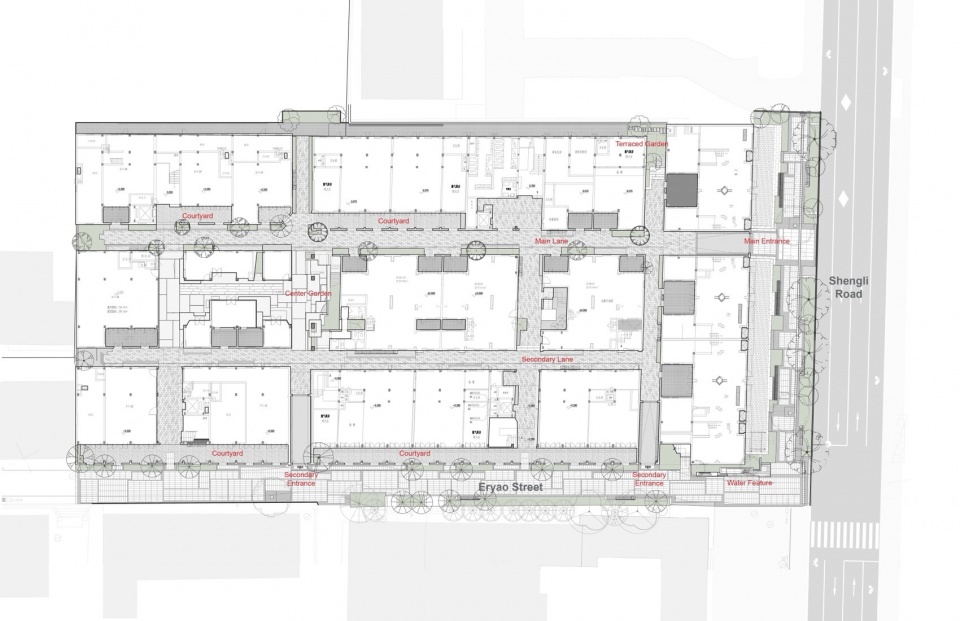
策略在四个维度上展开: The strategies:
里份原有的巷道均质而单调,且大部分时间闷热难耐。面对这样的场地,设计从四个层面介入:差异化处理街巷、打通建筑内环线、激活节点空间、唤醒天井。最终,场地获得了鲜明的差异化特征,形成漫游的节奏与停留的可能。
In their original state, the lanes of the lifen were uniform and monotonous, and stiflingly hot for much of the year. Confronted with these conditions, the design intervenes at four levels: differentiating the lane typologies, linking an inner loop through the block, activating key nodal spaces, and reanimating the courtyards. Together, these moves give the entire site a distinct spatial character — one that invites wandering and encourages moments of pause.
▼延庆里街区鸟瞰,Yanqing Lane – aerial view
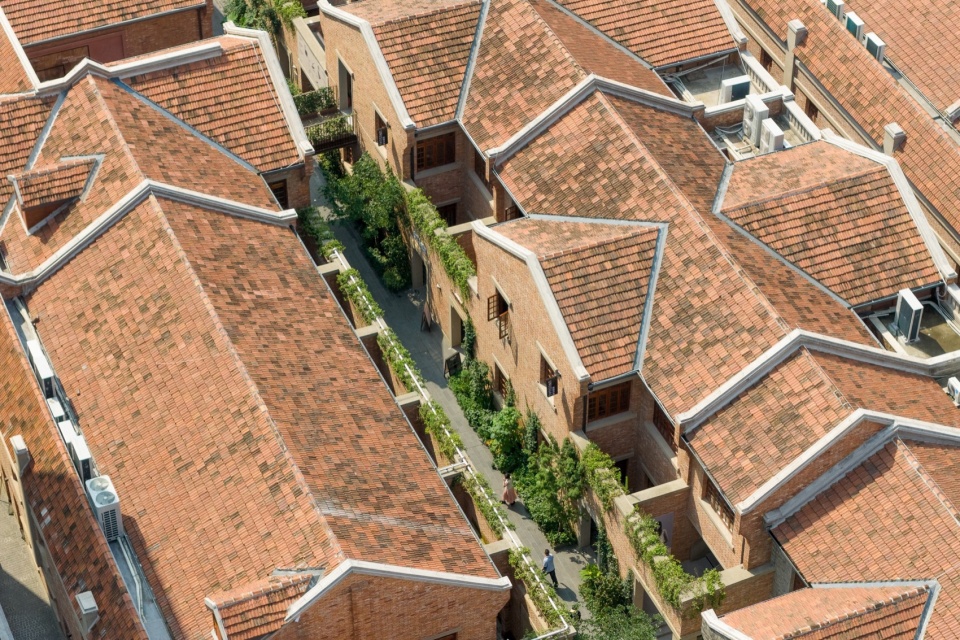
主巷道|The Main Lane
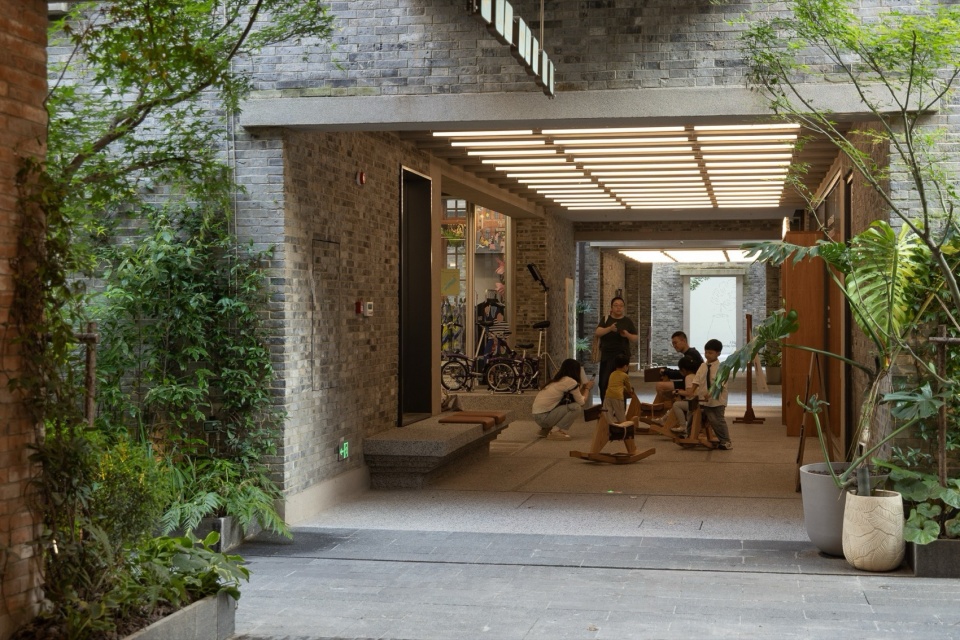
主街宽3.7至4米,两侧石库门特征强烈,原位是进入住宅天井的序列空间。改造后,主街转为商业主动线。景观以自然花园的方式介入——绿意从红砖之间生长出来,人在其中穿行,步调自然放缓。不期而遇的巷口、转角处探出的枝叶、砖缝间的阴影,共同构成一种松散的漫游节奏。同时,植被的介入也调节了巷道的微气候,为武汉炎热的夏季提供荫庇。
The main lane runs 3.7 to 4 meters wide, lined on both sides by strongly featured shikumen gateways—originally the sequence of spaces leading into the residential courtyards. After the renovation, the main street becomes the spine of the commercial circulation. The landscape enters in the manner of a natural garden—greenery growing up from between the red bricks, so that those who pass through find their pace slackening of its own accord. An unexpected alley mouth, a sprig of leaves leaning out at a corner, a shadow caught in the seam of the brickwork—together they compose a loose rhythm of wandering. At the same time, the planting tempers the lane’s microclimate, offering shade through Wuhan’s sweltering summers.
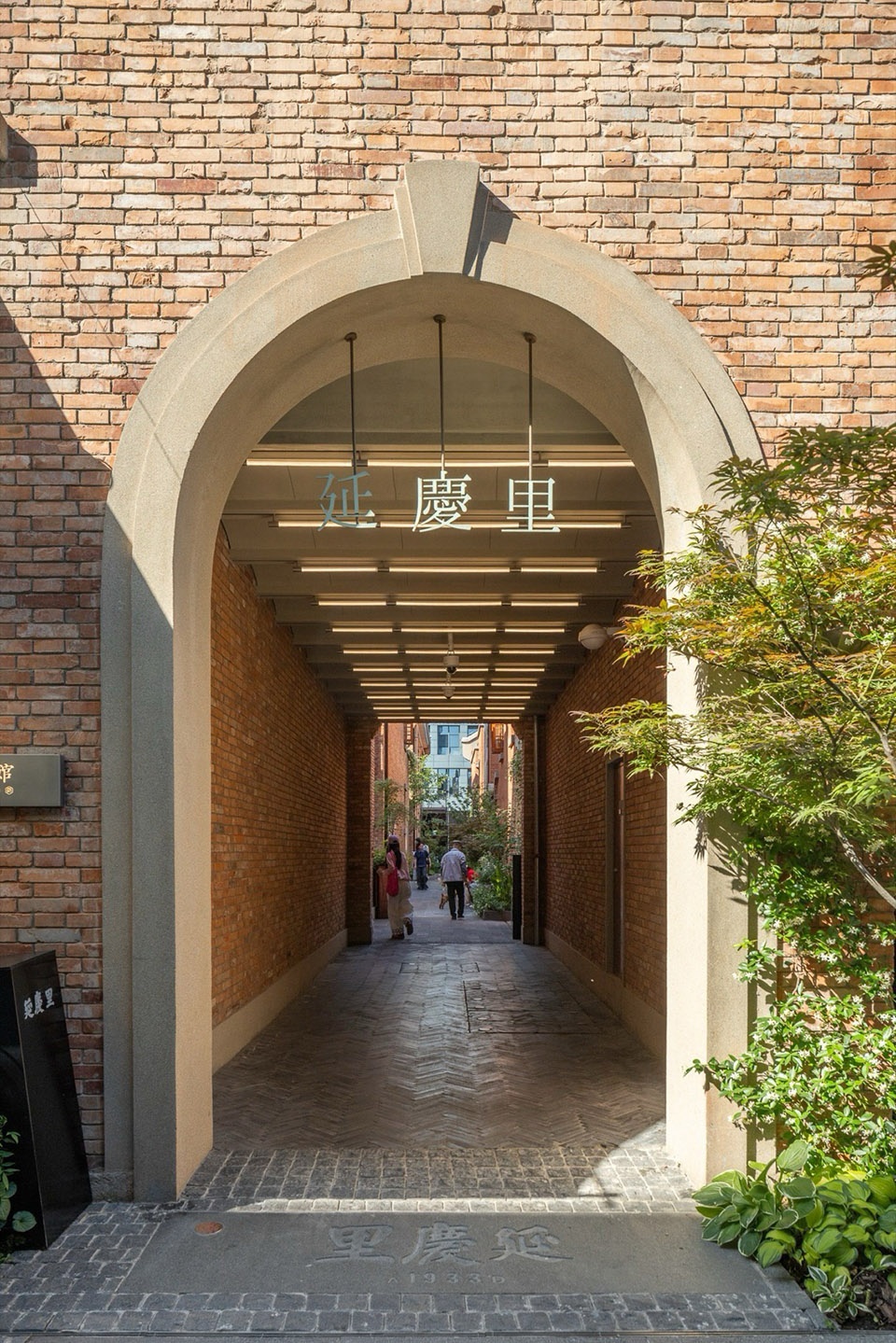
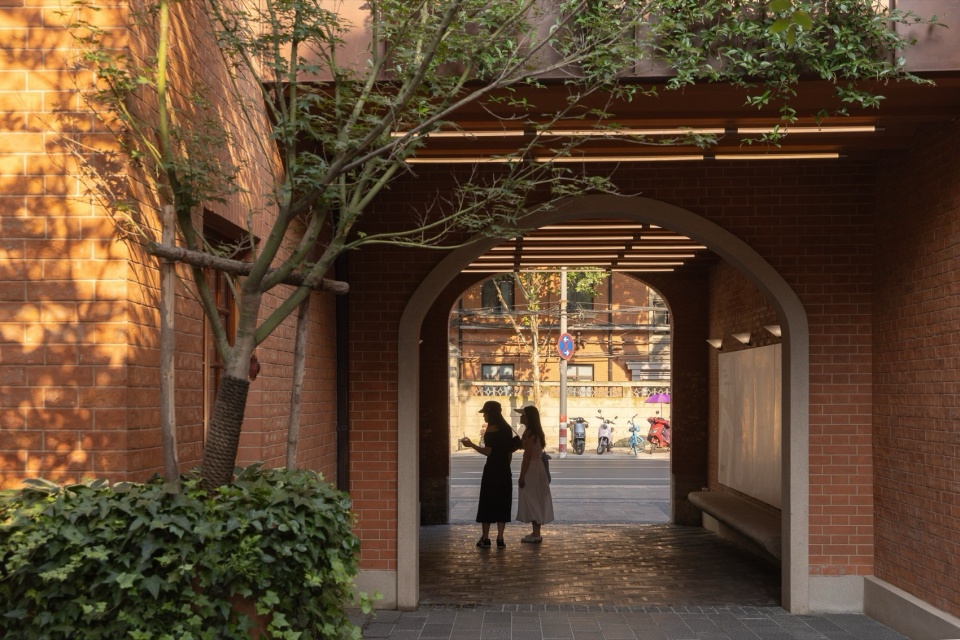
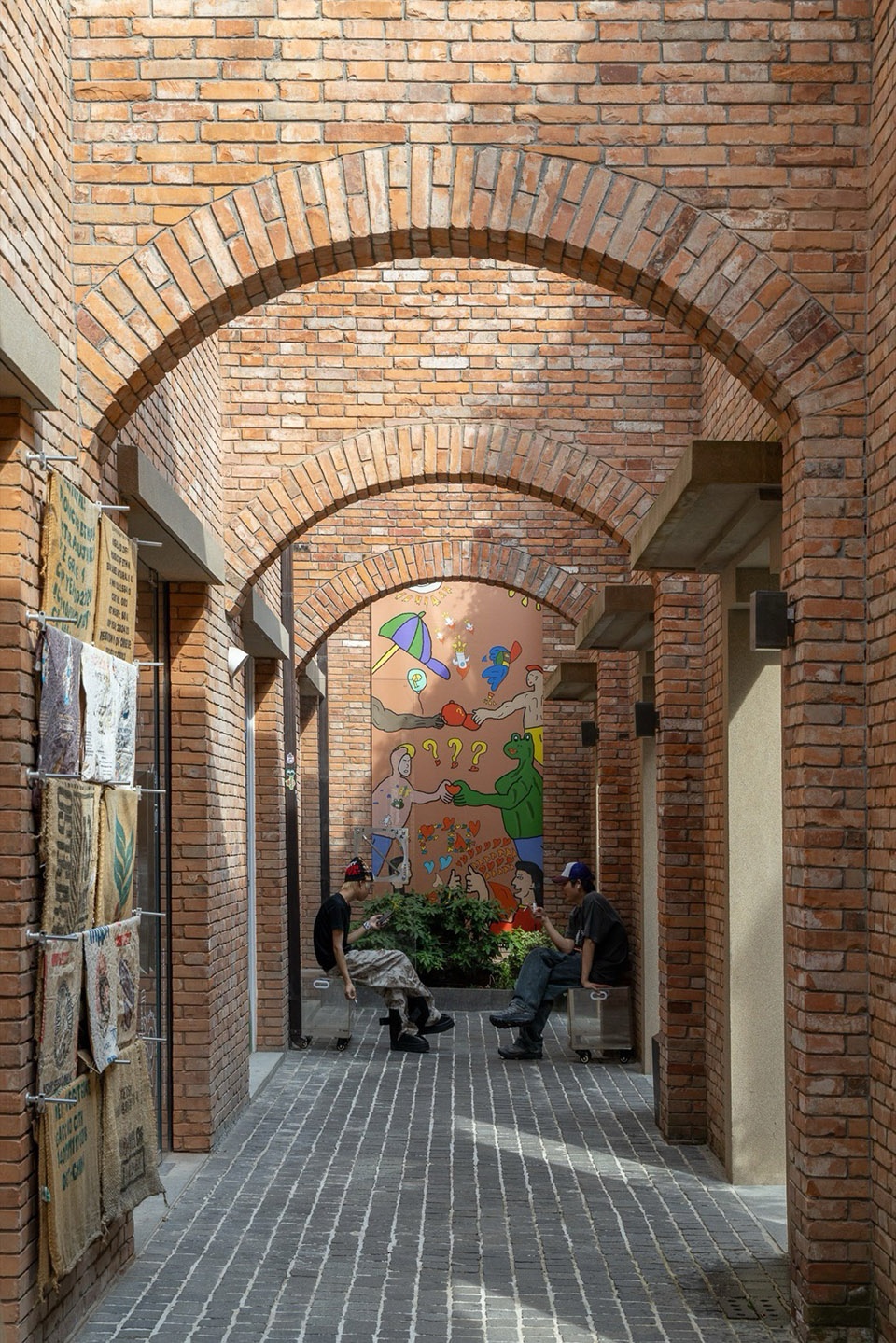
▼巷口拱门,强化停留和到达感,
Archway at the lane entrance, enhancing the sense of pause and arrival
▼将街边停留的生活感延续下来,Extending the street life’s lingering atmosphere
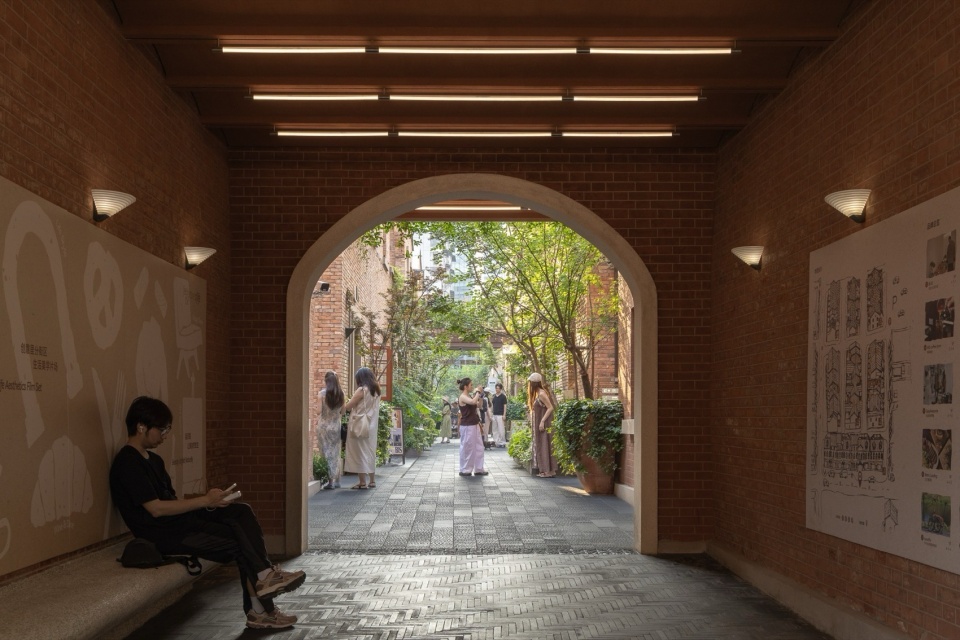
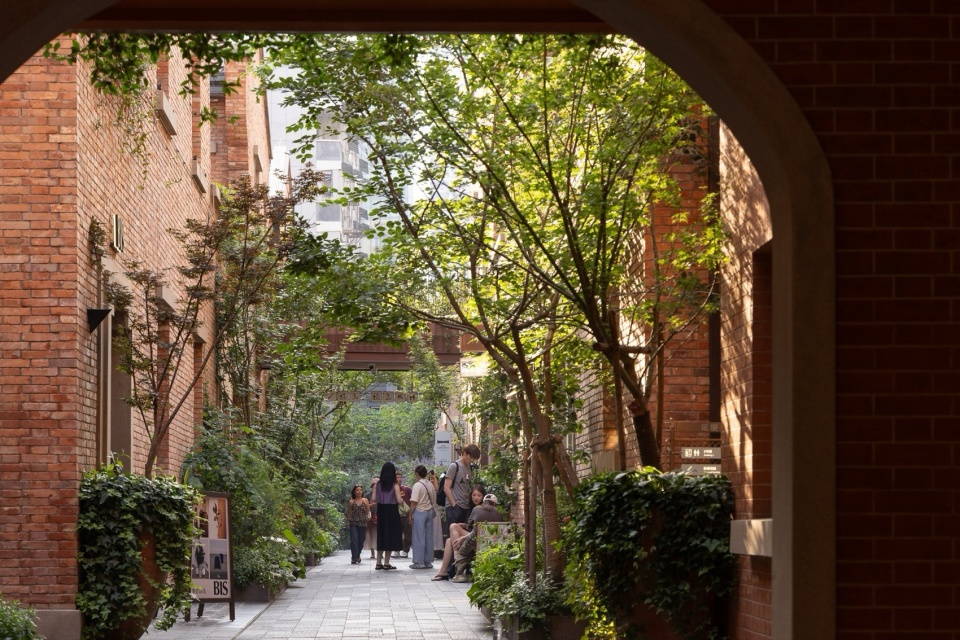
▼透过门拱看主巷道,View of the main lane through the archway
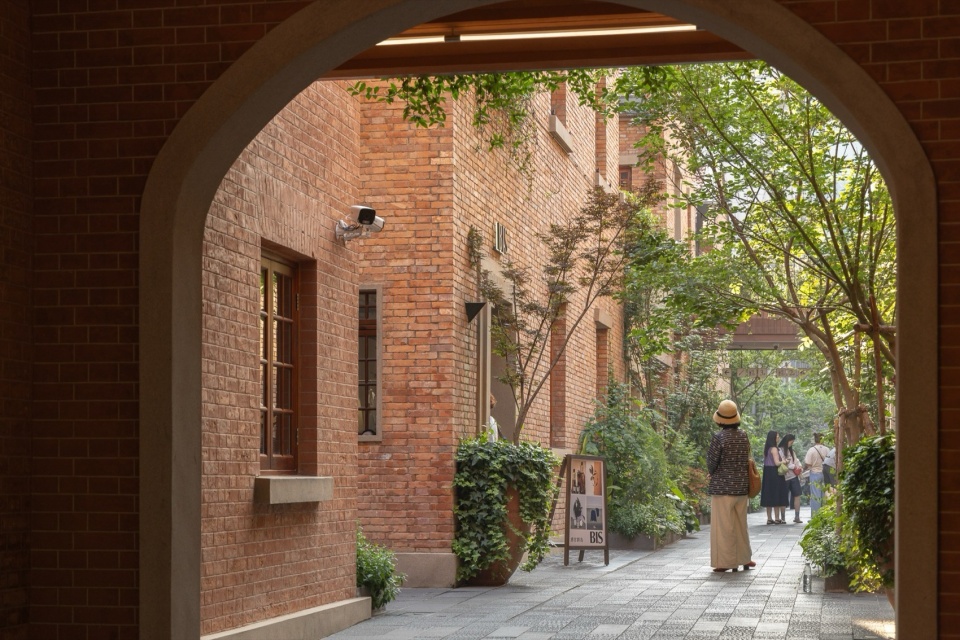
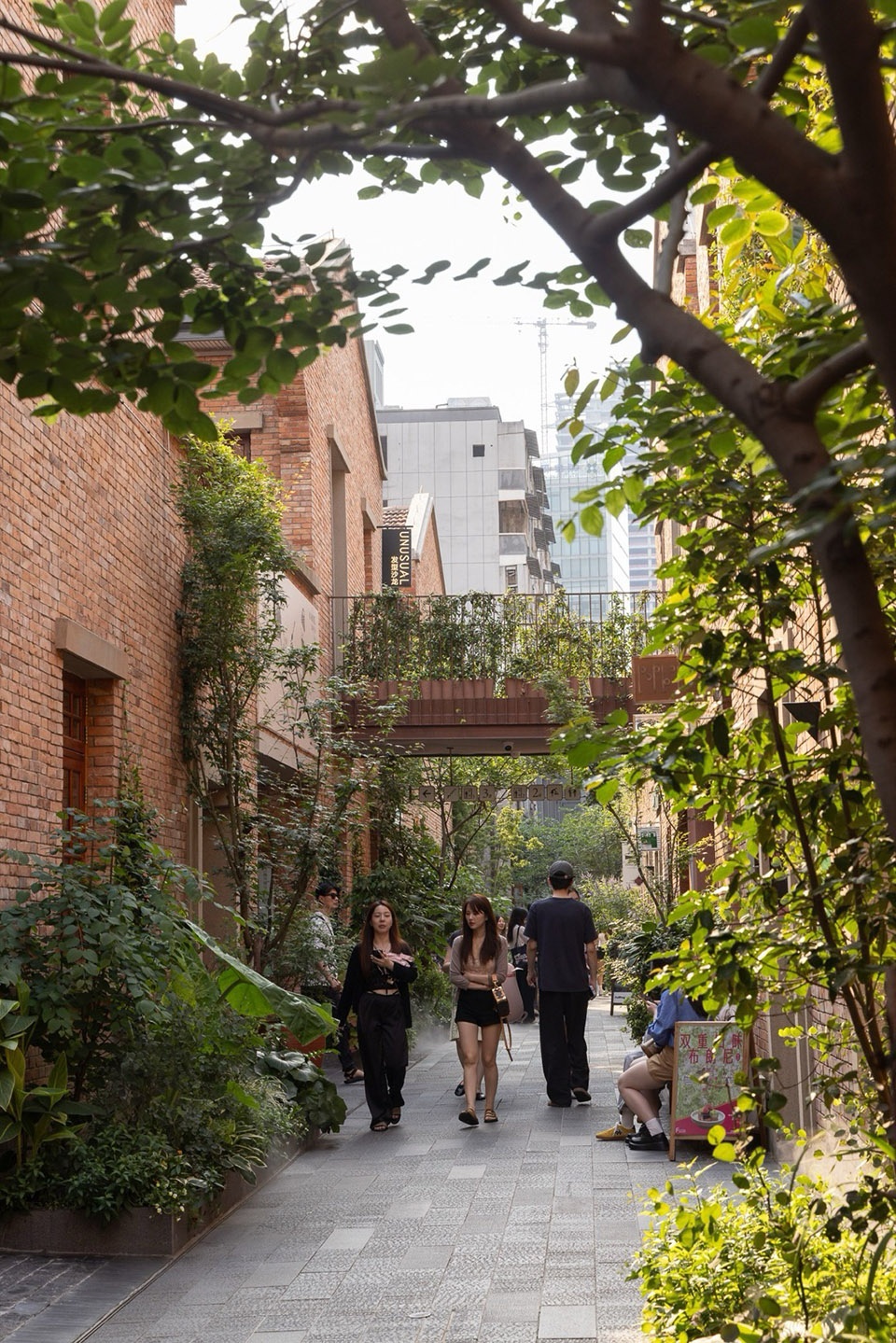
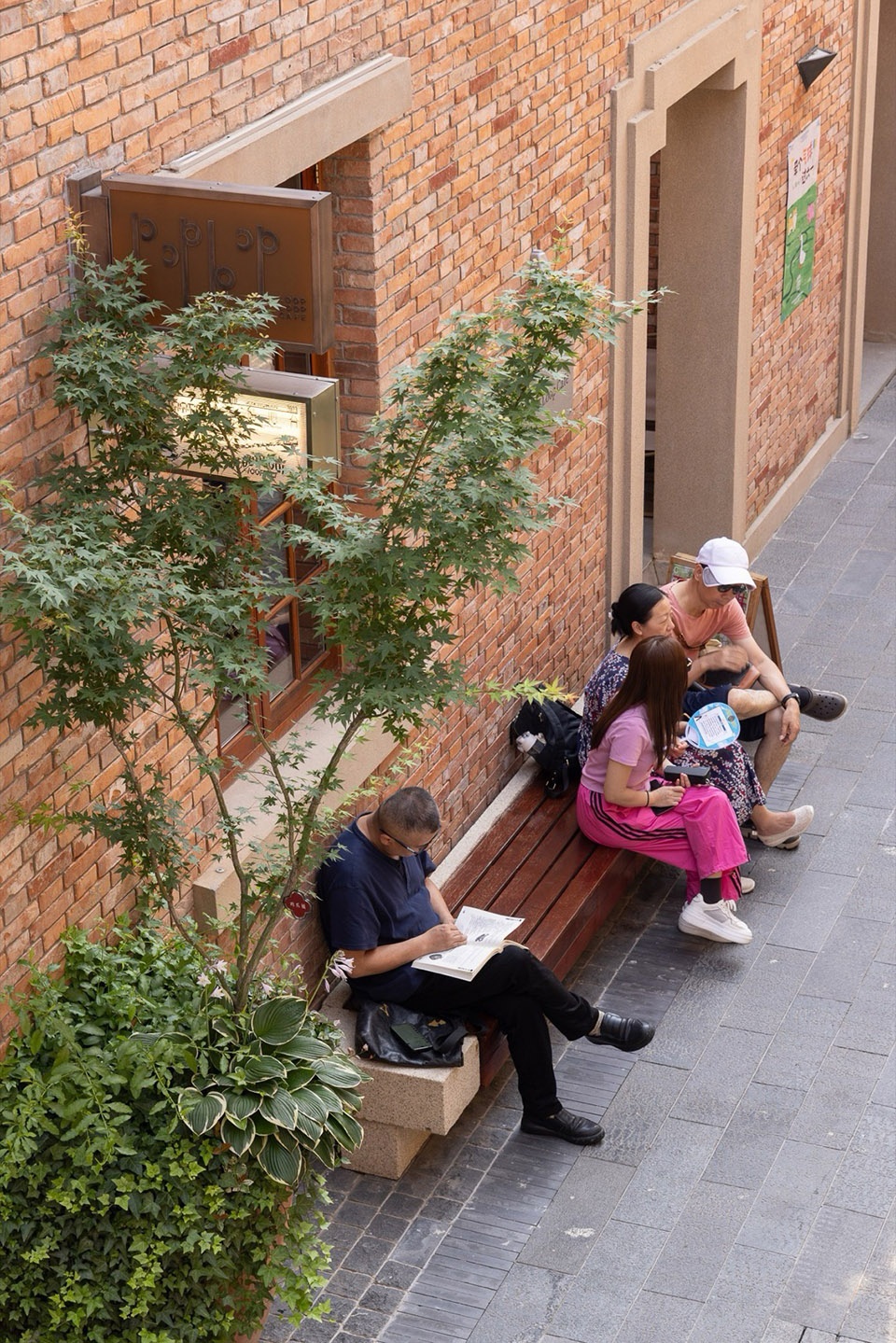
更新前,主巷道一眼望尽,视线无着落,夏日烈日灌入,无处可留。更新后,植物高低错落,绿意从两侧探出,在巷道上方交织成荫。家具散置其间,随处可坐——有人在转角处的长凳上歇脚,有人在树荫下的矮座旁聊天。巷道不再是穿过的地方,而是可以游逛、可以自然停下的场所。
Before the renewal, the main lane could be taken in at a single glance, the gaze finding nothing to rest on, the summer sun pouring straight in with nowhere to shelter. After the renewal, plants rise and fall at varied heights, greenery leaning in from either side to weave a canopy of shade overhead. Furniture is scattered through it, inviting one to sit anywhere—someone resting on a bench at the corner, others chatting beside a low seat in the shade of a tree. The lane is no longer merely a place to pass through, but a place to linger in and stop in.
▼将街边停留的生活感延续下来,Extending the street life’s lingering atmosphere
▼透过门拱看主巷道,View of the main lane through the archway
▼主巷道,The main lane
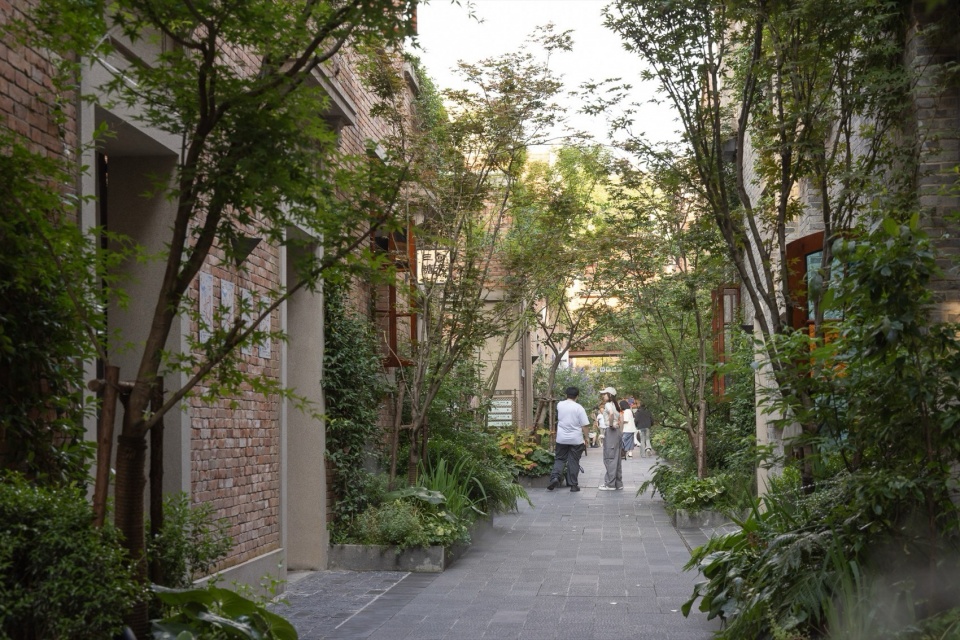
▼利用建筑灰空间打开的漫游路径,Wandering path opened up through the building’s transition spaces
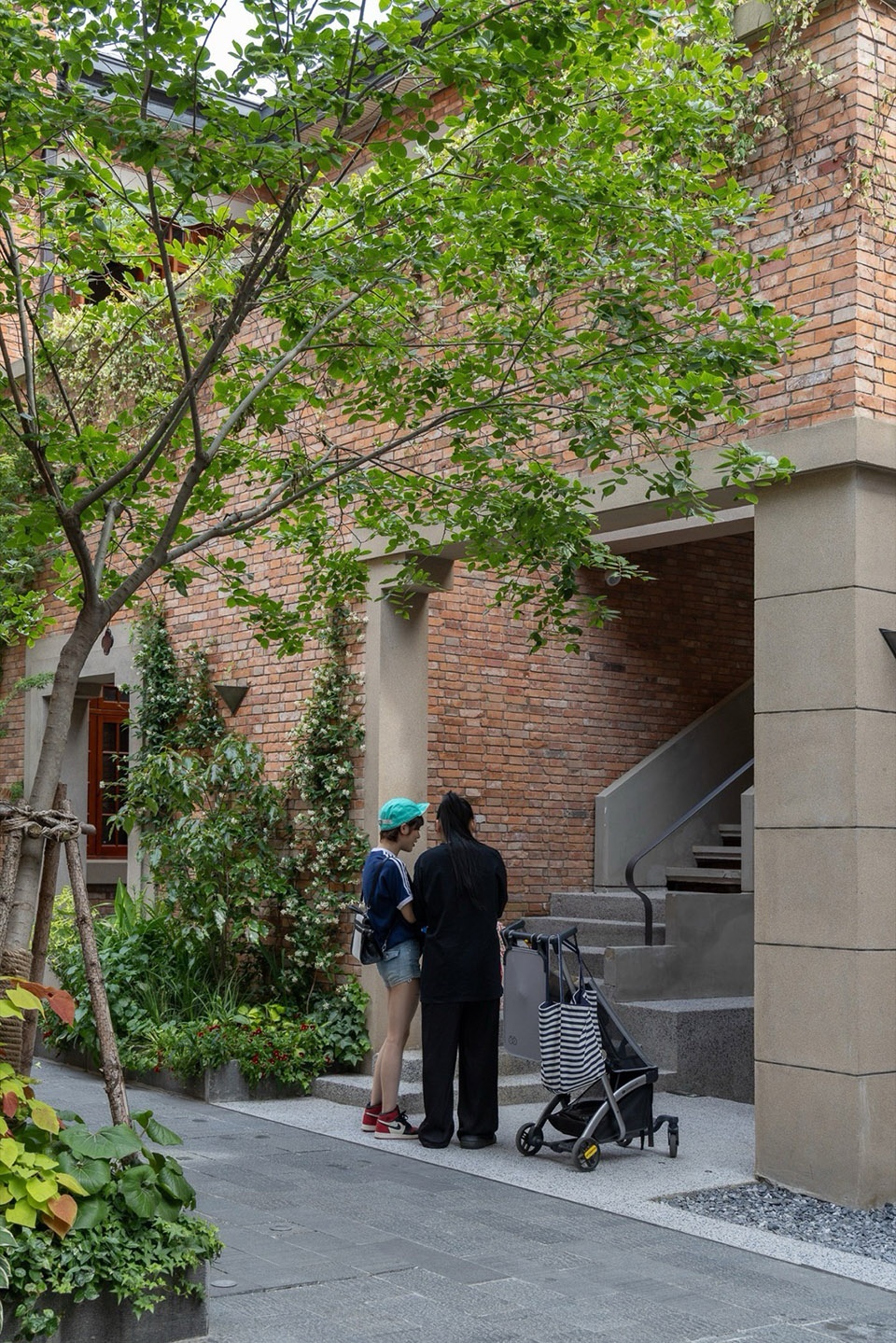
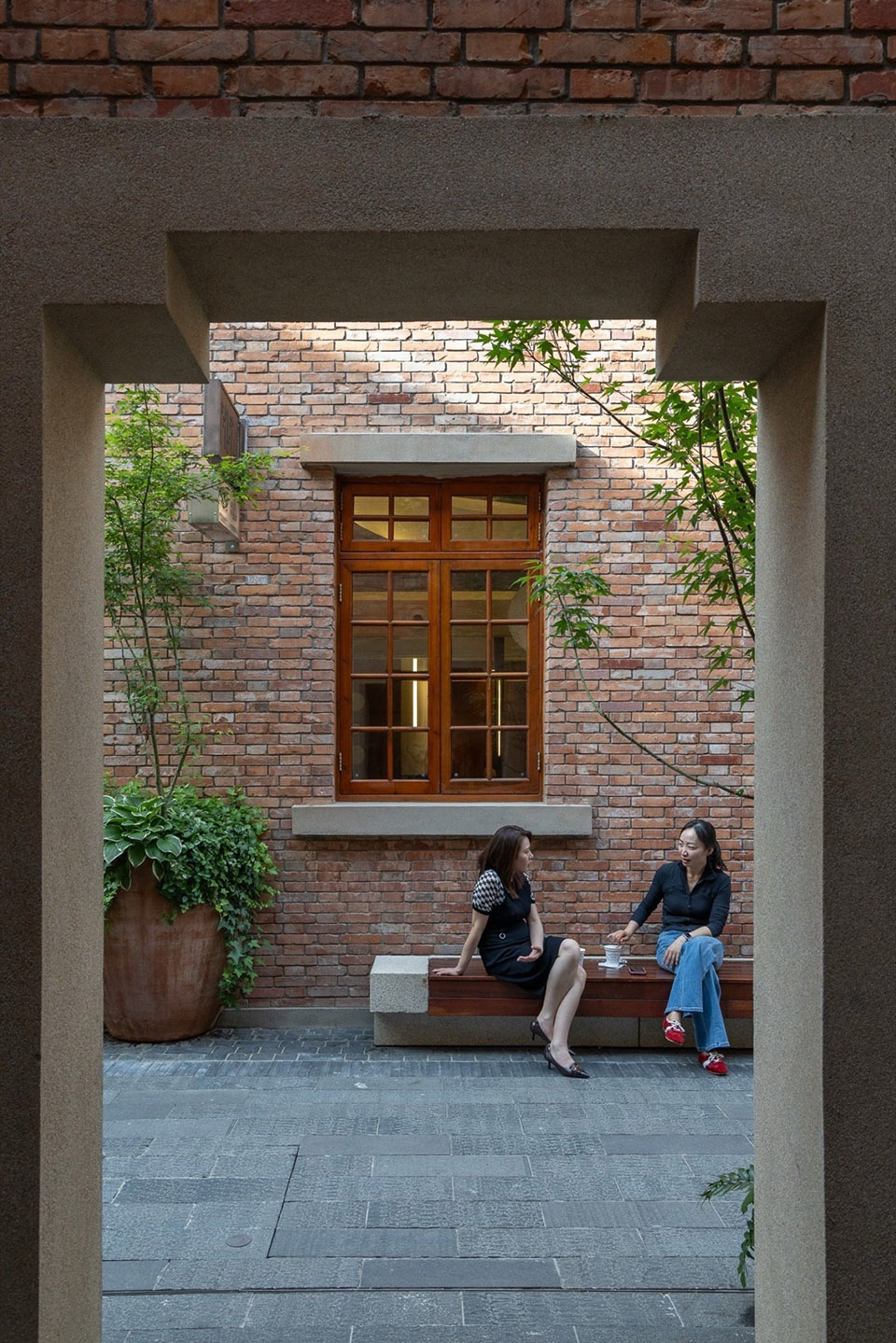
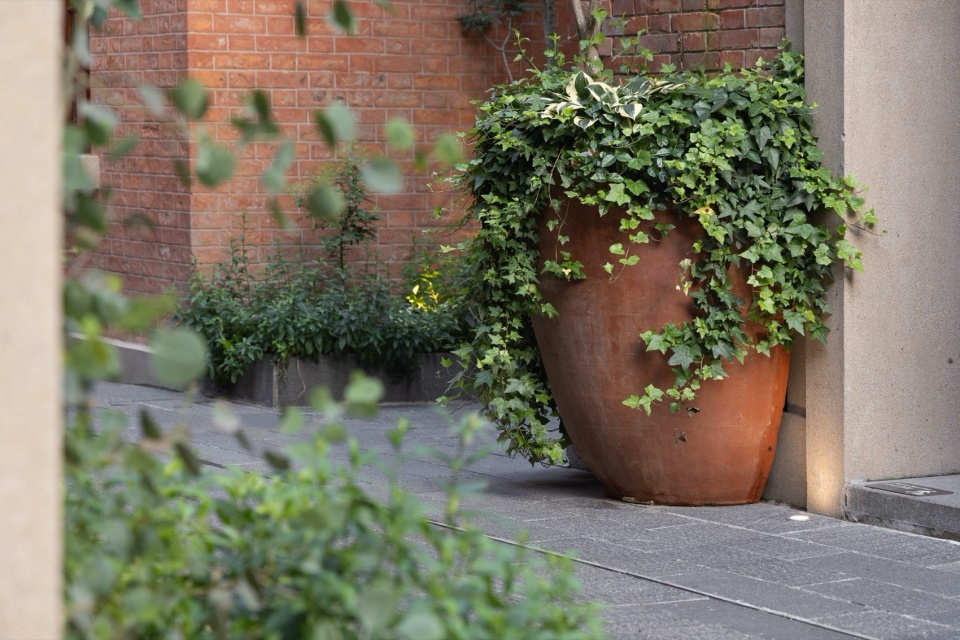
▼巷道,The main lane
中心花园: 将废墟化为心脏|The Central Garden: Turning a Ruin into a Heart
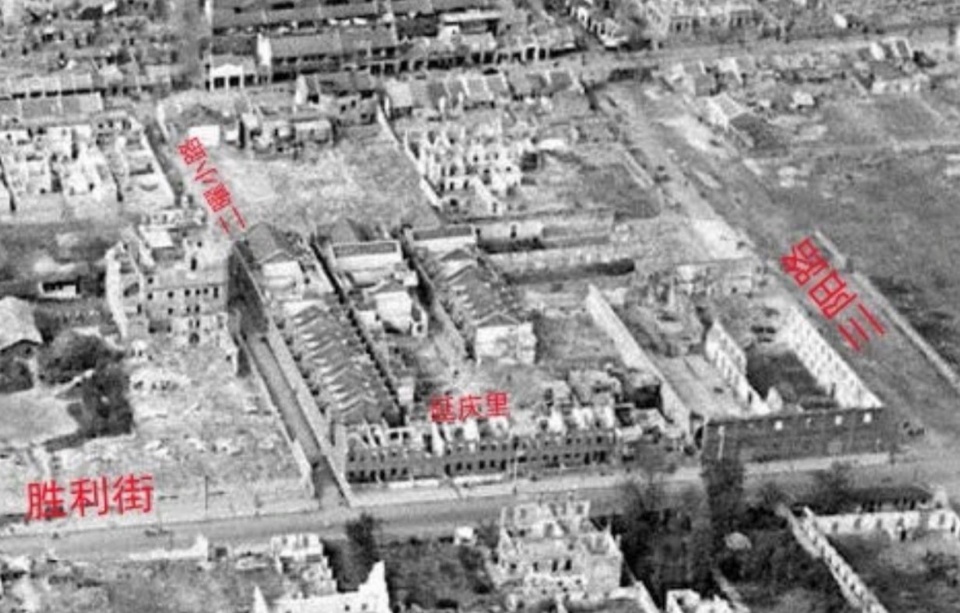
在看似匀质的里巷空间中,在原有场地在历史资料的阅读中, 我们发现, 这个场地形成 而在这些层积之中,有一层尤为特殊——1944年战时的一次空袭,在街区中心损毁大部分2号楼建筑。这段历史被后来的加建所覆盖,但它的空间痕迹一直存在于场地的肌理之中。
Within the seemingly uniform fabric of the alleys, reading the historical records of the original site, we found that among these accumulated layers one was especially singular—a wartime air raid in 1944 that destroyed most of Building No. 2 at the heart of the block. Later additions covered this history over, yet its spatial trace has lingered all along in the grain of the site.
▼美军飞机航拍,拍摄于1945年,Aerial photo by US military aircraft, taken in 1945
我们谨慎地打开了非历史隔墙,掏出一处微型公共空地:中心花园。我们没有向上加建,而是向下挖掘。层叠下沉的设计安静地隐喻着历史,形成内向围合的空间,同时解决了原首层层高低矮的压抑感,创造出灵活的小剧场式场所。台地可容纳演出、聚会与独处。由此向相邻里巷延伸出有顶的灰空间网络,市集可以在此漫溢与汇聚。
We carefully opened up the non-historic partition walls and carved out a miniature public clearing: the Central Garden. Rather than building upward, we dug downward. The terraced, descending design quietly serves as a metaphor for history, forming an inward, enclosed space while at once relieving the oppressive lowness of the original ground floor, creating a flexible, small-theater kind of place. The terraces can hold a performance, a gathering, or a moment of solitude. From here a network of roofed grey space reaches out into the neighboring alleys, where a market can spill over and gather.
▼利用建筑灰空间打开的漫游路径,Wandering path opened up through the building’s transition spaces
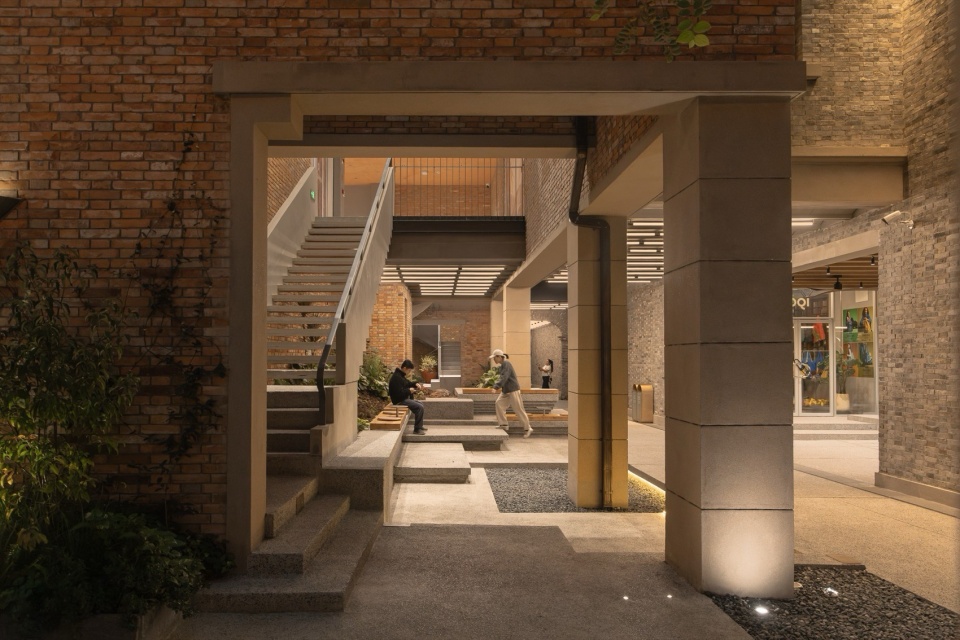
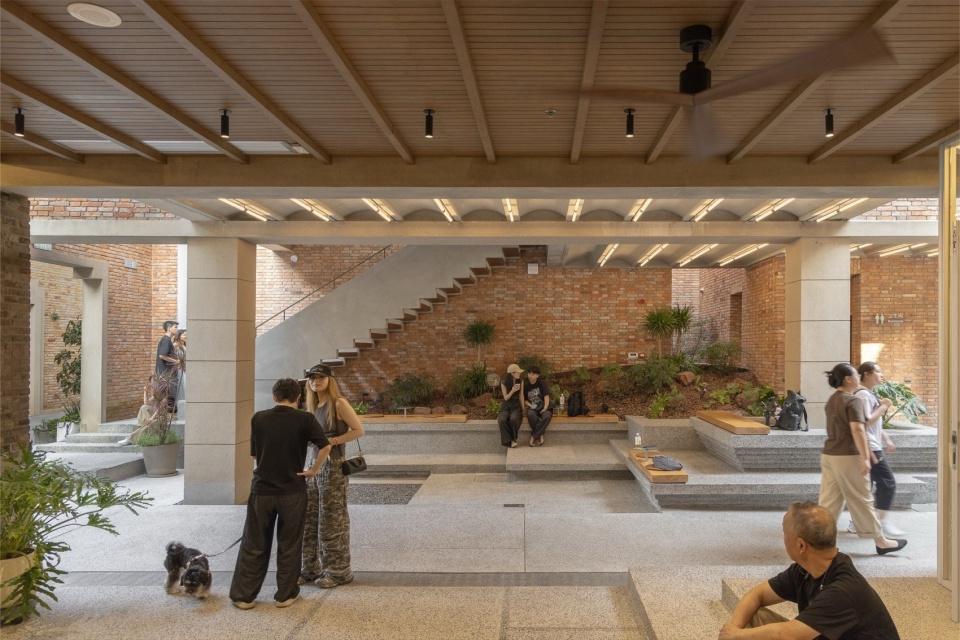
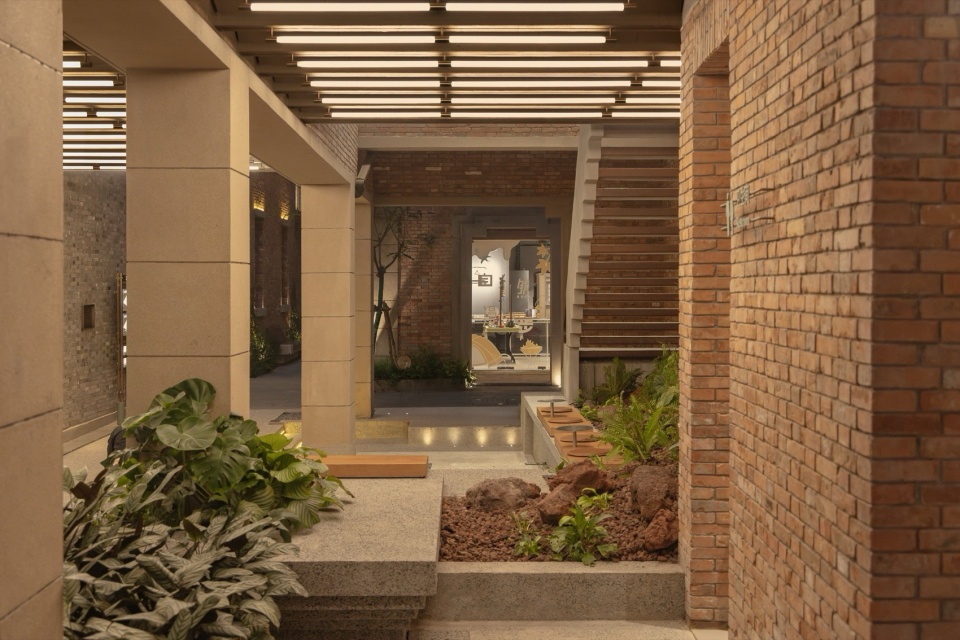
▼利用建筑灰空间打开的漫游路径,
Wandering path opened up through the building’s transition spaces
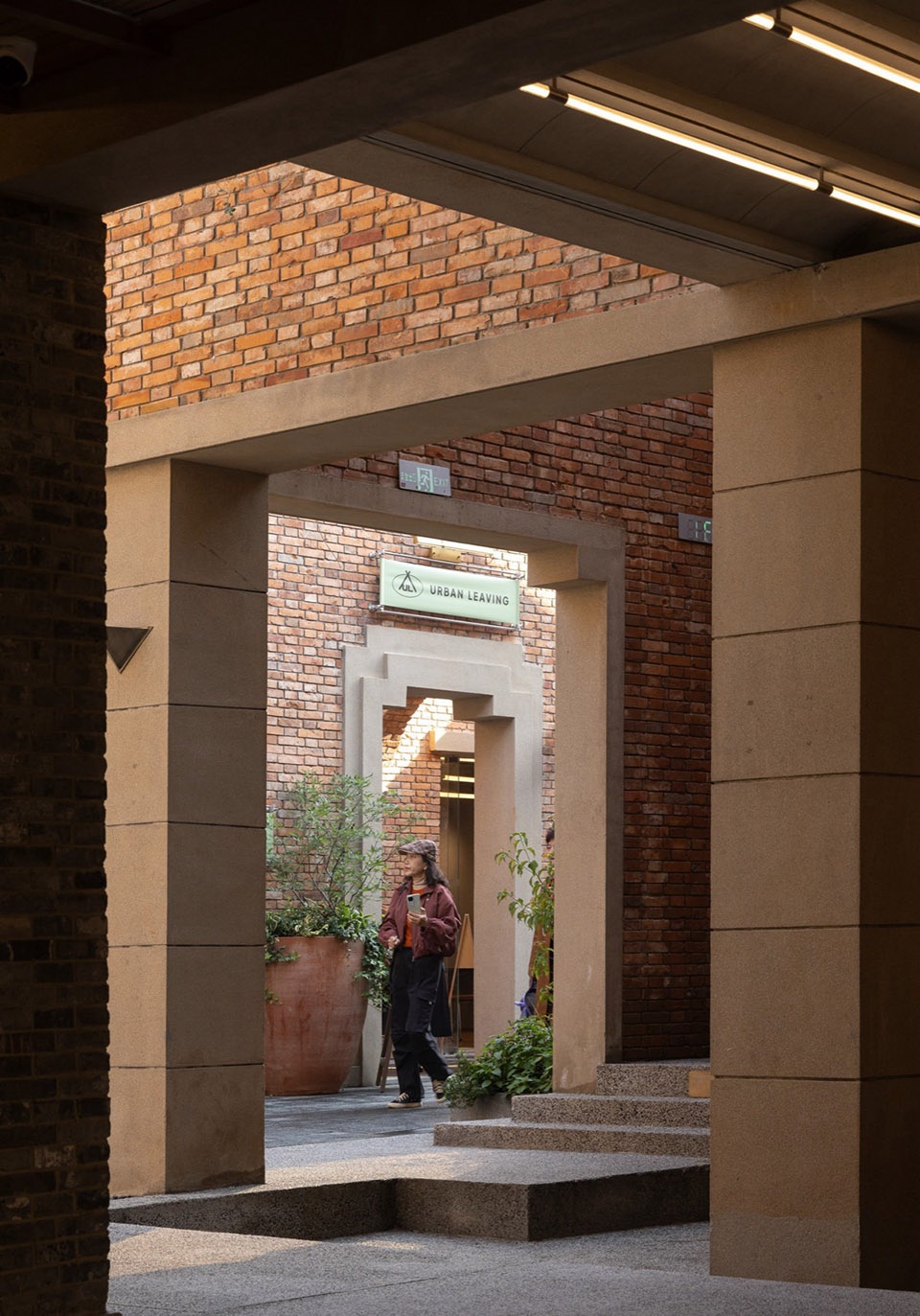
中心花园延伸 – 灰空间与市集 |From Central Garden to Grey Space & Market
延续中心花园的下沉语言,我们与建筑师、室内设计团队协作,在老建筑中打开一处灰空间。原本长而深的大铺被顺势打散为五个小铺,围合出一处属于老里份的“市集”。在这里,店铺边界变得模糊——中心花园的错台延伸进来,既是展台,也是台阶,也是可以坐下的地方。地面铺装采用延庆里回收的老石板,顺着空间走向铺成一条引导性的内街。
▼中心花园轴测图,Axonometric of the central garden
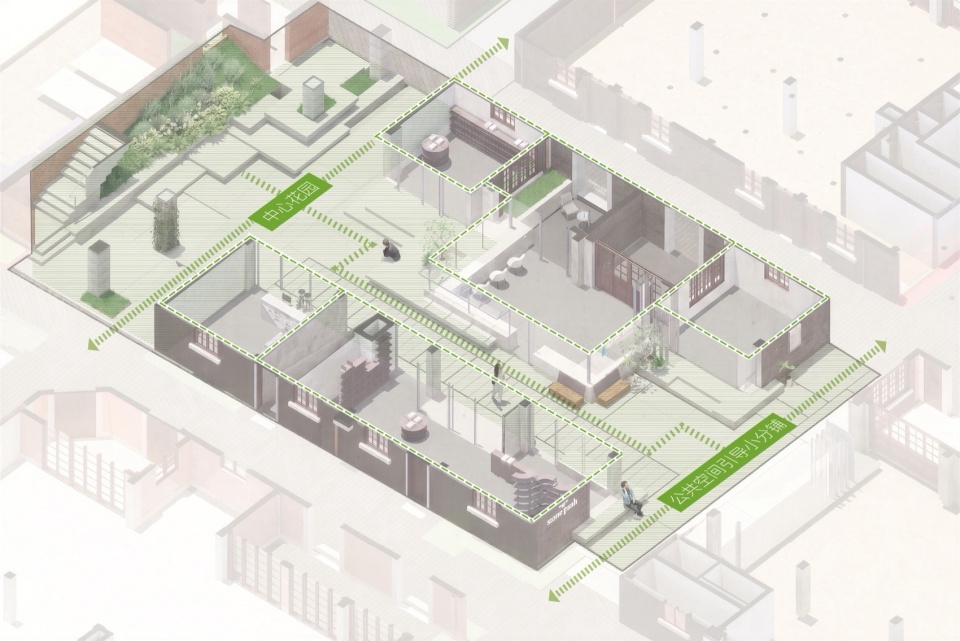
Extending the sunken language of the Central Garden, we worked with the architects and interior design team to carve a grey space out of the old building. A single deep retail unit was broken into five smaller shops, forming a market that feels native to the old lifen. Here, shop boundaries blur. The terraced levels of the Central Garden spill inward — serving as display plinths, steps, and places to sit. Underfoot, reclaimed stone slabs from Yanqingli are laid along the grain of the space, forming an inner street that gently guides movement through.
▼形成了不经意的小空间,Creating casual small spaces
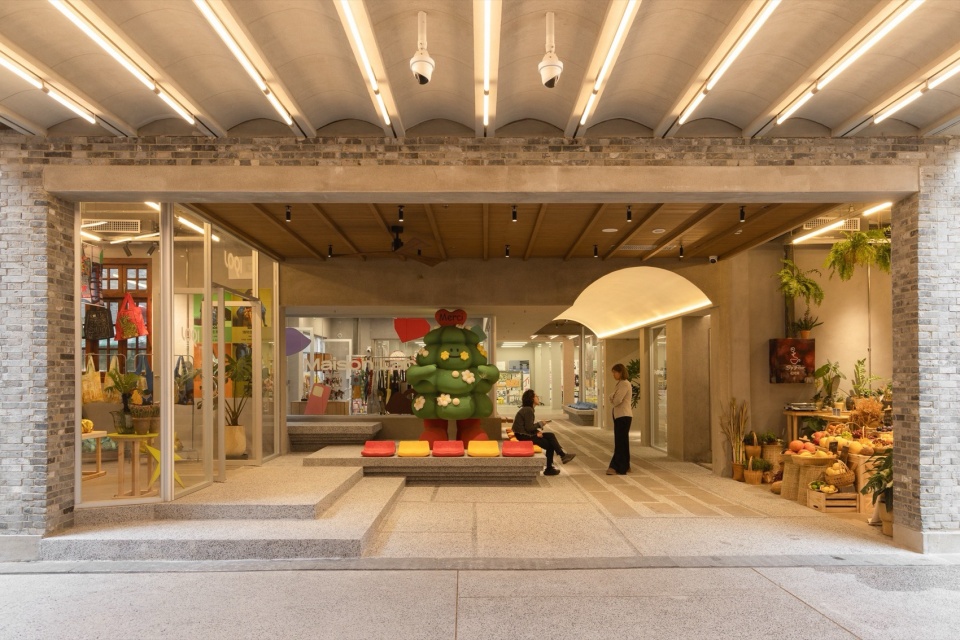
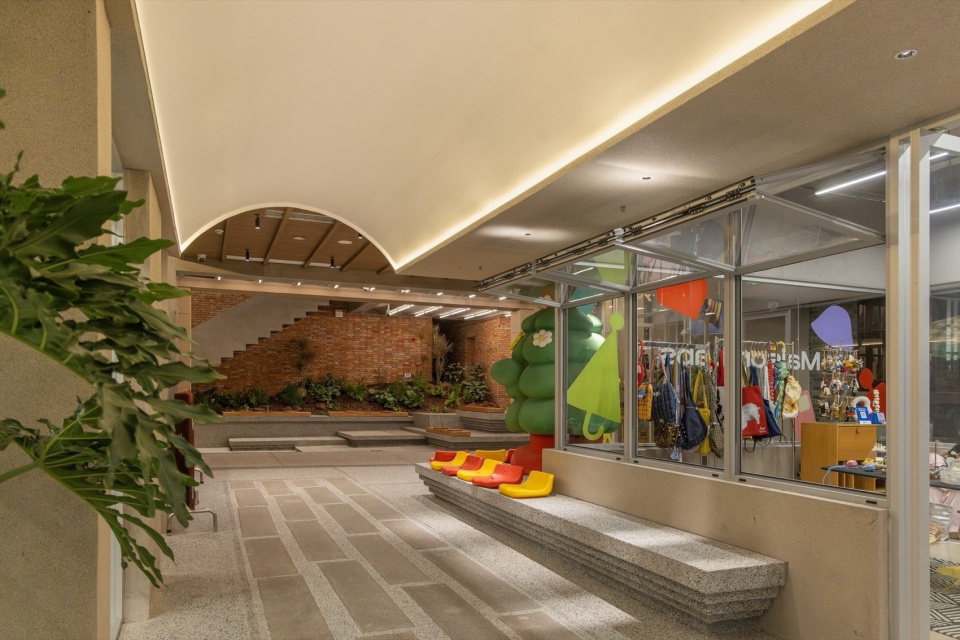
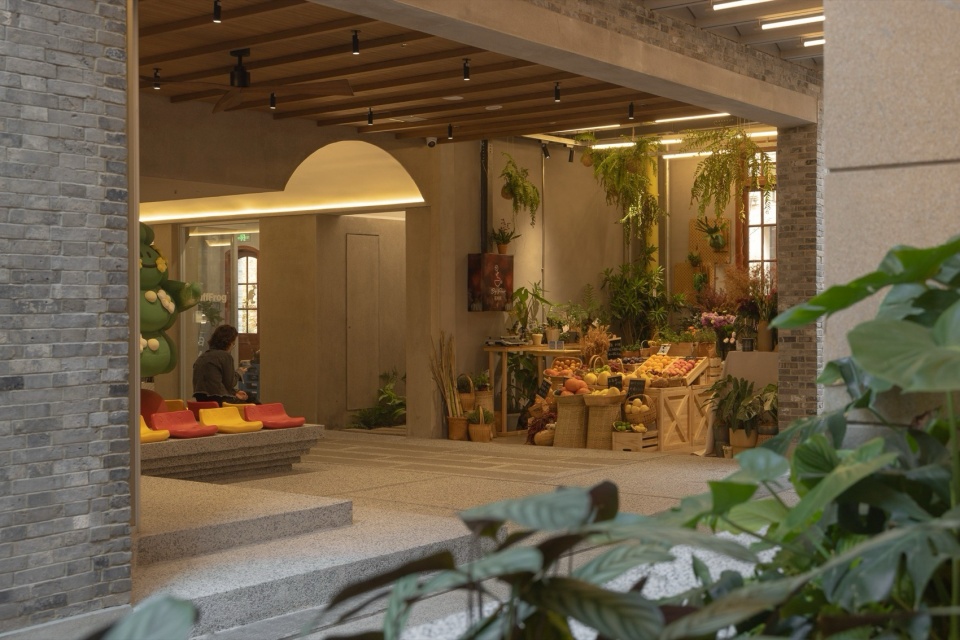
▼利用建筑灰空间打开的漫游路径,Wandering path opened up through the building’s transition spaces
胜利路与二耀小路|Shengli Road and Eryao Lane
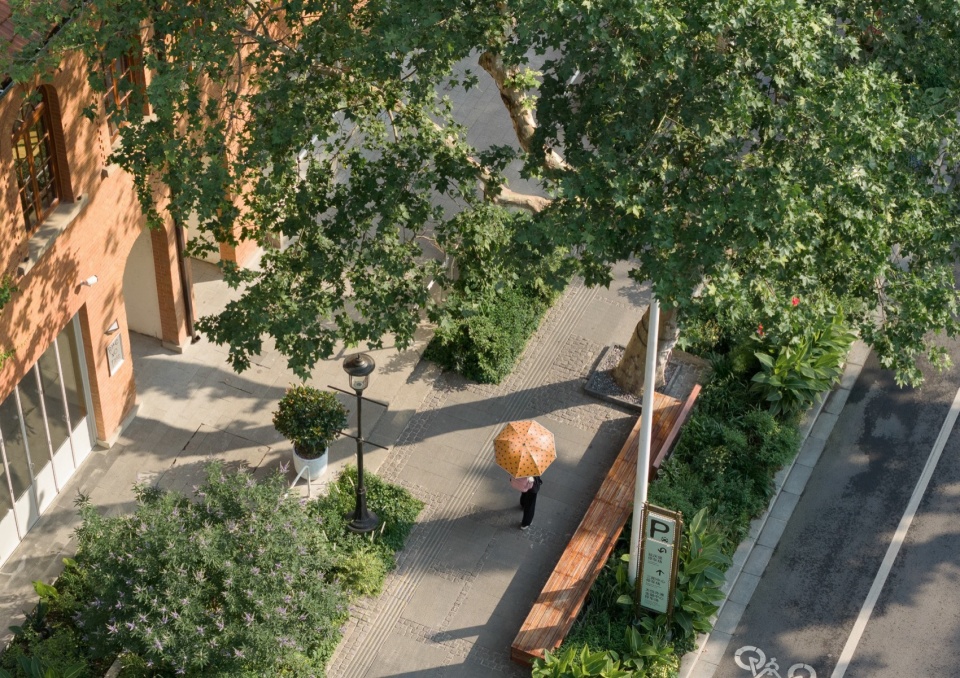
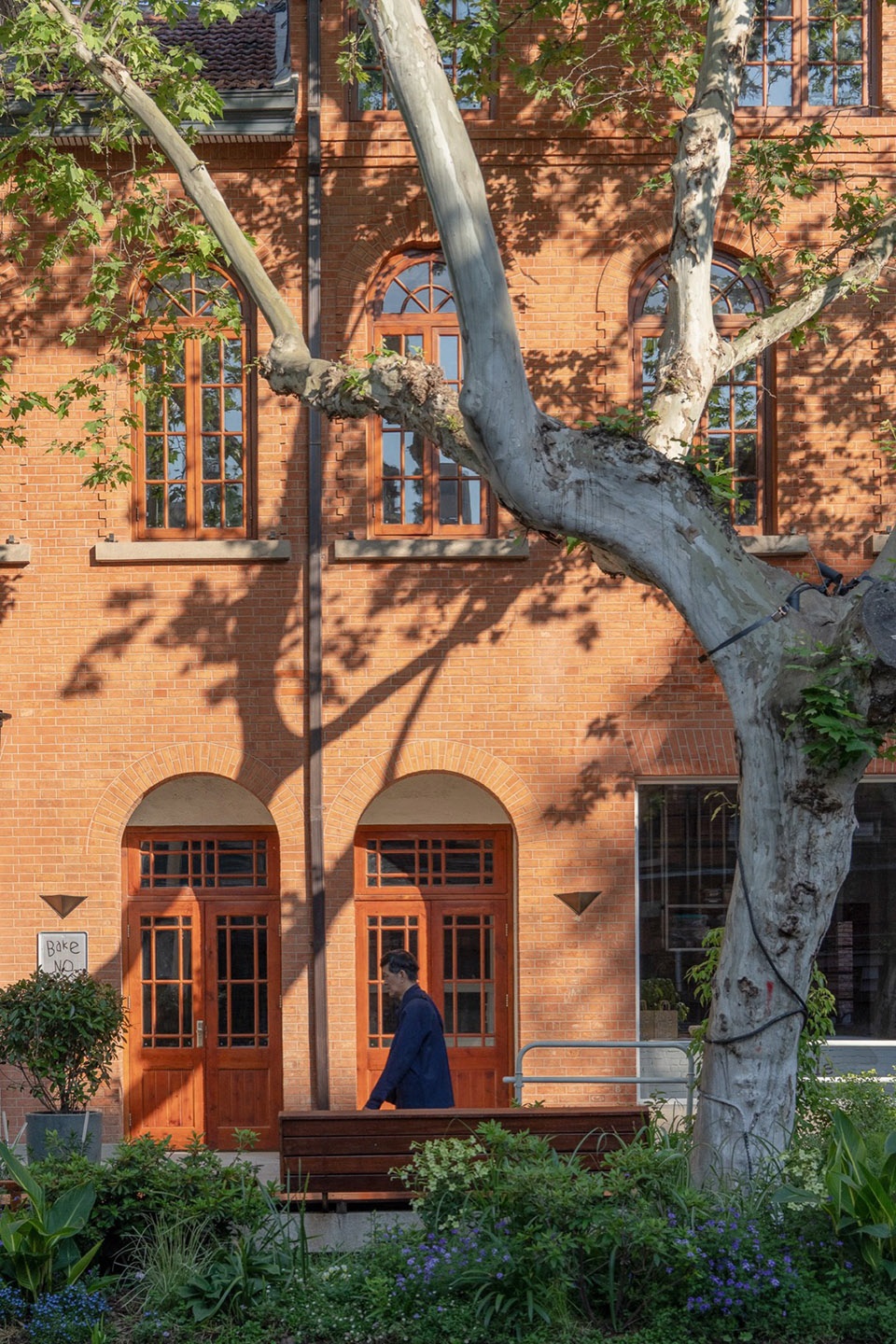
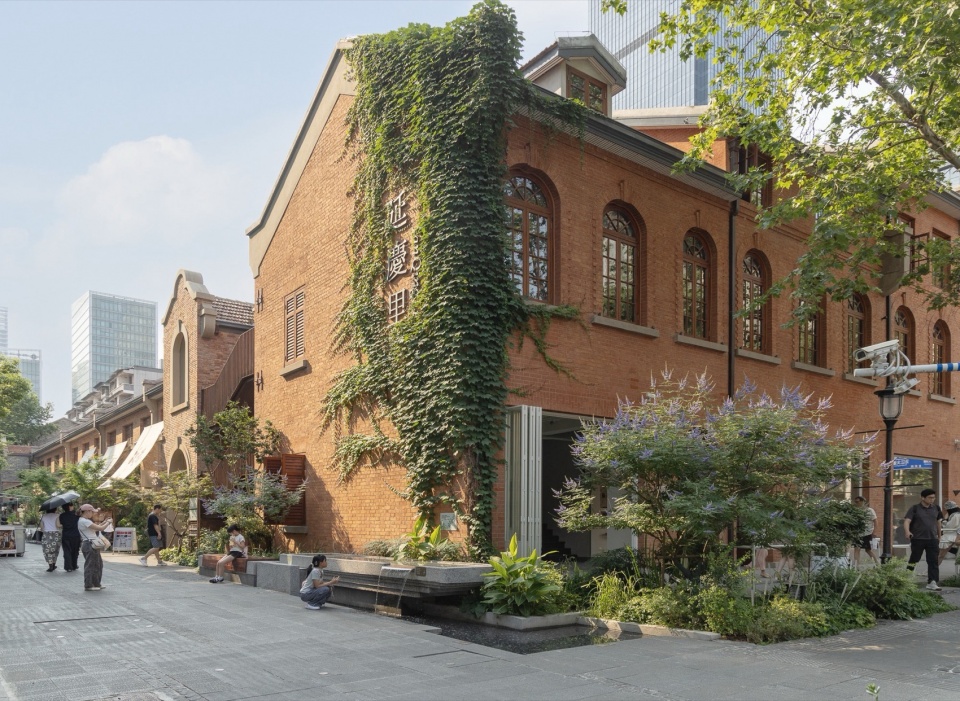
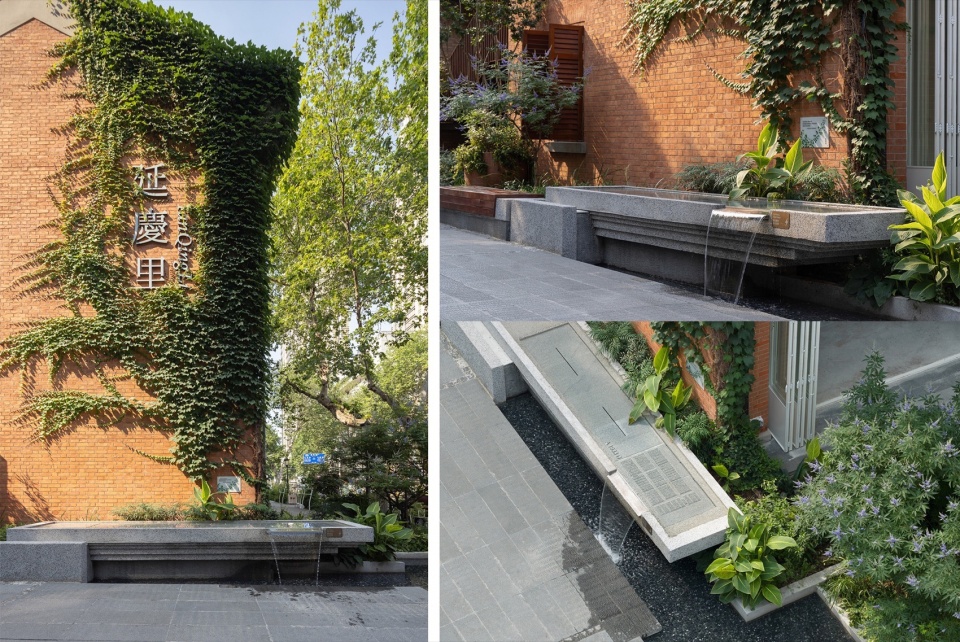
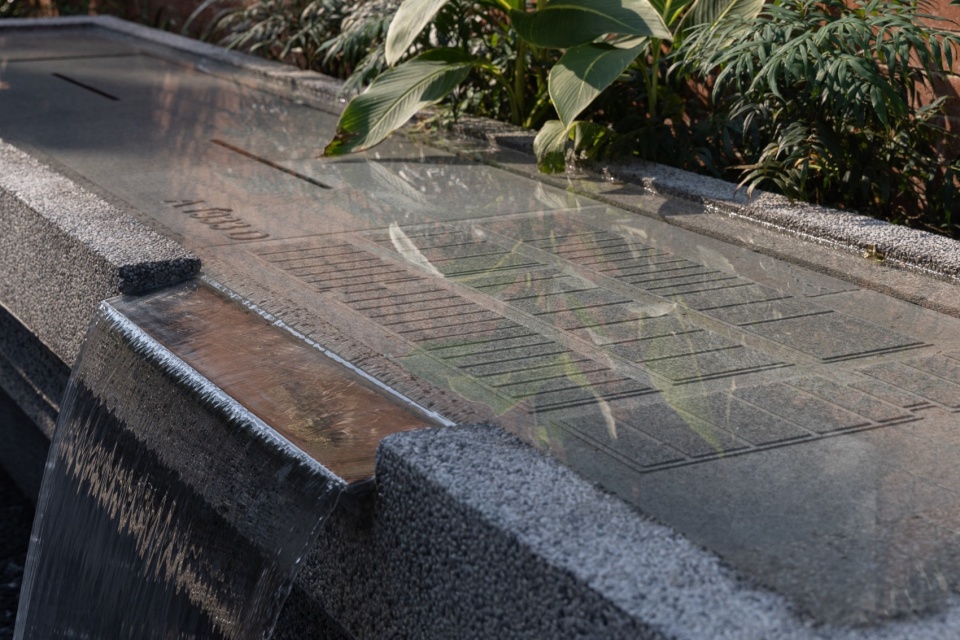
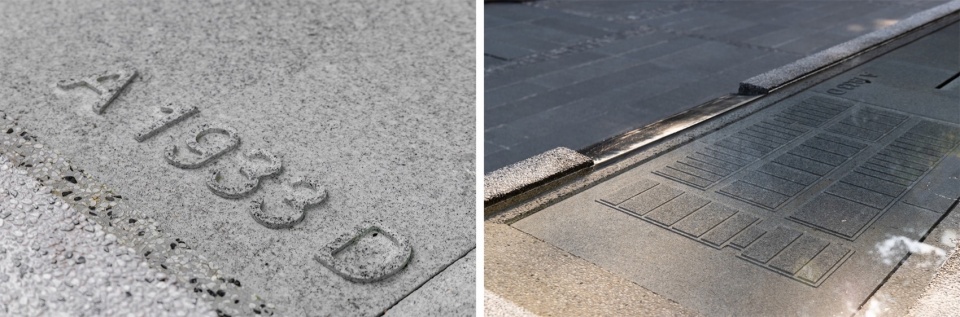
东面与南面的胜利街、二曜小路,是延庆里衔接城市的入口界面。空间相较内部巷道开阔,但紧邻市政道路,车流往来间,难以让人驻足。两路交叉口的建筑山墙下,保留着老法桐和现状鸡爪槭,树冠为街角提供了一片难得的绿荫。景观在此设置了一座水台。水台形体轻盈,以混凝土构筑,与传统里份的砖砌语言有意脱开;表面采用水洗石工艺,与老建筑立面的水洗砂在质感上遥相呼应。水声是这座水台的核心——水流持续涌动,人走过时忍不住伸手触碰;水声覆盖了一部分市政噪声,在嘈杂的街角划出一个听觉上的缓冲地带。水台池底阳刻着延庆里街区的里份划分图,流水覆于其上,昔日的分户界限在水中若隐若现,构成一层朦胧的距离感。街角之外,景观进一步强化外摆空间,增补植物层次,让这个原本只能经过的街口,变得可以停留。
▼改造前|改造后,Before renovation|After renovation
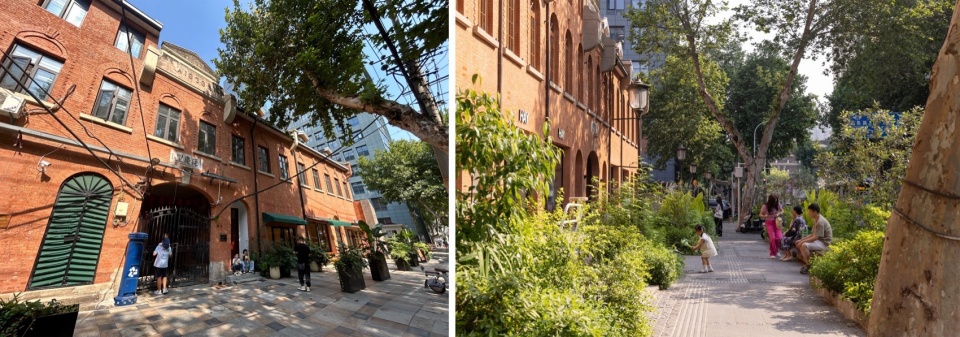
To the east and south, Shengli Street and Eryao Lane form the interface where Yanqing Li meets the city. The space is more open than the inner lanes, but it presses against the municipal roads, and amid the passing traffic it is hard for anyone to pause. Beneath the gable end of the building at the crossing of the two roads, an old plane tree and an existing Japanese maple have been kept; their crowns lend the corner a rare patch of shade. Here the landscape sets a water table. Light in form, built of concrete, it deliberately breaks with the brick-laid language of the traditional lifen; its washed-aggregate surface echoes, in texture, the washed sand of the old building facades. The sound of water is the heart of this table—water surging without pause, so that passersby cannot help reaching out to touch it; the sound veils part of the municipal noise, carving an acoustic buffer out of the clamorous corner. Incised into the basin floor is a map of the lifen’s old household divisions, and with water running over it, the boundaries of bygone homes flicker faintly beneath the surface, composing a hazy sense of distance. Beyond the corner, the landscape further strengthens the outdoor seating and enriches the layers of planting, turning a street mouth that once could only be passed through into a place to stay.
▼顶视图,Top view
▼建筑与环境,Architecture and trees
▼街巷,Street alley
▼细部,Details
▼座椅与花草,The seating and landscape
▼顶视图,top view
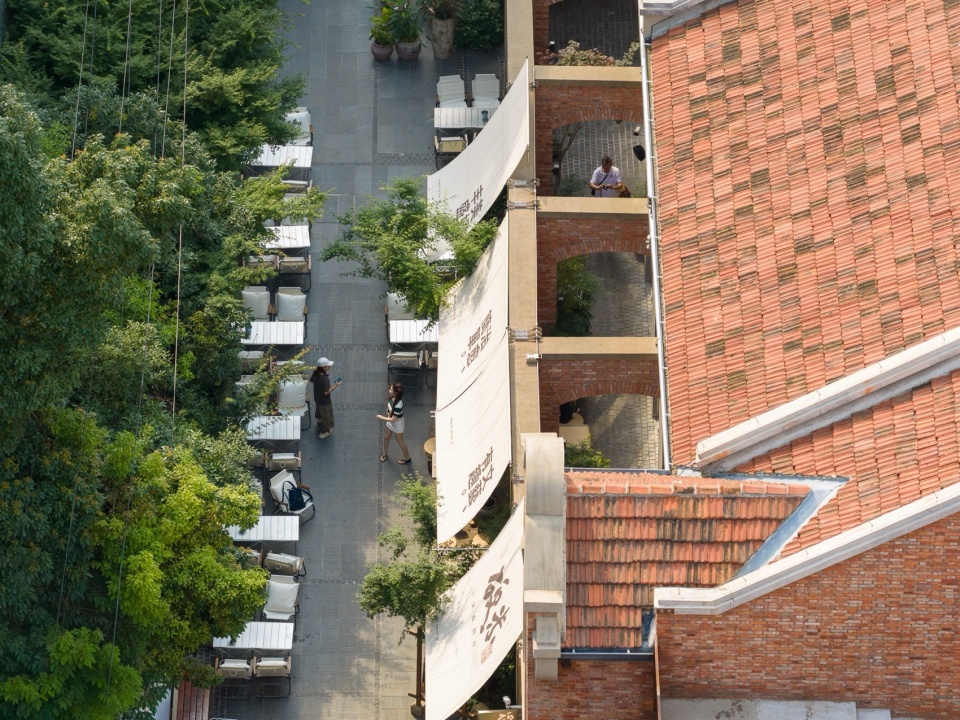
▼休闲空间,Leisure area
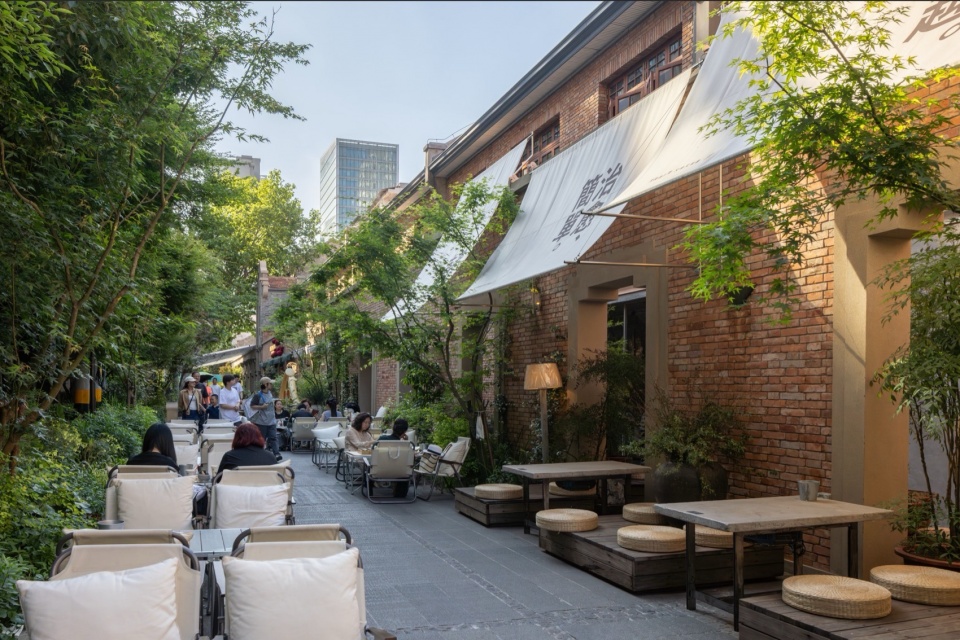
次巷|The Secondary Lane
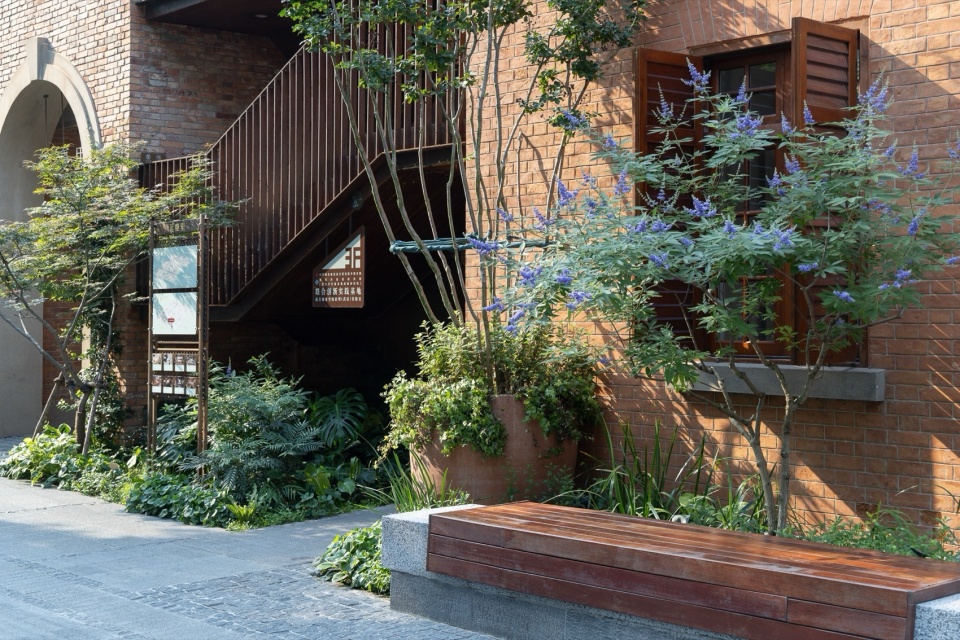
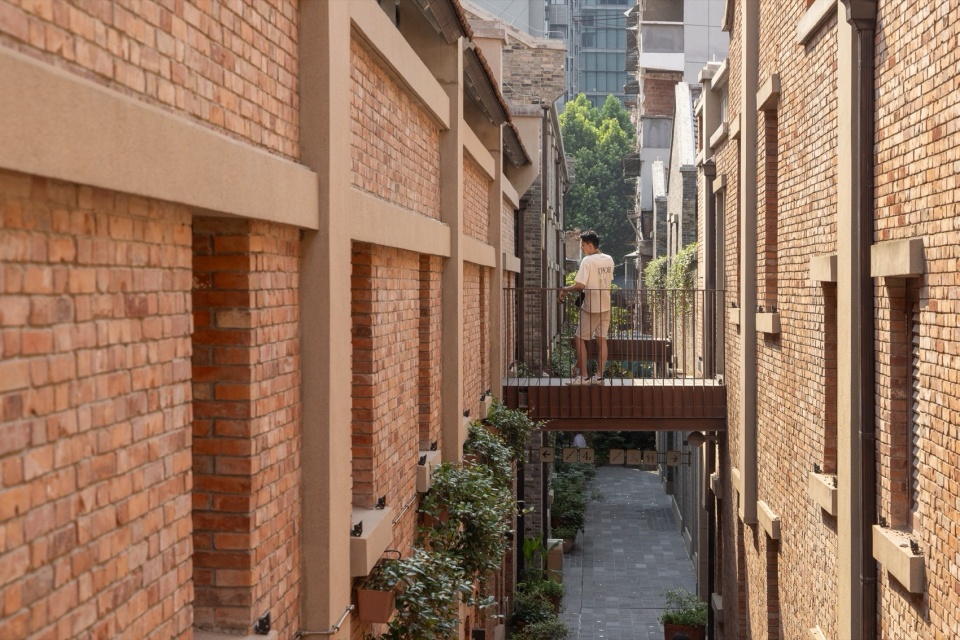
次街宽3米,邻接店铺背面,定义为后勤巷道。原始空间高而窄,两侧墙体逼近,行走其中难免感到压抑。景观通过首层花钵与二层阳台种植,重新划分了立面的视觉比例——原本向上挤压的空间感被横向的绿意打断,巷道由此变得亲近。种植并非纯粹的装饰,它们附着在建筑立面上,像曾经里份生活里那些窗台上的花盆、墙角的藤蔓,重新唤起了社区的温度。
▼改造前|改造后,Before renovation|After renovation
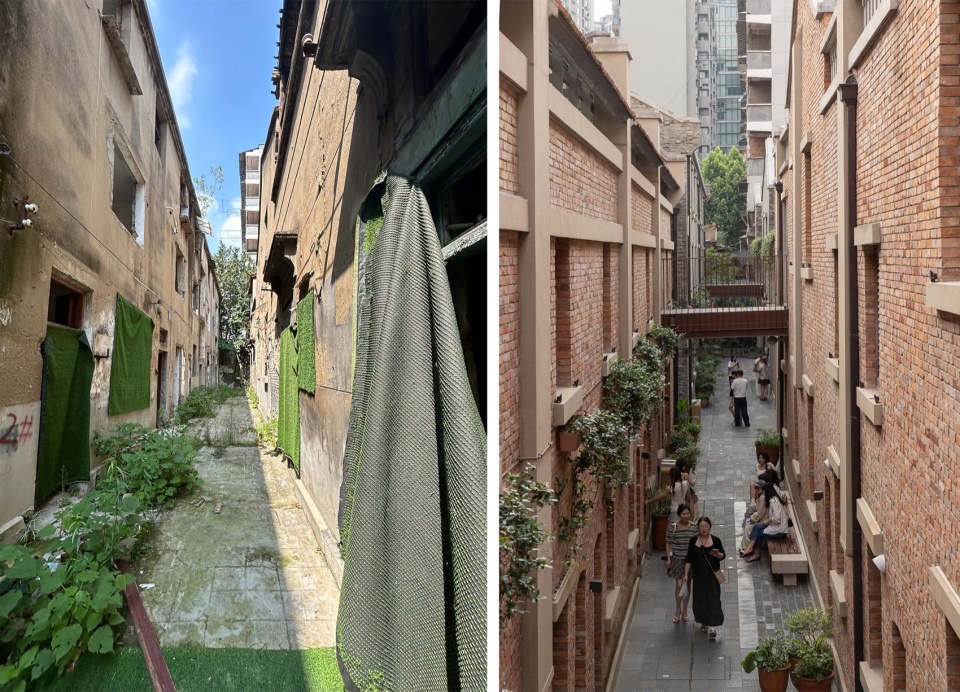
The secondary street is 3 meters wide, adjoining the backs of the shops, and is defined as a service lane. Its original space was tall and narrow, the walls pressing close on either side, so that walking through it felt inevitably oppressive. Through ground-floor planters and second-floor balcony planting, the landscape redraws the visual proportions of the facade—the upward-squeezing sense of space is interrupted by horizontal greenery, and the lane becomes intimate. The planting is no mere decoration; clinging to the building facades, like the flowerpots once set on windowsills and the vines in the corners of old lifen life, it rekindles the warmth of community.
▼次巷,The Secondary Lane
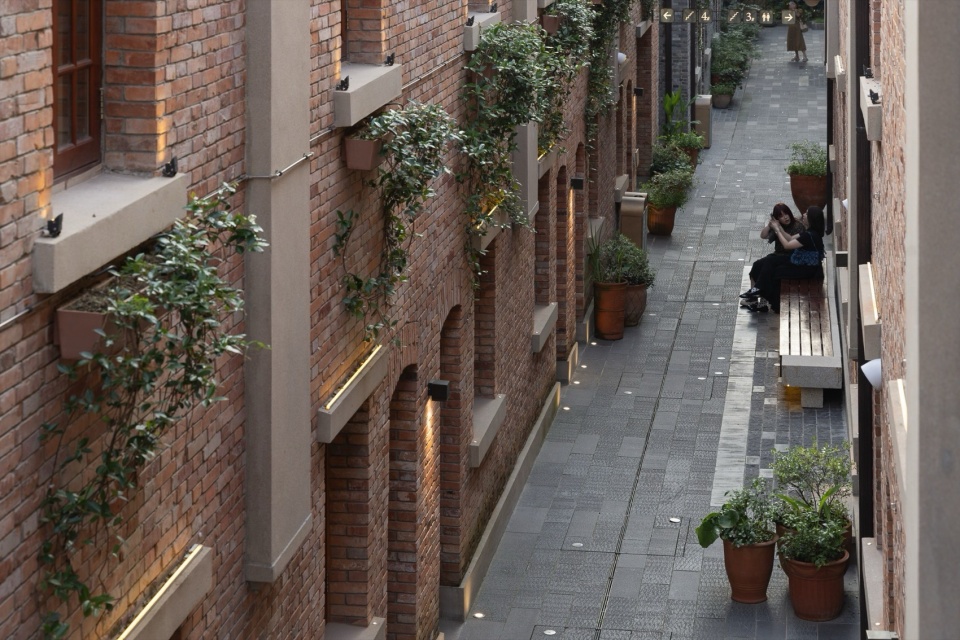
天井 |The Courtyards
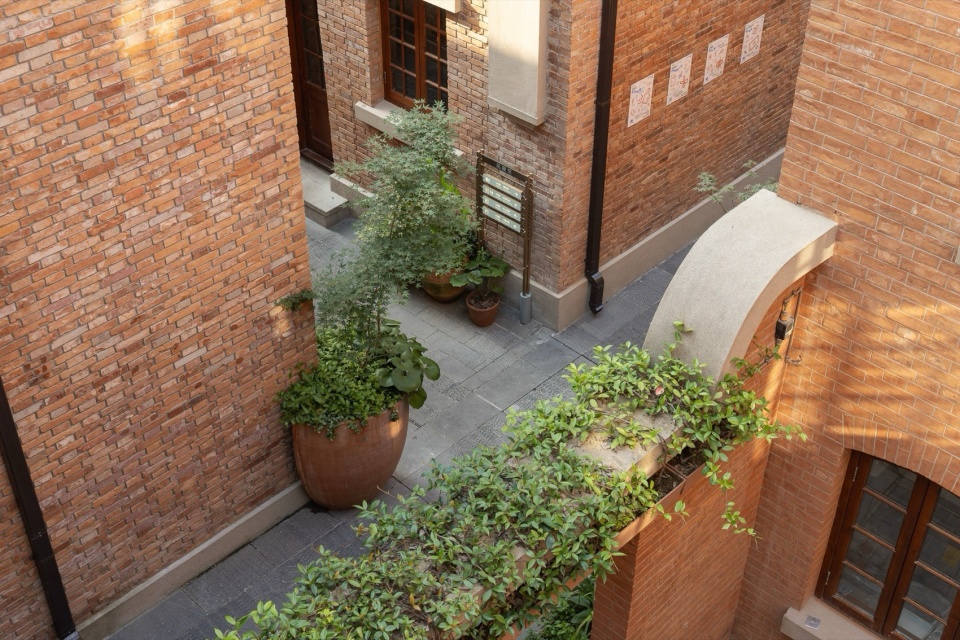
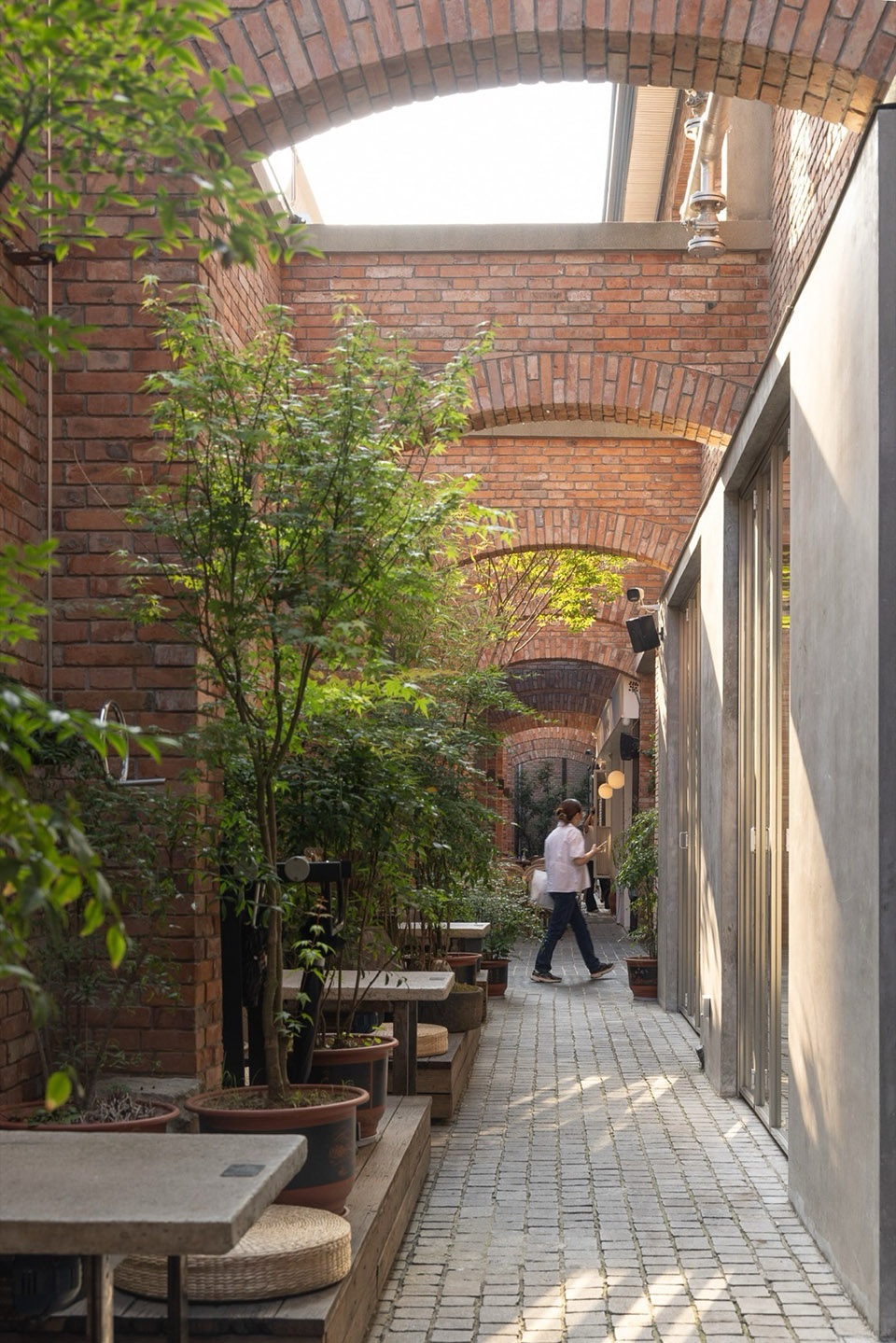
巷道串联起的天井,经过统筹后成为商业的外延。在高密度的里份肌理中,天井是难得的呼吸口——有地,有天,有风从中穿过。
The courtyards strung together by the lanes, after careful coordination, have become extensions of the commerce. Within the dense fabric of the lifen, the courtyard is a rare breathing space—with ground below, sky above, and wind passing through.
▼天井,Courtyard
材料的对话Dialogue of Materials
铺装的原则是克制:耐久、简洁,与老建筑安静地相处。
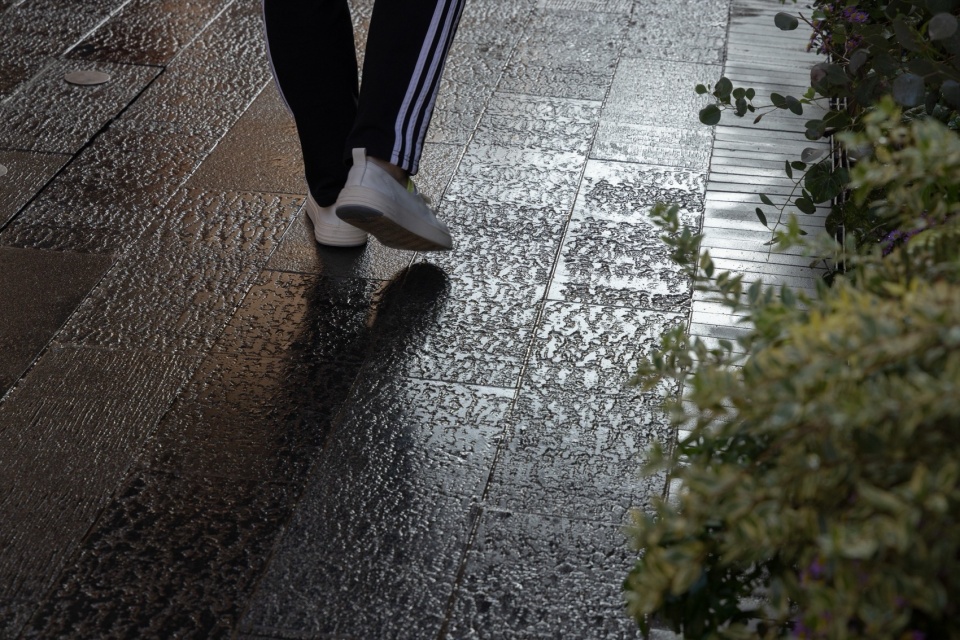
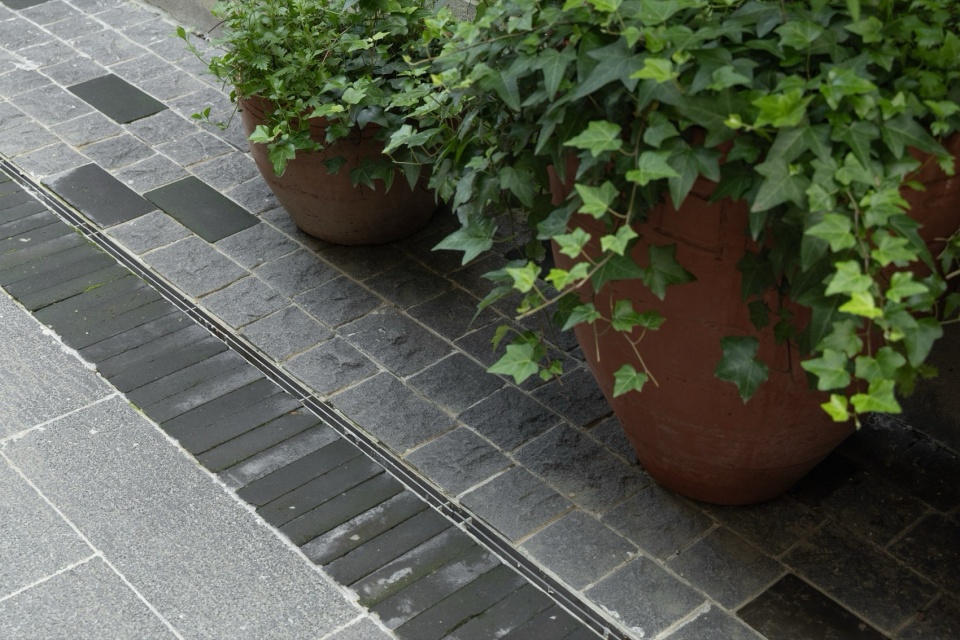
主街以菠萝面、剁斧面与火烧水洗面花岗岩同色系拼合,不同面层处理在光线下形成微差——粗粝与温润交替,远看统一,近看耐读。两侧采用砖与弹石混合的铺装方式,衔接种植已经界定街道的停留区。
The guiding principle of the paving is restraint: durable, simple, keeping quiet company with the old buildings.
The main street combines granite of a single color family in pineapple-textured, bush-hammered, and flamed-and-washed finishes—the different surface treatments forming subtle differences under the light, coarse and smooth alternating, unified from afar yet rewarding to read up close. Along both sides, a mix of brick and cobble paving connects with the planting that already defines the street’s resting zones
▼铺装局部,Partial paving
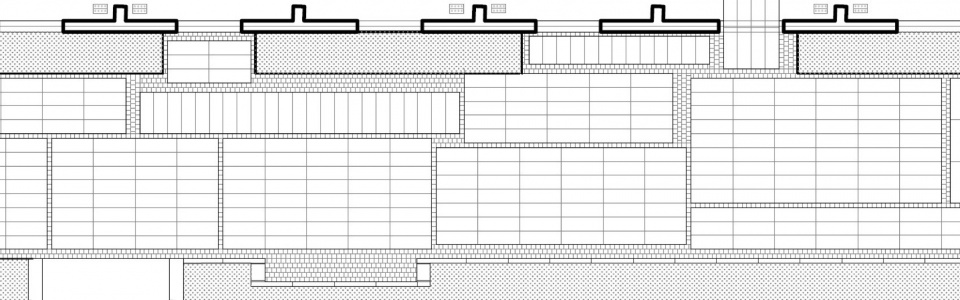
▼铺装平面局部,Partial paving plan
▼铺装局部,Partial paving
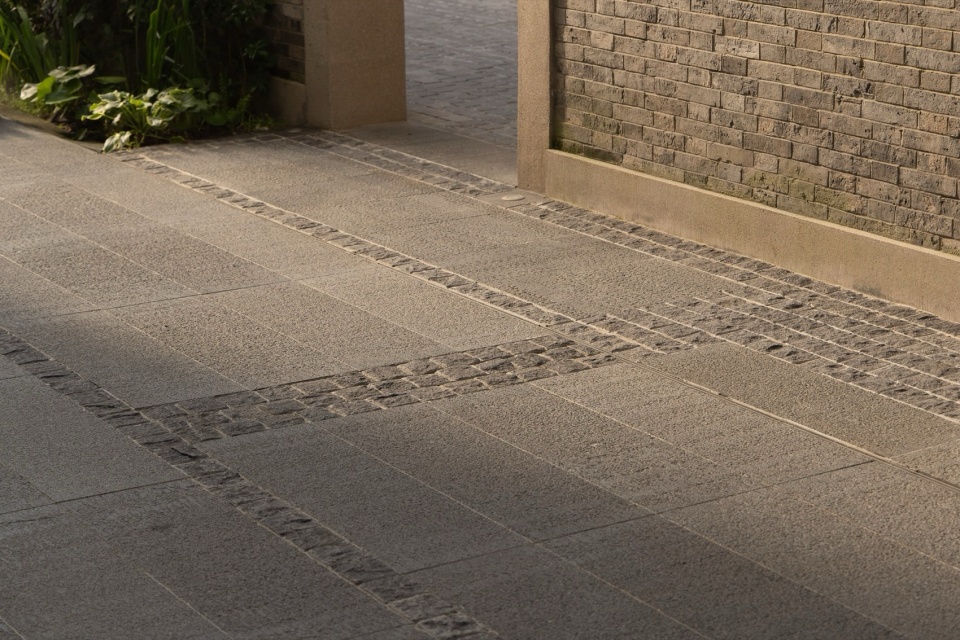
外街尺度较宽,铺装采用斑驳感的块面处理,形成介于新旧两者间的现代的斑驳状态。
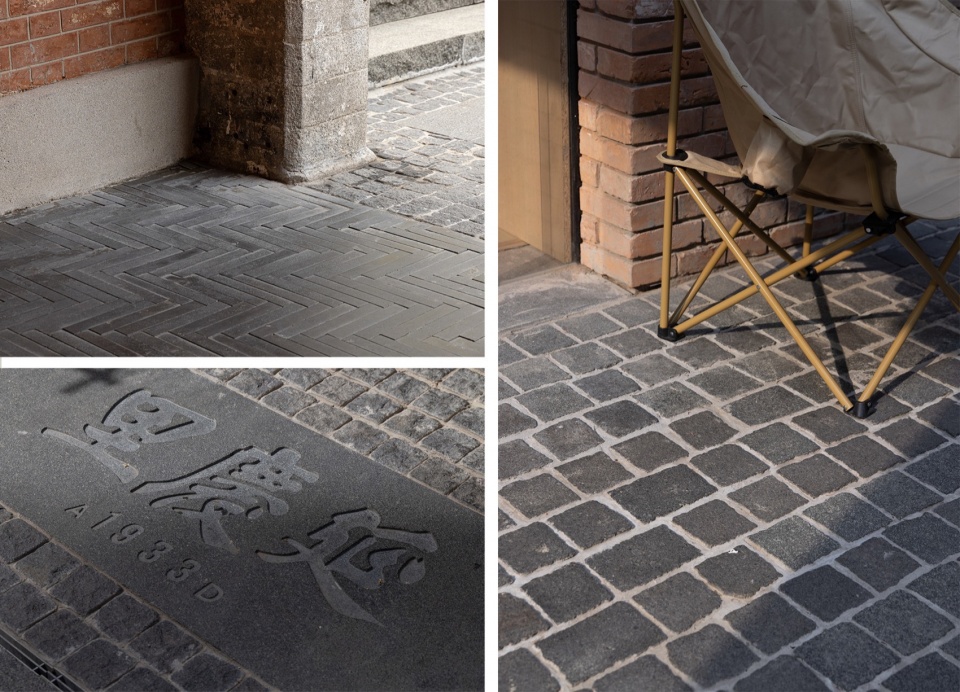
门拱区域采用细纹转铺,铺装方向与走向强化了空间的停顿。
天井通铺巧克力边弹石,色泽沉稳,质地紧密。小块径的排布在有限的院落中收拢视线,给人安定的脚感。
The outer street, broader in scale, is paved with mottled block surfaces, striking a modern, dappled state poised between old and new.
In the gateway-arch areas, fine-grained paving is laid crosswise, its direction at odds with the line of travel to reinforce the sense of pause in the space.
The courtyards are paved throughout in chocolate-edged cobble, steady in color and dense in texture. The small-module layout draws the gaze inward within the confined yard, lending a settled footing.
▼铺装局部,Partial paving
竖向与不可见的基础设施The Vertical and the Invisible Infrastructure
在可见的变化之下,是一层不可见的工作。
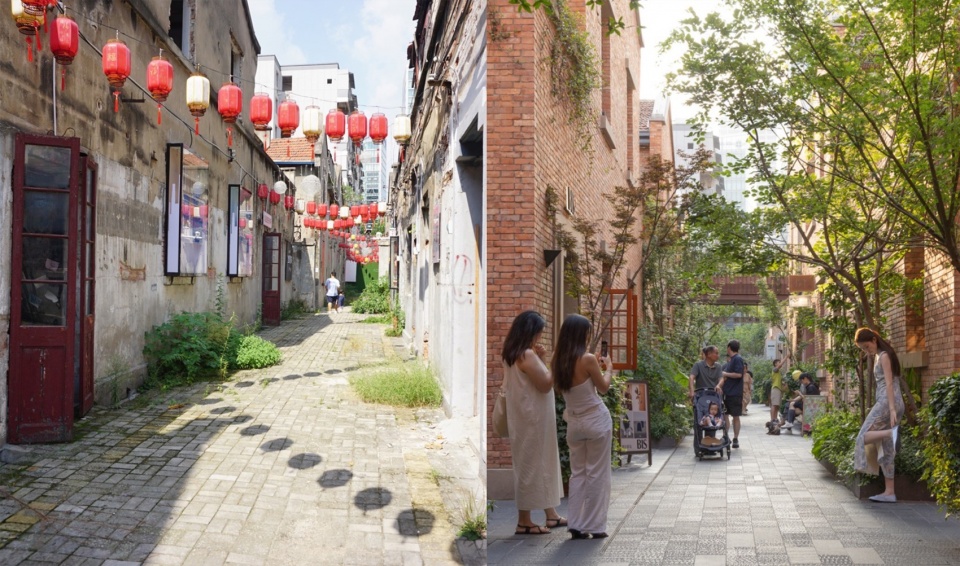
改造前,场地各处建筑高差不统一,无法实现无障碍通行。排水系统老化,雨后积水。各类市政管线架设于空中,遮挡了建筑轮廓。
设计重新校准了全区的竖向,将原本分散的高差消化在连续的铺地之中,从街道到巷道再到院落,实现了无障碍通达。这是该街区有史以来第一次实现全场地无障碍通行。
各类架空线缆被埋入地下,排水管网整体更新,给水、消防与智能监控系统同步升级。雨水沿回收老麻石铺就的地面,顺着石门库线脚引导的方向组织排水。这些基础设施的更新,不显露于外,以恢复天空的完整性、地面的干爽与平整为衡量标准。
▼改造前|改造后,Before renovation|After renovation
Beneath the visible changes lies a layer of invisible work.
Before the renovation, the buildings across the site sat at inconsistent levels, making barrier-free passage impossible. The drainage system had aged, and rainwater pooled after storms. Municipal lines of every kind were strung overhead, obscuring the outlines of the buildings.
The design recalibrated the levels across the entire district, absorbing the once-scattered height differences into a continuous paving, achieving barrier-free passage from street to lane to courtyard. This was the first time in the neighborhood’s history that the entire site became fully accessible.
The various overhead cables were buried underground, the drainage network wholly renewed, and the water-supply, fire-protection, and smart-monitoring systems upgraded in step. Rainwater is organized to flow across the recovered old granite paving, guided in the direction set by the moldings of the shikumen gateways. These infrastructural renewals reveal nothing of themselves outwardly; their measure is the restoration of an unbroken sky and a dry, even ground.
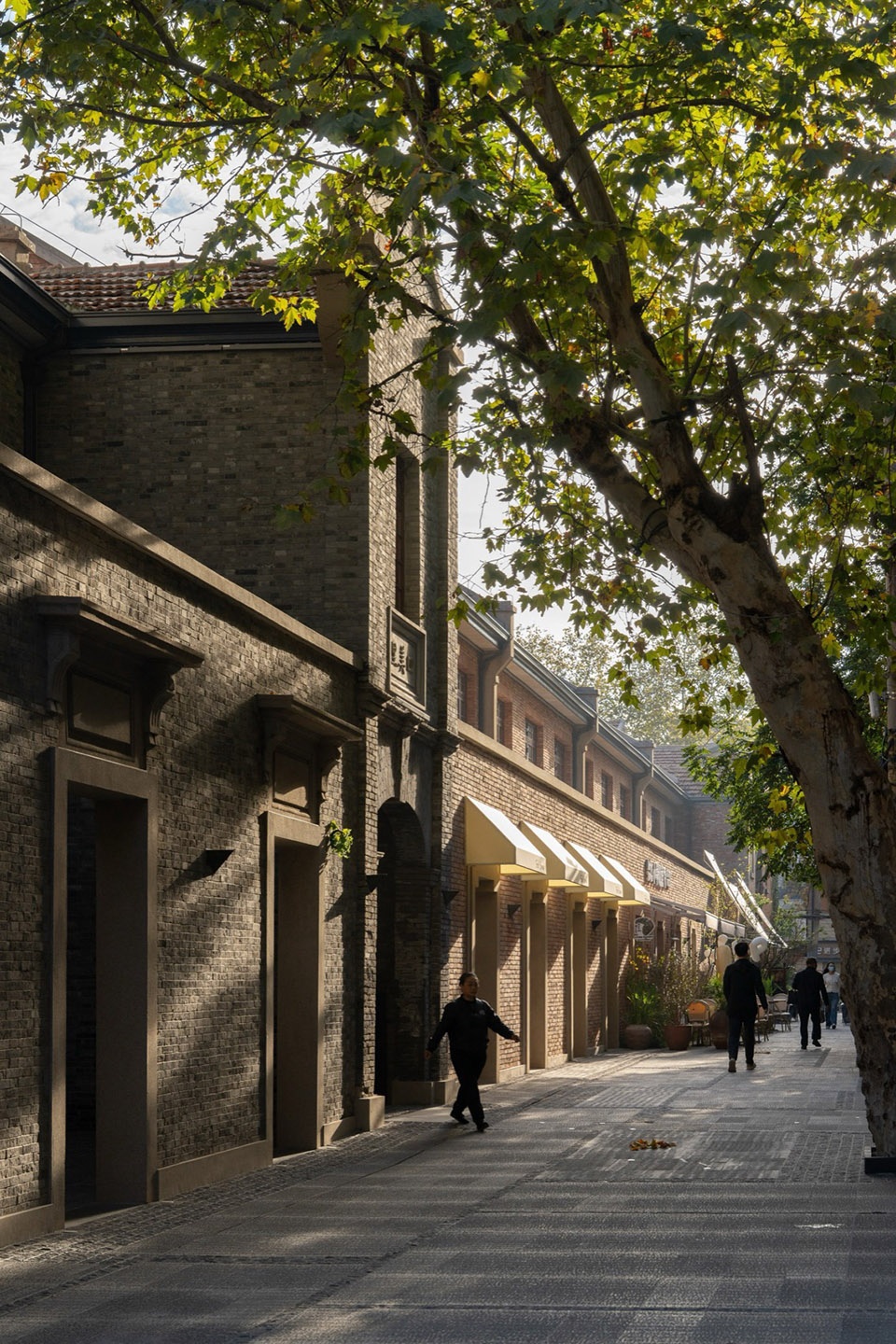
▼改造后,BAfter renovation
老里份中植物的故事The Story of Plants in the Old Lifen
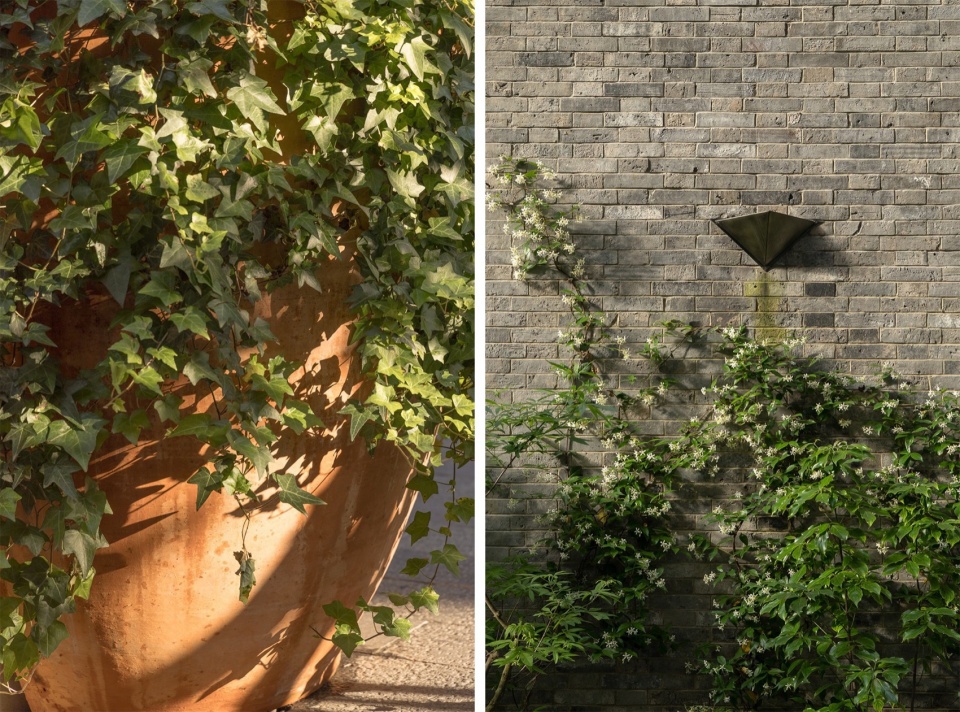
场地内原有的树木被全部保留,包括法桐与爬山虎。攀缘植物传统被系统性地恢复和强化,砖墙正在逐步重新被绿色覆盖。种植品种选择在武汉本地历史巷道中的合适生长的植物种类,诸如鸡爪槭、四照花、丛生小叶梣、连香等。花钵采用本地陶土烧制。在部分覆土不足的狭窄区域,设计采用了半个花钵——竖向切分后贴墙设置,使这些原本无法种植的位置也能够容纳植物。
Every existing tree on the site was kept, plane trees and Boston ivy alike. The tradition of climbing plants has been systematically restored and strengthened, and the brick walls are gradually being clothed in green once more. The planting palette favors species suited to the historic lanes of Wuhan—Japanese maple, Cornus dogwood, clustered small-leaf ash, Cercidiphyllum, and the like. The planters are fired from local terracotta. In certain narrow areas where the soil depth falls short, the design uses half-planters—split vertically and set against the wall—so that even these otherwise unplantable spots can hold greenery.
▼场地内原有的树木被全部保留,
Every existing tree on the site was kept, plane trees and Boston ivy alike
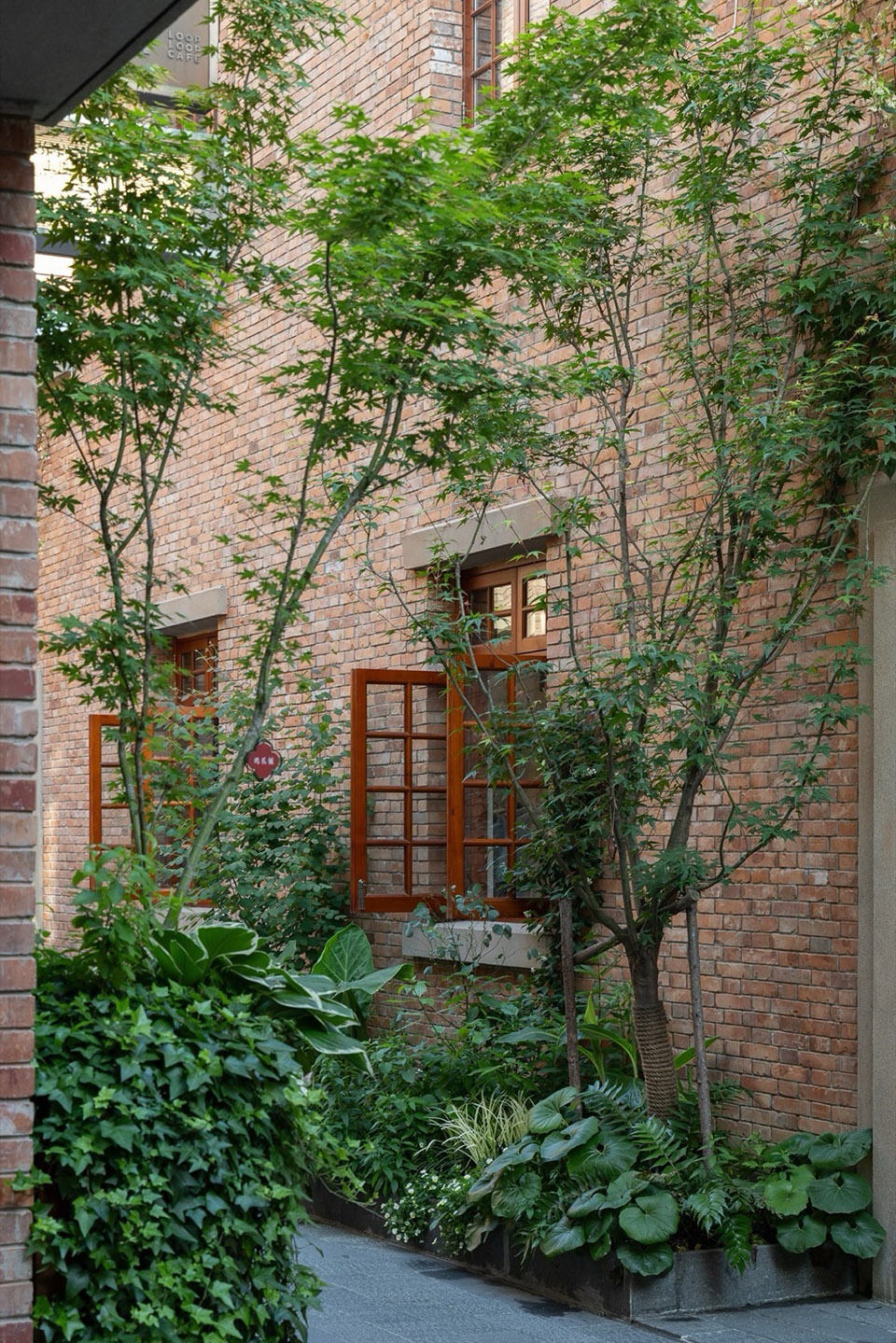
▼砖墙正在逐步重新被绿色覆盖,The brick walls are gradually being covered again with greenery
项目详细信息
Project Information
Project Name: Yanqing Li Location: Wuhan, China
Landscape Design: Landtek Group (风物营造)
Lead Landscape Designers: Lu Shilei, Diao Jingshi
Landscape Design Director (Later Phase): Su Shuwen
Landscape Design Team: Liang Jiawei, Lu Yi, Zhao Huan, Wang Jieping, Feng Kangtai, Wu Tong (Intern)
Landscape Construction Drawing – MEP Design: Huang Yuliang (MEP), Xie Shuqing (MEP), Xue Mei (MEP)
Client: Wuhan City Investment Real Estate Group Co., Ltd.
Commercial Operation: Wuhan City Investment Real Estate Group Co., Ltd.; Wuhan Luhua Commercial Management Co., Ltd.
Design Management: Wuhan City Investment Real Estate Group Co., Ltd.; Chengdu Luxe Lake Culture & Tourism Development Co., Ltd.
Architectural Design: MINX Architects
Historical Research & Building Restoration: Wuhan Civil Architectural Design & Research Institute Co., Ltd.
Construction: Wuhan Tianshi Construction Engineering Co., Ltd. (a subsidiary of Wuhan City Investment)
Historical Research & Restoration Construction Drawings: Wuhan Civil Architectural Design & Research Institute Co., Ltd. (a subsidiary of Wuhan City Investment)
Structural Consultant: iStructure
Interior Design: F.O.G. Architecture (反几建筑)
Planting / Garden Design: Luxe Lake Horticulture
Signage Design: Liangxiang
Photography: © IAM Studio